Question
In: Finance
) Assume that you have successfully completed the R&D phase of a new product development project;...
) Assume that you have successfully completed the R&D phase of a new product development project; this phase took several years and cost an estimated $14.75 million but resulted in a successful prototype product. You and your company are now ready to start the market development and research phase of your new product development project. It is estimated that the market development and research phase of this project will take two years and cost $11.5M per year. There is an eighty percent probability that the market development and research phase will indicate that a viable market exists for your new product.
Before your company can begin the market development and research phase, however, a long-time rival announced that it plans to market a similar product in one year that will directly compete with your newly developed product. Your company feels that there is a 60 percent probability that your new product will be superior to your competitor’s product.
If your company’s product is superior to your competitor’s product and the market development phase indicates that a viable market exists, you will earn a net profit of $10 million per year for ten years. If your product is inferior to your competitor’s product, you will terminate the project. Assuming a discount rate of 14 percent, calculate the expected NPV of your new product assuming that you proceed immediately with the marketing development and research phase.
In analyzing this problem, you should make the following assumptions. First, if you learn that your competitor’s product is better than your product after one year of market development, you will terminate the project and not incur the market development cost ($11.5M) for the second year. Second, assume that all cash flows occur at the end of the year.
Compare your results to the case when you decide to wait for one year (to learn more about your competitor’s product) before proceeding with the market development and research phase. If you postpone the market development phase by a year, however, and your product is superior to your competitor’s project (and a viable market exists), it will only have a nine year life span. What do you think is your best strategy? Why?
Solutions
Expert Solution
R&D Phase cost - $14.75 million
Market and Development Phase Cost – $11.5 million for next 2 years
each
Probability of a viable market – 80%
Probability of your product being superior than competition =
60%
If viable market and product superior – Net profit = $10 million
for 10 years.
If product inferior – project terminated
Discount Rate – 14%
Assumptions –
- If at the end of 1 year you get to know product is inferior, project will be terminated after 1 year, without incurring cost in 2nd year.
- All cash flow occurs at the end of year.
Remember that R&D cost is a sunk cost and hence need not be
considered in the process of decision making.
Case 1: Product Inferior probability = 1 – product superior
probability = 1 – 60% = 40%
Case 2: Product Superior, but market unviable probability = Product
superior probability*(1 – market viable) = 60%*(1 – 80%) = 60%*20%
= 12%
Case 3: Product Superior and market also viable probability =
Product Superior Probability*Viable Market Probability = 60%*80% =
48%
Case 1: There is a 40% chance that product is inferior and then
project will have just 1 cashflow of -11.5 million at the end of
1st year.
Case 2: Of the remaining 60%, (1-80%) chance( total chance of this
scenario = 60%*20% = 12%), that market is not viable, in this case
there will be 2 cashflows of -11.5 million in year1 and year2
Case 3: Finally there is a chance of 60%*80% = 48% that project is
superior as well as viable and will have net profit of $10 million
for 10 years.
Cashflows as explained above, are entered in an excel sheet and
"NPV" formula is used to calculate the NPV of project in 3
different scenarios.
Probability adjusted NPV = Probability of case1*NPV of case1 +
Probability of case2*NPV of case2 + Probability of case3*NPV of
case3
Formulas look like below in excel -
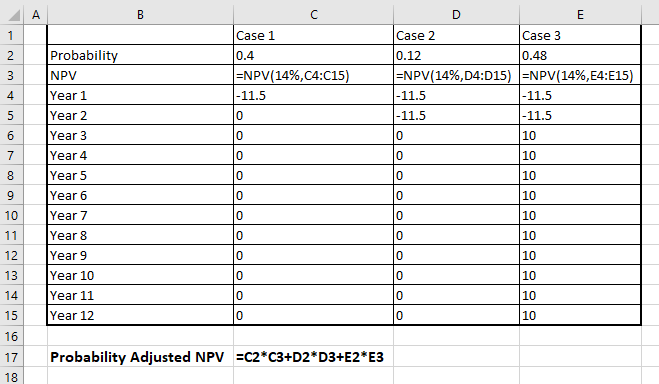
Values look like below in excel -
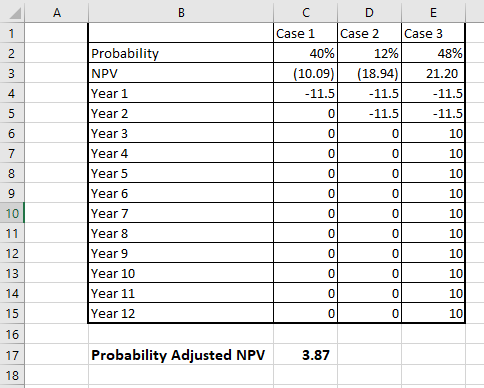
Hence, NPV of this project is +ve $3.87 million, and company should
go ahead with the project.
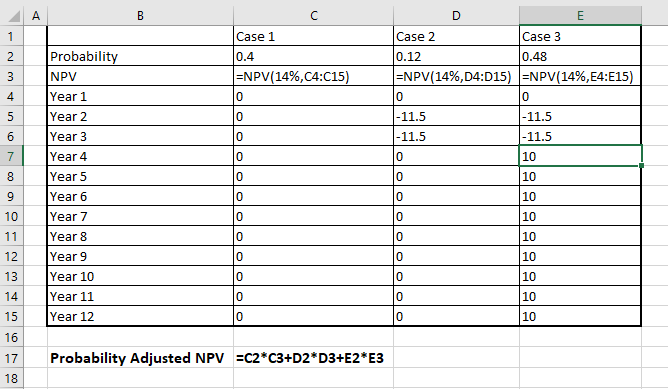
Now, what happened if company waits for 1 more year,
cashflows will look like below -
1. It will become 0 for all 3 cases in year 1
2. In case product is not viable(case1), there will be no expense
in year2 onwards in case1
3. For case2 that product is superior but market unviable, year2
and year3 will have a negative cashflow of 11.5 million and 0
onwards.
4. In case3, year2 and year3 will have same cashflow as case2, but
year4 to year12(9 years) will have a positive cashflow of 10
million.
Formulas in excel will look like below -
values in excel will look like below -
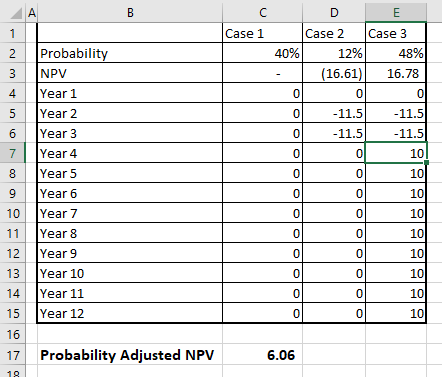
Hence, final NPV in this case is $6.06 million, which is
higher than the previous case, so company must wait for 1 year
before starting its market viability studies.
 jeff jeffy answered 6 months ago
Related Solutions
The R&D department is planning to bid on a large project for the development of a...
You and your new partner have successfully built a prototype of your personal tax product and...
"Research and development (R & D) is a process intended to create new or improved technology...
NEW PROJECT ANALYSIS You must evaluate the purchase of a proposed spectrometer for the R&D department....
NEW PROJECT ANALYSIS You must evaluate the purchase of a proposed spectrometer for the R&D department....
NEW PROJECT ANALYSIS You must evaluate the purchase of a proposed spectrometer for the R&D department....
NEW PROJECT ANALYSIS You must evaluate the purchase of a proposed spectrometer for the R&D department....
NEW PROJECT ANALYSIS You must evaluate the purchase of a proposed spectrometer for the R&D department....
NEW PROJECT ANALYSIS You must evaluate the purchase of a proposed spectrometer for the R&D department....
NEW PROJECT ANALYSIS You must evaluate the purchase of a proposed spectrometer for the R&D department....
- describe why independent oversight is important to taxpayers.
- Graph a Monopoly. Compare the price, quantity, and ATC of a monopoly with a perfectly competitive...
- Problem 18-12 Various shareholders' equity topics; comprehensive [LO18-1, 18-4, 18-5, 18-6, 18-7, 18-8] Part A In...
- Hello There, This is discussion Question For Advanced Database Systems Question: (a) Please define what a...
- Physicians at a clinic gave what they thought were drugs to 860860 patients. Although the doctors...
- On January 1, 2018, bonds with a face value of $ 79,000 were sold. The bonds...
- How do I make this sort in true alphabetical order instead of ascii(ABCabc) order? I am...