Question
In: Economics
Question 1: Rebel without a cause Two drivers speed head-on toward each other and a collision...
Question 1: Rebel without a cause
Two drivers speed head-on toward each other and a collision is bound to occur unless one of them deviates at the last minute. If both deviate, everything is okay (they both win 1). If one deviates and the other does not, then it is a great success for the driver with iron nerves (he wins 2) and a great disgrace for the deviating driver (he loses 1). If both drivers have iron nerves, disaster strikes (both lose 2).
1. Write down the payoff matrix of this game.
2. Briefly (1-2 sentences) define the notion of Nash Equilibrium.
3. What are the Nash equilibria of this game?
Solutions
Expert Solution
1. The playoff matrix of this game would be:
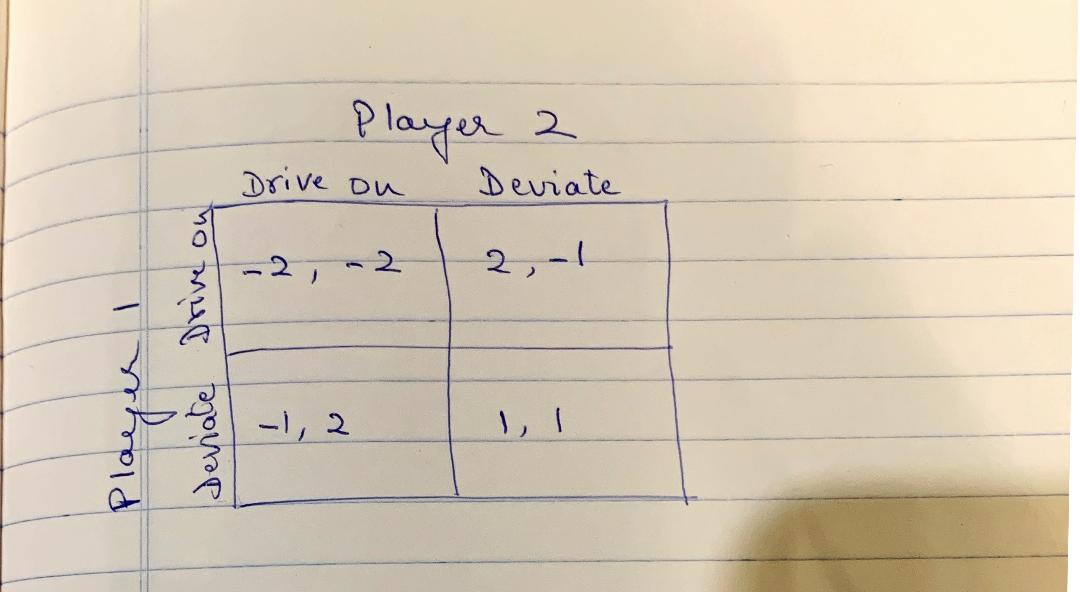
2. In game theory, Nash equilibrium is a situation where no payer can do better by changing his or her strategy alone. In simpler terms, if all the players were told of the strategies of every other player, but each of them would not want to change their original strategy, then that strategy profile would e Nash equilibrium.
3. In the above strategies as per the payoff matrix, (-2,-2) is the worst strategy as both players stand to lose. (1,1) is not the best strategy for both players either as player 1 stands to gain better if he deviates and player 2 drives on - that is, (2, -1); and player 2 gains better if he drives on and player 1 deviates. That is if either player drives on while the other deviates, that is a better strategy than both deviating.
Thus, (2, -1) and (-1, 2) are both pure strategy Nash equilibrium strategies.
 Rahul Sunny answered 6 months ago
Related Solutions
required info: Question 1: Rebel without a cause Two drivers speed head-on toward each other and...
Two protons, each having a speed of 0.910c in the laboratory, are moving toward each other....
A completely inelastic collision occurs between two balls of putty that move directly toward each other...
Two titanium spheres approach each other head-on with the same speed and collide elastically. After the...
a. Two air-track gliders with equal and opposite speeds of 10.00 cm/s head toward each other...
A Mack truck and a Honda traveling at the same speed have a head-on collision. The...
Consider a completely elastic head-on collision between two particles that have the same mass and the same speed.
A 0.060-kg tennis ball, moving with a speed of 5.20 m/s , has a head-on collision...
A 0.060-kg tennis ball, moving with a speed of 5.32 m/s, has a head-on collision with...
In an experiment, two protons are shot directly toward each other, each moving at half the...
- An Auditor may decide to make use of a specialist in obtaining sufficient appropriate audit evidence...
- Dirac's Theorem states that "A simple graph with n vertices (n >= 3) is Hamiltonian if...
- Two 10-cm-diameter charged rings face each other, 15cm apart. The left ring is charged to -29nC...
- Under what conditions would it be possible for an excise tax to have no efficiency cost...
- explain the difference between activities and financial statements of service businesses and merchandising businesses.
- 2. Compare and compare the matrix multiplication algorithm and the Floyd-Warshall algorithm to find all pairs...
- Q: 50.00 ml of 0.5216 M copper(II) nitrate solution is combined with 100.0 ml of 0.5580...