Question
In: Economics
Exercise goals: Be able to solve the profit maximization problem of a monopolist with third-degree price...
Exercise goals: Be able to solve the profit maximization problem
of a monopolist with third-degree price discrimination.
Understand the differences between 3DPD and single-pricing. You own
a monopoly that produces cars to be sold in two countries:
Freedonia and Sylvania. Demand for cars in Freedonia is given by PF
= 16,000-20QF, while demand in Sylvania is given by
PS = 20, 000 - 10QS. You own a single plant in Sylvania
that produces cars for both countries. Your cost function is C (Q)
= 8, 000Q, where Q = QF + QS.
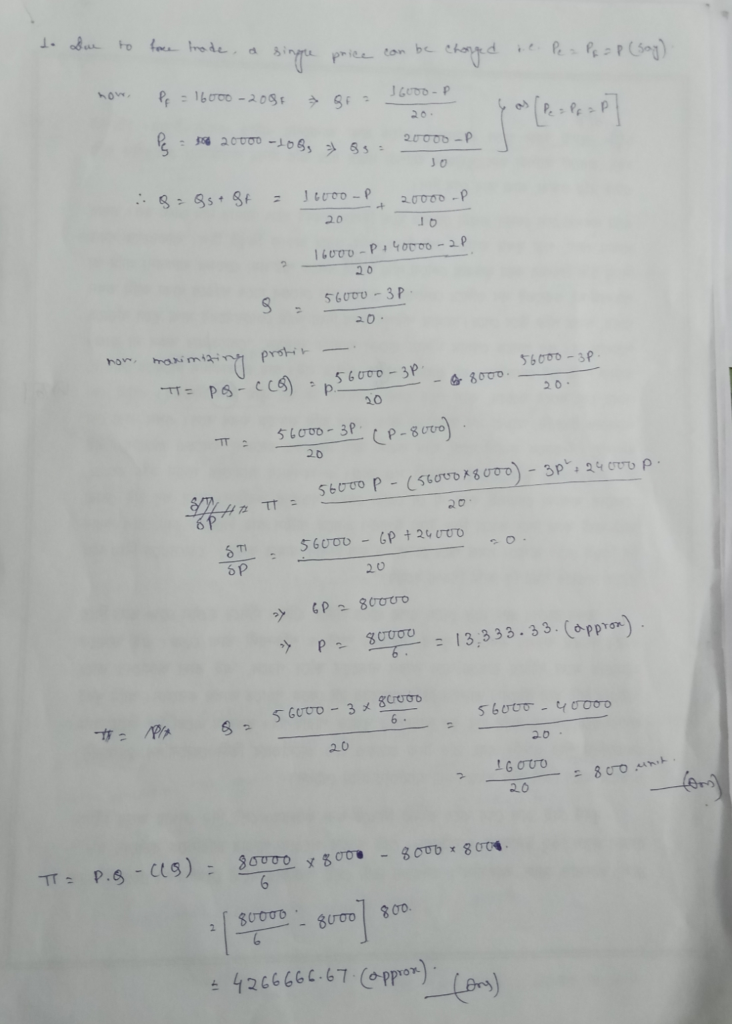
1. (1 point) Initially, these two countries have a peaceful
relationship, and free trade exists between them, therefore you can
only charge a single price between the two countries. What price do
you set? How much profit do you collect? [Hint: it may be easier to
solve this maximization problem in terms of P. To do so, you can
first obtain the demand functions (i.e. Q(P) = . . .), and then
write the cost function in terms of P using the demand
functions]
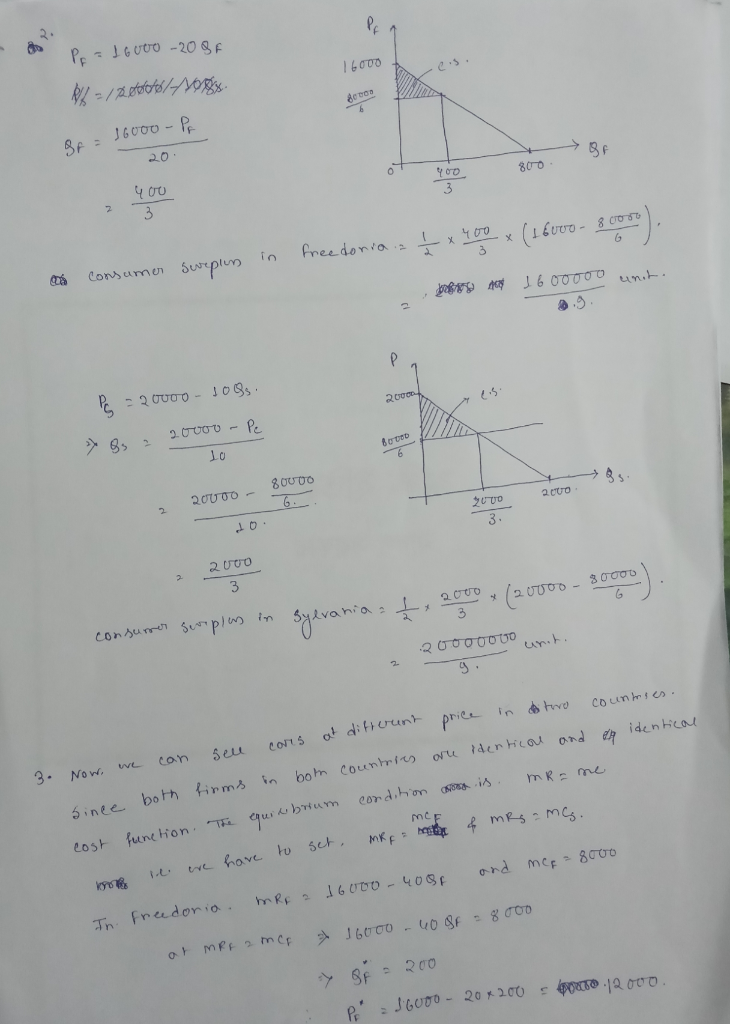
2. (1 point) How much consumer surplus is generated in each country?
3. (1 points) The Freedonian government finds out that Sylvania
is secretly plotting to invade Freedonia. This discovery leads to
an interruption in free trade between the two countries. That’s
good news for you: it means you can now sell cars in Freedonia at a
different price than in Sylvania. However, in order to do so, you
have to build a factory in Freedonia as well. Suppose that you can
build a factory for free (the Freedonian government is giving you a
generous handout because they like your cars). The plants are
identical, so you have the same cost function in both countries (C
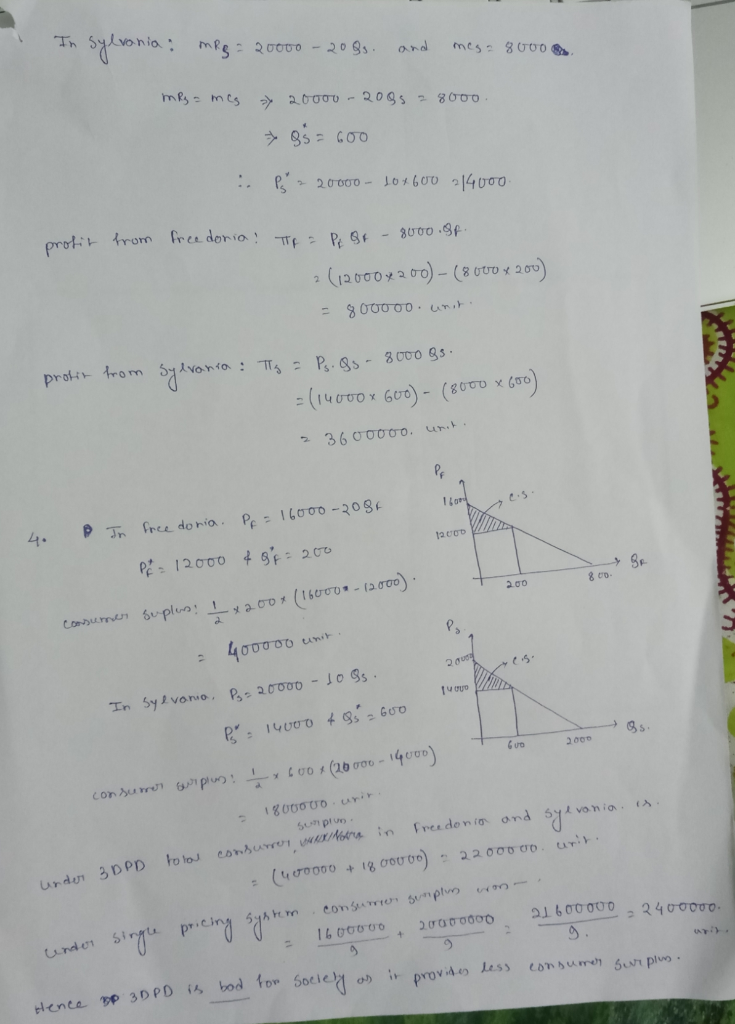
(Q) = 8, 000Q). What prices do you set? How much profit do you
collect?
4. (1 point) How much consumer surplus is generated for each
country in this new scenario? Comment on whether you think 3DPD is
good or bad for society as a whole (i.e. Freedonia + Sylvania) in
this case.
5. (1 point) Suppose that the cost of building a factory is
300,000. Does it make sense for the Freedonian government to
subsidize the plant? Why or why not? [When answering this question,
assume that the Freedonian government only cares about the
well-being of its citizens]
Solutions
 Rahul Sunny answered 6 months ago
Related Solutions
A monopolist is considering third degree price discrimination. It estimates that the inverse demand curves of...
A monopolist is considering third degree price discrimination. It estimates that the inverse demand curves of...
A monopolist practicing third degree price discrimination has two types of consumers.
Write out the profit-maximization conditions for a monopolist to mark-up over price. That is, what is...
A monopolist is using third-degree price discrimination. Which of the following statements are true? I. ...
a) Evaluate and explain the following assertion: “Profit maximization on the part of a monopolist means...
7. Show analytically that the necessary condition for the profit maximization of a monopolist that supplies...
Suppose a pure monopolist sells output in two different markets [A&B]. (third-degree price discrimination!). The demand...
Exercise 3. Third Degree Price Discrimination Some air routes are only served by a couple of...
3. Profit maximization and loss minimization BYOB is a monopolist in beer production and distribu...
- On January 1, 2018, bonds with a face value of $ 79,000 were sold. The bonds...
- How do I make this sort in true alphabetical order instead of ascii(ABCabc) order? I am...
- As a healthcare provider in physical therapy, athletic training, or as an exercise scientist and personal...
- in the market for makeup artists, what happens after the invention of high-definition tv allowing viewers...
- 10. What are the three monetary policy tools of the Fed? Briefly describe how each tool...
- In what ways would the role of a manager working in a nonstandard international assignment arrangement...
- Write a Bash script called move that could replace the UNIX command mv. 'move' tries to...