Question
In: Physics
An object’s position is described by the equation x = At – Bt 4 + C....
An object’s position is described by the equation x = At – Bt 4 + C. What are the dimensions of (a) A, (b) B, and (c) C? (d) Find the time derivative of position, dx/dt. (e) What are the dimensions of the time derivative?
Solutions
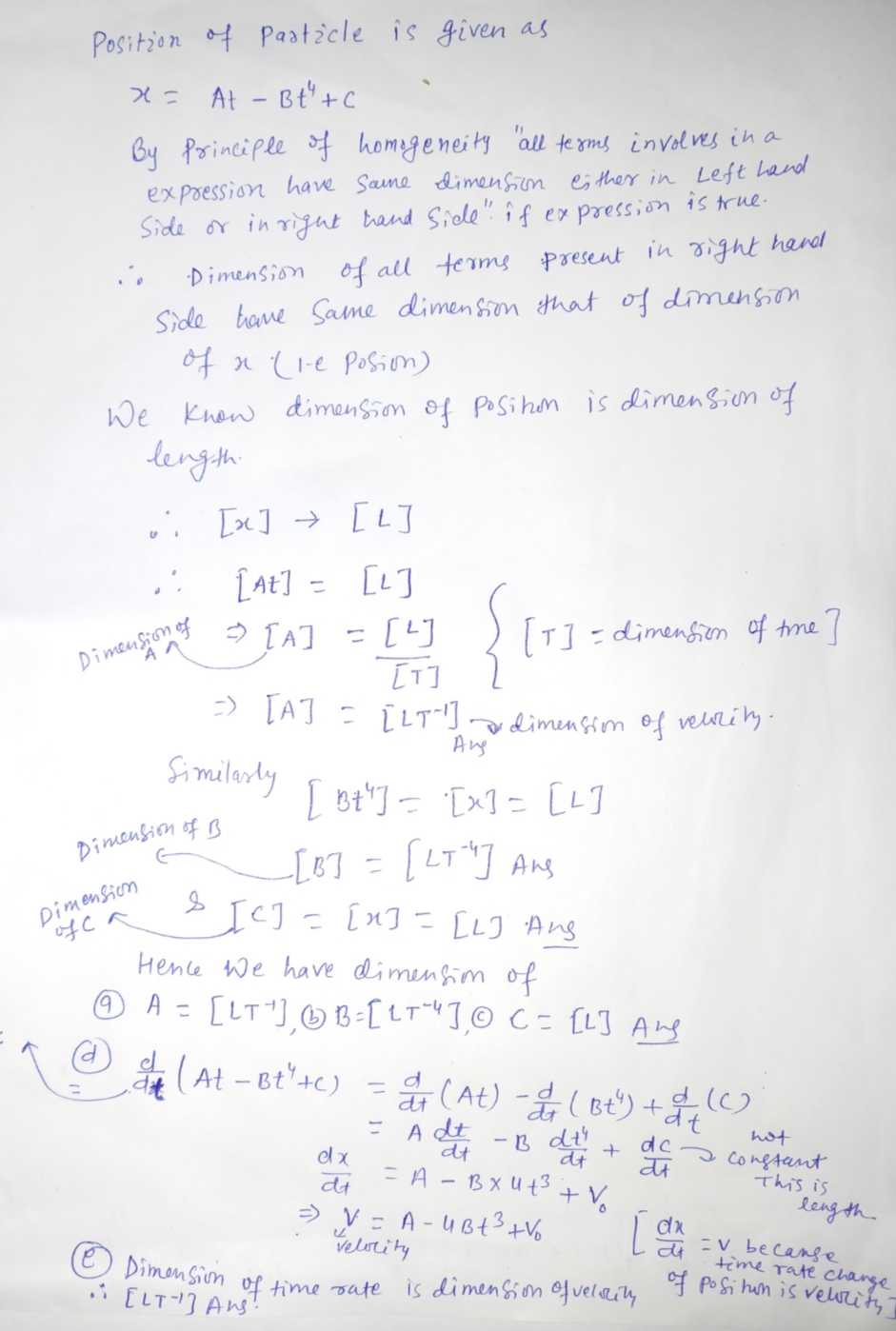
 genius_generous answered 6 months ago
Related Solutions
the position a the rocket sled on a straight track is given as x= at^3+ bt^2+c,...
the position a the rocket sled on a straight track is given as
x= at^3+ bt^2+c, where a= 1.04m/s^2, b=1.94 m/s^2, and c= 8.29m.
what is the sled's average speed between t= 3.72 and t=6.79
Find the general solution to the differential equation. y'=xy/x−4 y(x)=C⋅ ...
Find the general solution to the differential equation.
y'=xy/x−4
y(x)=C⋅ ...
The position of a 0.30-kg object attached to a spring is described by x = (0.24...
The position of a 0.30-kg object attached to a spring is
described by x = (0.24 m) cos(0.8πt). (Assume t is in seconds.) (a)
Find the amplitude of the motion. 0.24 Correct: Your answer is
correct. m (b) Find the spring constant. 1.9 Correct: Your answer
is correct. N/m (c) Find the position of the object at t = 0.33 s.
0.16 Correct: Your answer is correct. m (d) Find the object's speed
at t = 0.33 s. Incorrect: Your...
The position of a 0.30-kg object attached to a spring is described by x = (0.22...
The position of a 0.30-kg object attached to a spring is
described by
x = (0.22 m) cos(0.3?t)
(a) Find the amplitude of the motion.
m
(b) Find the spring constant.
N/m
(c) Find the position of the object at t = 0.26 s.
m
(d) Find the object's speed at t = 0.26 s.
m/s
Recall that the general form of a logistic equation for a population is given by P(t) = c/1 + ae−bt , such that the initial ..
Recall that the general form of a logistic equation for a population is given by P(t) = c/1 + ae−bt , such that the initial population at time t = 0 is P(0) = P0 . Show algebraically that
In a horizontal spring-mass configuration, the position of the 0.44 kg mass is described by [x...
In a horizontal spring-mass configuration, the position of the
0.44 kg mass is described by [x = (0.49 m) sin(2.39t)]
a) What is in meters the amplitude of these oscillations?
b) What is in m/s the maximum speed of the mass under these
conditions?
c) What is in Joules the spring potential energy stored in this
system when the spring is stretched at a maximum?
d) What is in Joules the kinetic energy of the mass when the
spring is...
The estimated demand function for commodity X is described by the following equation: ^ Qd =...
The estimated demand function for commodity X is described by
the following equation:
^
Qd = 50 – 2Px + 1.5 In - 0.75 Py
where Px = Price of commodity X
In = Consumer Income
Py = Price of commodity Y
(a)Does the behavior of the consumer of this product follow
the law of demand? Explain
(b)Is commodity X a normal good or an inferior good? How did
you know?
(c)Comment on the relationship between commodity X and
commodity...
i. Sketch the velocity vs time graph for the object’s motion described below. Mark all labels...
i. Sketch the velocity vs time graph for the object’s motion
described below. Mark all labels and values appropriately. The
object at rest starts to move from east to west. • Between 0-4
seconds it moves with an acceleration of 2 ??−2 • Then with a
constant velocity for 4-10 seconds. • Finally with a deceleration
of 2 ??−2 the object comes to rest. ii. Find the velocity of the
object at t= 4 secs and calculate how long the...
An object’s position above the ground, s(t), in meters, after t seconds is given by s(t)...
An object’s position above the ground, s(t), in meters, after t
seconds is given by s(t) = 16t2+120t+6. (a) What is the position of
the object at time t = 3 seconds? (
b) Find the velocity of the object as a function of t.
(c) Find the object’s acceleration at any time t.
(d) When is the velocity of the object 56 m/s?
(e) Find the position of the object at the time when the
velocity is 56 m/s....
And object is undergoing simple harmonic motion along the x-axis. Its position is described as a...
And object is undergoing simple harmonic motion along the
x-axis. Its position is described as a function of time by
x(t) = 2.7 cos(3.1t – 1.2), where x is
in meters, the time, t, is in seconds, and the argument of
the cosine is in radians.
A) Find the amplitude of the simple harmonic motion, in
meters.
B) What is the value of the angular frequency, in radians per
second?
C) Determine the position of the object, in meters, at...
ADVERTISEMENT
ADVERTISEMENT
Latest Questions
- Padre holds 100 percent of the outstanding shares of Sonora. On January 1, 2016, Padre transferred...
- Question: Use backtracking algorithm design to write Java code to solve the subset problem: given a...
- Patsy Ltd. produces ice-cream and would like to accurately forecast sales so that it can meet...
- Power Music owns five music stores, where it sells music, instruments, and supplies. In addition, it...
- 4) A client wants to finance the purchase of a house costing $50,000 over a period...
- [The following information applies to the questions displayed below.] In 2018, Sheryl is claimed as a...
- Show that the acceleration of any object down a frictionless incline that makes an angle theta...
ADVERTISEMENT