Question
In: Physics
A box with an inertia of 2kg is held on a 1m high table against a...
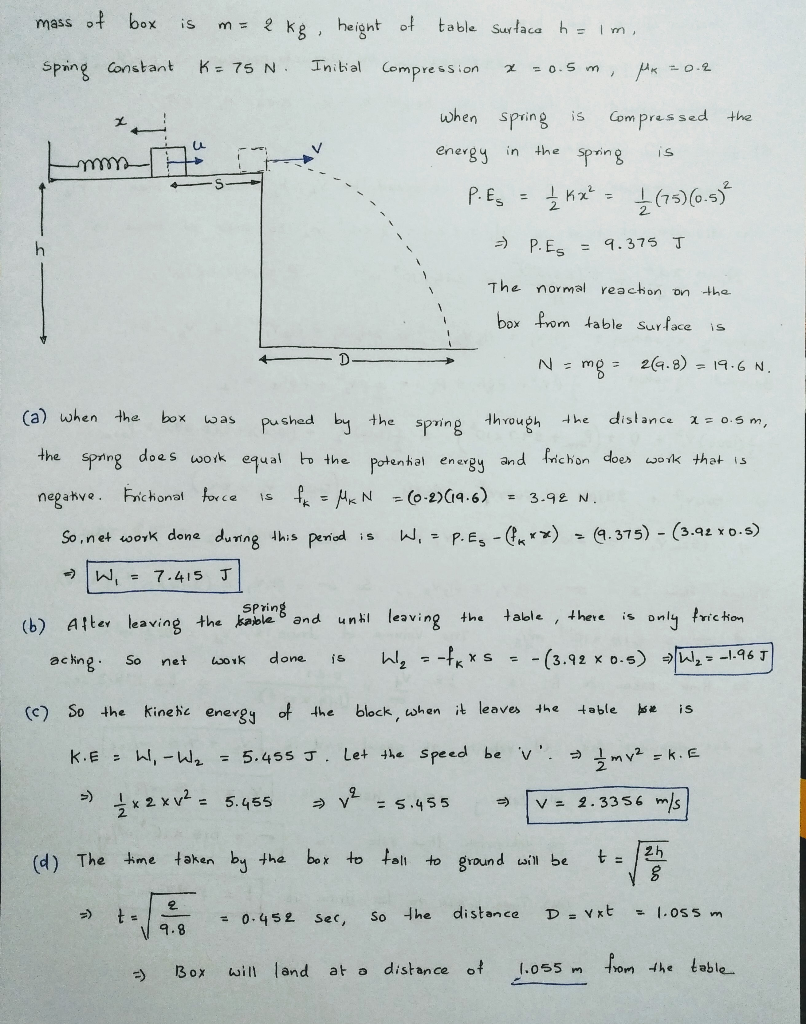
A box with an inertia of 2kg is held on a 1m high table against a spring with k = 75N which is initially compressed 0.5m. The coefficient of friction between the box and the table is 0.2. The spring is released, and it pushes the box until it reaches its equilibrium length. At this point, the spring is stopped by a stopper and the box continues to slide across the table with only the force of friction acting on it. After losing contact with the spring, the box travels the distance of the rest of the table, another 0.5m, where it then flies off the end of the table and lands on the floor. Assuming no air resistance,
-
(a) What was the net work done on the box while it was being pushed by the spring?
-
(b) What was the net work done on the box from the time it left the spring until it reached the edge of the table?
-
(c) How fast was the box moving when it flew off the table?
-
(d) How far from the table did the box land?
Solutions
 genius_generous answered 6 months ago
Related Solutions
A 2kg rock is thrown horizontally from the top of a building that is 20m high....
A cylindrical bronze sleeve (2) is held in compression against a rigid machine wall by a...
A horizontal rod of length 508 cm is held aloft by friction against a brick wall...
A 1.1 kg mass is held at rest on top of a frictionless and horizontal table....
Below is a table that shows ‘for’ and ‘against’ opinions on the topic: ‘City life is...
On the table is a box of donuts containing 8 donuts, each of a different kind....
6. Solve parts a and b: A box is at rest on a horizontal, frictionless table....
A wooden block of mass 20.0 g is placed on a table, and pressed against a...
Two cardboard boxes full of books are in contact with each other on a table. Box...
Provide a high level (cartoon or box model) description of how an ICP-MS and how an...
- Identify which of the perspectives you believe is the BEST for accurately explaining human behavior and...
- What trade policies should a country adopt? why? Explain. Also, find some reference materials on this...
- In Java: Suppose you want to implement a Sudoku game that consists of 9x9 rows and...
- What is the percent yield of the solid product when 17.62 g of iron(III) nitrate reacts...
- Kilgore Natural Gas has $1,000 par value bonds outstanding at 12% interest. The bonds will mature...
- 19.20 grams of barium hydroxide, Ba(OH)2 is dissolved in 178.0 ml of water (you may assume...
- An LC circuit like that in the figure below consists of a 3.40-H inductor and an...