Question
In: Computer Science
I'm working with using recursion to find the sum and the min of these two arrays...
I'm working with using recursion to find the sum and the min of these two arrays respectively. So far what I have gives the correct answers when they run, however when I use a test code on them they fail because they cannot handle out of bounds points, for example if int[] sumMe = { } or if the position is set to the last number "89" in the array. I kinda know what I'm supposed to tell it but not how to properly implement it, if you could help be adjust the code to catch these out of bounds instances I'd very much appreciate it.
I'll put the failed messages for each of these under the test code I put down in case it helps.


public class test {
    public static void main(String[] args) {
        int[] sumMe = { 1, 1, 2, 3, 5, 8, 13, 21, 34, 55, 89 };
        System.out.printf("Array Sum: %d\n", arraySum(sumMe, 0));


        int[] minMe = { 0, 1, 1, 2, 3, 5, 8, -42, 13, 21, 34, 55, 89 };
        System.out.printf("Array Min: %d\n", arrayMin(minMe, 0));
    }
    public static long arraySum(int[] data, int position) {
        if (position <= data.length && position >= 0) {
            if (data.length - 1 == position) {
                return data[position];
            }
            else {
                return data[position] + arraySum(data, position + 1);
            }
        }
        return 0;
    }

    public static int arrayMin(int[] data, int position) {
        int min;
        int i;
        min = data[position];
        for (i = 0; i < data.length; i++) {
            if (min > data[i]) {
                min = data[i];
                arrayMin(data, i++);
            }
        }
        return min;
    }
}
Failed test in arrayMin:
java.lang.AssertionError: ArrayMin must be able to
handle position of
Expected :89
Actual :1
Failed test in arraySum:
java.lang.ArrayIndexOutOfBoundsException: Index 0 out of
bounds for length 0
Solutions
Expert Solution
/***************************Recursion.java***************/
import org.junit.Assert;
public class RecursionTest {
@org.junit.Test
public void RecursionTestArraySumInputTest() {
int[] emptyArray = {};
Assert.assertEquals("ArraySum must
be able to handle an empty array", 0,
Recursion.arraySum(emptyArray, 0));
Assert.assertEquals("ArraySum must
be able to handle bad position values", 0,
Recursion.arraySum(emptyArray, 1));
}
@org.junit.Test
public void RecursionTestArraySumTest() {
int[] array = { 1, 1, 2, 3, 5, 8,
13, 21, 34, 55, 89 };
int position = 4;
Assert.assertEquals("ArraySum
calculated an incorrect sum", 232, Recursion.arraySum(array,
0));
Assert.assertEquals(
String.format("ArraySum calculated an incorrect
sum when starting at position %d", position), 225,
Recursion.arraySum(array, position));
position = array.length -
1;
Assert.assertEquals(String
.format("ArraySum calculated an incorrect sum
when starting at position %d (end of array)", position),
89, Recursion.arraySum(array, position));
}
@org.junit.Test
public void RecursionTestArrayMinTest() {
int[] inOrder = { 1, 1, 2, 3, 5, 8,
13, 21, 34, 55, 89 };
int[] reverseOrder = { 10, 9, 8, 7,
6, 5, 4, 3, 2, 1 };
int[] randomOrder = { 5, 1, 100, 7,
6, 2, 0 };
int[] randomWithNeg = { 5, 1, 100,
-6, 7, 6, 2, 0, -1 };
Assert.assertEquals("ArrayMin
must be able to find the correct min with an in-order array",
1,
Recursion.arrayMin(inOrder, 0));
Assert.assertEquals("ArrayMin must
be able to find the correct min with a reverse-ordered array",
1,
Recursion.arrayMin(reverseOrder, 0));
Assert.assertEquals("ArrayMin must
be able to find the correct min with a random-ordered array",
0,
Recursion.arrayMin(randomOrder, 0));
Assert.assertEquals("ArrayMin must
be able to find the correct min with a random-ordered array with
negatives",
-6, Recursion.arrayMin(randomWithNeg, 0));
}
@org.junit.Test
public void RecursionTestArrayMinInputTest() {
int[] inOrder = { 1, 1, 2, 3, 5, 8,
13, 21, 34, 55, 89 };
int position = inOrder.length -
1;
Assert.assertEquals(String.format("ArrayMin must be able to handle
position of ", position), 89,
Recursion.arrayMin(inOrder, position));
}
@org.junit.Test
public void RecursionTestIsWordSymmetricInputTest()
{
String[] emptyArray = {};
String[] array = { "I" };
String[] array2 = "I have to push
the pram a lot!".split(" ");
Assert.assertEquals("IsWordSymmetric must be able to handle an
empty array", true,
Recursion.isWordSymmetric(emptyArray, 0,
0));
Assert.assertEquals("IsWordSymmetric must be able to handle a
single word", true,
Recursion.isWordSymmetric(array, 0, 0));
Assert.assertEquals("IsWordSymmetric must be able to handle a start
and end position at the end of the array",
false, Recursion.isWordSymmetric(array2,
array2.length - 2, array2.length - 1));
Assert.assertEquals("IsWordSymmetric must be able to handle a start
and end position at the end of the array",
true, Recursion.isWordSymmetric(array2,
array2.length - 1, array2.length - 1));
}
@org.junit.Test
public void RecursionTestIsWordSymmetricTest() {
String[] array = "I have to push
the pram a lot!".split(" ");
String[] array1 = "this easy
this".split(" ");
String[] array2 = "You can cage a
swallow can't you but you can't swallow a cage can you".split("
");
Assert.assertEquals(false,
Recursion.isWordSymmetric(array, 0, array.length - 1));
Assert.assertEquals(true,
Recursion.isWordSymmetric(array1, 0, array1.length - 1));
Assert.assertEquals("IsWordSymmetric must be case insensitive",
true,
Recursion.isWordSymmetric(array2, 0,
array2.length - 1));
}
@org.junit.Test
public void
RecursionTestComputePyramidWeightsInputTest() {
double[][] weights = { {} };
double[][] weights1 = { { 51.18 },
{ 55.90, 131.25 }, { 69.05, 133.66, 132.82 },
{ 53.43, 139.61, 134.06, 121.63 } };
Assert.assertEquals("ComputePyramidWeights must be able to handle
an empty array", 0.0,
Recursion.computePyramidWeights(weights, 0, 0),
0.001);
Assert.assertEquals("ComputePyramidWeights must be able to handle
negative row values", 0.0,
Recursion.computePyramidWeights(weights, -1, 0),
0.001);
Assert.assertEquals("ComputePyramidWeights must be able to handle
negative col values", 0.0,
Recursion.computePyramidWeights(weights, 0, -1),
0.001);
Assert.assertEquals("ComputePyramidWeights must be able to handle
invalid column", 0.0,
Recursion.computePyramidWeights(weights1, 0, 3),
0.001);
Assert.assertEquals("ComputePyramidWeights must be able to handle
invalid row", 0.0,
Recursion.computePyramidWeights(weights1, 4, 0),
0.001);
}
@org.junit.Test
public void RecursionTestComputePyramidWeightsTest()
{
double weights[][] = { { 51.18 }, {
55.90, 131.25 }, { 69.05, 133.66, 132.82 },
{ 53.43, 139.61, 134.06, 121.63 } };
Assert.assertEquals("ComputePyramidWeights must be able to handle
an array with a single row and col", 51.18,
Recursion.computePyramidWeights(weights, 0, 0),
0.001);
Assert.assertEquals("ComputePyramidWeights must be able to handle
an array with multiple rows and one col",
108.327,
Recursion.computePyramidWeights(weights, 3, 0), 0.001);
Assert.assertEquals("ComputePyramidWeights must be able to handle
an array with multiple cols and rows", 227.25,
Recursion.computePyramidWeights(weights, 3, 3),
0.001);
}
@org.junit.Test
public void RecursionTestHowManyOrganismsInputTest()
{
char[][] image = { {} };
char[][] image1 = { { '*' }
};
char[][] image2 = { { '*', ' ' }
};
char[][] image3 = { { '*', ' ' }, {
'*' }, { '*', '*', '*' } };
Assert.assertEquals("HowManyOrganisms must be able to handle an
empty image", 0,
Recursion.howManyOrganisms(image));
Assert.assertEquals("HowManyOrganisms must be able to handle an
image with a single row/col", 1,
Recursion.howManyOrganisms(image1));
Assert.assertEquals("HowManyOrganisms must be able to handle a
rectangular image", 1,
Recursion.howManyOrganisms(image2));
Assert.assertEquals("HowManyOrganisms must be able to handle a
ragged image", 1,
Recursion.howManyOrganisms(image3));
}
@org.junit.Test
public void RecursionTestHowManyOrganismsTest()
{
char[][] image = { { '*', ' ', ' ',
'*', ' ', ' ', ' ', ' ', '*', ' ' },
{ ' ', '*', ' ', ' ', ' ', ' ', ' ', ' ', ' ', '
' },
{ ' ', ' ', ' ', ' ', ' ', ' ', '*', ' ', ' ', '
' },
{ ' ', '*', ' ', '*', ' ', '*', ' ', ' ', ' ', '
' },
{ ' ', ' ', ' ', ' ', '*', ' ', '*', ' ', '*', '
' },
{ ' ', '*', ' ', ' ', ' ', '*', ' ', '*', ' ',
'*' },
{ ' ', ' ', ' ', '*', ' ', ' ', ' ', ' ', '*', '
' },
{ ' ', ' ', '*', ' ', ' ', ' ', ' ', ' ', ' ', '
' },
{ ' ', ' ', ' ', ' ', '*', ' ', ' ', ' ', '*', '
' },
{ ' ', ' ', ' ', ' ', ' ', '*', ' ', ' ', ' ', '
' } };
char[][] image1 = { { '*', '*',
' ', '*', '*', '*', '*', '*', '*', '*' },
{ '*', '*', ' ', ' ', '*', ' ', ' ', ' ', '*',
'*' },
{ '*', ' ', ' ', ' ', '*', ' ', '*', '*', ' ',
'*' },
{ '*', '*', ' ', '*', '*', '*', '*', ' ', ' ',
'*' },
{ '*', '*', '*', ' ', '*', ' ', '*', ' ', '*',
'*' },
{ '*', '*', '*', ' ', '*', '*', '*', '*', '*',
'*' },
{ '*', ' ', ' ', '*', ' ', ' ', ' ', ' ', '*',
'*' },
{ '*', ' ', '*', '*', ' ', ' ', ' ', ' ', '*',
'*' },
{ '*', ' ', '*', '*', '*', '*', ' ', ' ', '*',
'*' },
{ '*', '*', '*', '*', '*', '*', '*', '*', '*',
'*' } };
Assert.assertEquals(21,
Recursion.howManyOrganisms(image));
Assert.assertEquals("HowManyOrganisms should be able to handle
cascading", 1,
Recursion.howManyOrganisms(image1));
}
@org.junit.Test
public void
RecursionTestHowManyOrganismsInputRaggedTest() {
char[][] image = { { '*', ' ' }, {
' ' }, { '*', ' ', '*' } };
char[][] image1 = { { '*', ' ' }, {
'*' }, { '*', '*', '*' } };
Assert.assertEquals("HowManyOrganisms must be able to handle a
ragged image", 3,
Recursion.howManyOrganisms(image));
Assert.assertEquals("HowManyOrganisms must be able to handle a
ragged image with cascading", 1,
Recursion.howManyOrganisms(image1));
}
}
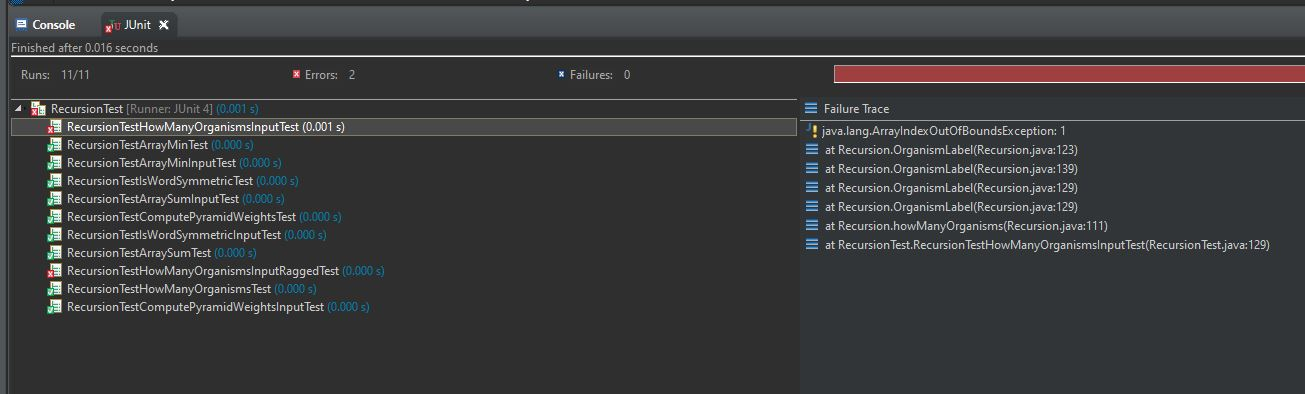
Please let me know if you have any doubt or modify the answer, Thanks :)
 venereology answered 7 months ago
Related Solutions
For this question we will be using arrays and classes in Java to compute the min,...
I'm working in Java and am working on a project where I need to find an...
In C++ write a function to find a product of two matrices using arrays. The function...
I'm trying to get the union of two arrays and I tried making a loop that...
Hello there, I'm wondering can you do this problem without arrays? Using the given code on...
Objective: The goal of this lab is to practice (ragged) 2D arrays and simple recursion (in...
Hi. I'm trying to write a program that uses dynamic memory management to create two arrays....
I'm working on a scatter-plot program in Python using Pandas, Matplotlib, Numpy, etc. I'm pulling data...
a. Two dice are rolled; find the probability that the sum of the two numbers is...
*****I'm using excel spreadsheet so I'm stuck on how to find a least square straight line...
- Padre holds 100 percent of the outstanding shares of Sonora. On January 1, 2016, Padre transferred...
- Question: Use backtracking algorithm design to write Java code to solve the subset problem: given a...
- Patsy Ltd. produces ice-cream and would like to accurately forecast sales so that it can meet...
- Power Music owns five music stores, where it sells music, instruments, and supplies. In addition, it...
- 4) A client wants to finance the purchase of a house costing $50,000 over a period...
- [The following information applies to the questions displayed below.] In 2018, Sheryl is claimed as a...
- Show that the acceleration of any object down a frictionless incline that makes an angle theta...