Question
In: Chemistry
In radical chlorination of alkanes, non-equivalent hydrogens react with chlorine atoms at different rates. At 35
In radical chlorination of alkanes, non-equivalent hydrogens react with chlorine atoms at different rates. At 35
Solutions
Expert Solution
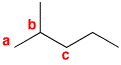
1) Specify the most reactive C-H bond(s), a-c.
The Answer is b, the tertiary center, because the radical formation at this center is stbilised by the three alkyl groups through inductive effect and hyper-conjugation.
Two non-equivalent C-H bonds of comparable reactivity should be separated by commas, i.e. a,c.
b > c > a
2) Specify the site of chlorination in the
major monochloro substitution product,
a-c.
Two products that form in comparable quantities should be separated
by commas, i.e. a,c
Again the answer is b, the tertiary center, because the radical formation at this center is stbilised by the three alkyl groups through inductive effect and hyper-conjugation.
b > c > a

1) Specify the most reactive C-H bond(s), a-c.
The answer is b becuse it is tertiary center and
produced more stable tertiary-radical
Two non-equivalent C-H bonds of comparable reactivity should be
separated by commas, i.e. a,c.
b > a
2) Specify the site of chlorination in the major monochloro substitution product, a-c.
The anser is b, the tertiary center.
Two products that form in comparable quantities should be separated by commas, i.e. a,c
b > a
 queen_honey_blossom answered 14 hours ago
Related Solutions
In HNMR, - What are non-equivalent hydrogens - What are the "# of Hydrogens per Peak"...
Consider a one-dimensional lattice with a basis of two non-equivalent atoms of masses M_1and M_2. 1....
- Need solution: HSL Company produces rugs. The following cost information from last year is available: Total...
- You are the network administrator for your organization. Your DHCP server (Server1) has a scope of...
- python3 Let x0,...,xn−1 be n numbers stored in the list x. The median of x, denoted...
- Raintree Cosmetic Company sells its products to customers on a credit basis. An adjusting entry for...
- 1. The larger the calculated χ2 value in a goodness-of-fit test, the _______ likely the data...
- tcp 16115
- #include <iostream> #include <fstream> #include <vector> #include <string> using namespace std; // Define a Person class,...