Question
In: Economics
Outline and explain the three essential functions of economic policy. b) Illustrate diagrammatically stabilization versus allocation...
Outline and explain the three essential functions of economic policy.
b) Illustrate diagrammatically stabilization versus allocation policies.
c) With the aid of appropriate diagrams explain the supply and demand shocks in an aggregate supply-aggregate demand framework.
Solutions
Expert Solution
(a) The Economic Policy of governments covers the systems for setting levels of taxation, government budgets, the money supply and interest rates as well as the labour market, national ownership, and many other areas of government interventions into the economy.
*** The three essential functions of Economic Policy are :- (1) The Allocative Function, (2) The Stabilization Function and (3) The Distributive Function.
Thses functions are explain as follows :-
(1) The Allocative Function :- The Allocative Function in budgeting determines on what government revenue will be spent. Because a high proportion of national income is now devoted to public expenditure, allocation decisions become more significant in political and economic terms. At all times and in all countries the calls for expenditure on specific services or activities, or for more generous transfer payments, will always exceed the amount that can reasonably be raised in taxation or by borrowing. The debate about how these scarce resources should be allocated has continued for hundreds of years, and, although numerous methods of deciding on priorities have emerged, it has never been satisfactorily resolved. In practice, most democracies contain a number of different factions that disagree on the proper allocation of resources and indeed the proper level of public sector involvement in the economy; the frequent change of national governments is related to the constant search for the right answers.
(2) The Stabilization Function :- Stabilization of the economy (e.g., full employment, control of inflation, and an equitable balance of payments) is one of the goals that governments attempt to achieve through manipulation of fiscal and monetary policies. Fiscal policy relates to taxes and expenditures, monetary policy to financial markets and the supply of credit, money, and other financial assets.
(3) The Distributive Function :- Virtually everything that a government does has some effect on the distribution of income or wealth at the various levels of society. Improvements in health care facilities benefit the sick, the old, and those about to have children. An increase in taxes on tobacco and beer affects the poor disproportionately, while an increase in capital taxes similarly affects the rich. Even regulatory and legislative activity benefits one group out of proportion to another. The re-distributive consequences of the governmental budget can be reflected in a variety of ways; sometimes they are explicit and sometimes they are cited in the debate that follows the presentation of a budget. Usually, however, these consequences are hidden, unintended, and imperfectly understood.
(b) Stabilization Policy versus Allocation Policy :-
Stabilization Policy is a strategy enacted by a government or its central bank that is aimed at maintaining a healthy level of economic growth and minimal price changes. Sustaining a stabilization policy requires monitoring the business cycle and adjusting benchmark interest rates as needed to control abrupt changes in demand. In the language of business news, a stabilization policy is designed to prevent the economy from excessive "over-heating" or "slowing down."
Whereas, Allocation Policy means the investment allocation policy and procedures of the Manager and/or its Affiliates with respect to the allocation of investment opportunities among the Company and one or more Other Blackstone Funds (as the same may be amended, updated or revised from time to time).
(c) Case of Aggregate Demand ( Positive & Negative ) :-
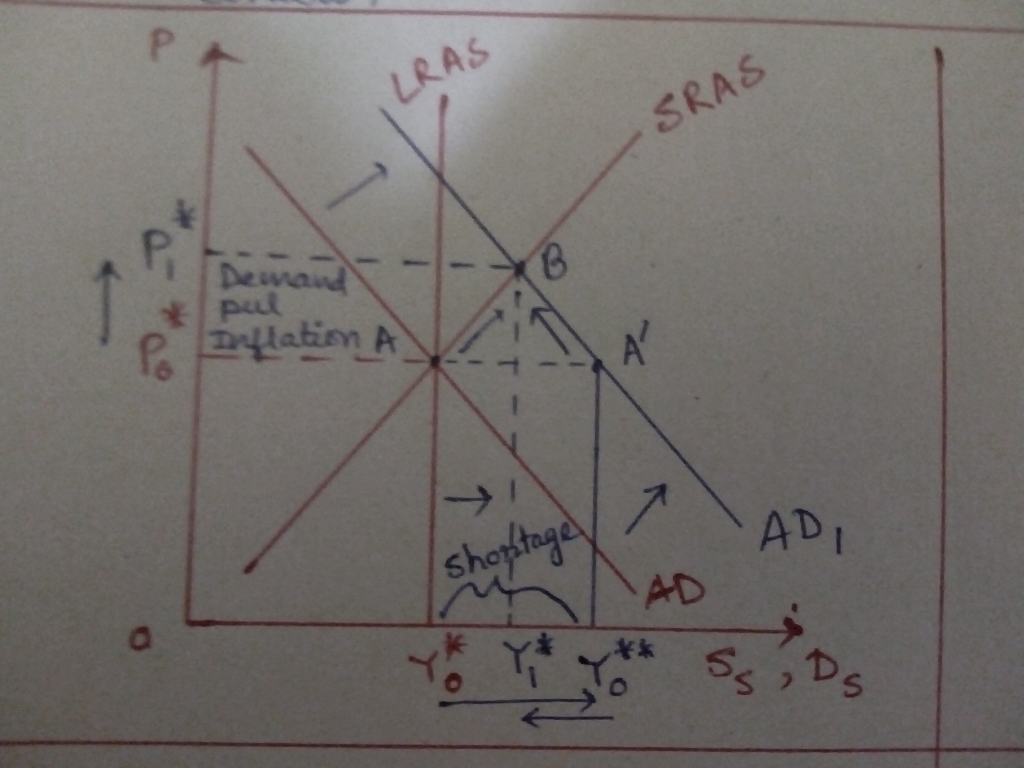
Positive Case :- An increase in Aggregate Demand (AD) results from an increase in Consumption (C), Investment (I), Government Expenditure (G) and Net Export (X-M). In this case, a situation of Demand-pull Inflation and Shortage are happened. Here is the respective figure. [ Ss and Ds are Supply of Shocks and Demand for Shocks respectively, P = Price level, LRAS , SRAS = Long-run and Short-run Aggregate Supply curve, AD = Aggregate Demand curve ]
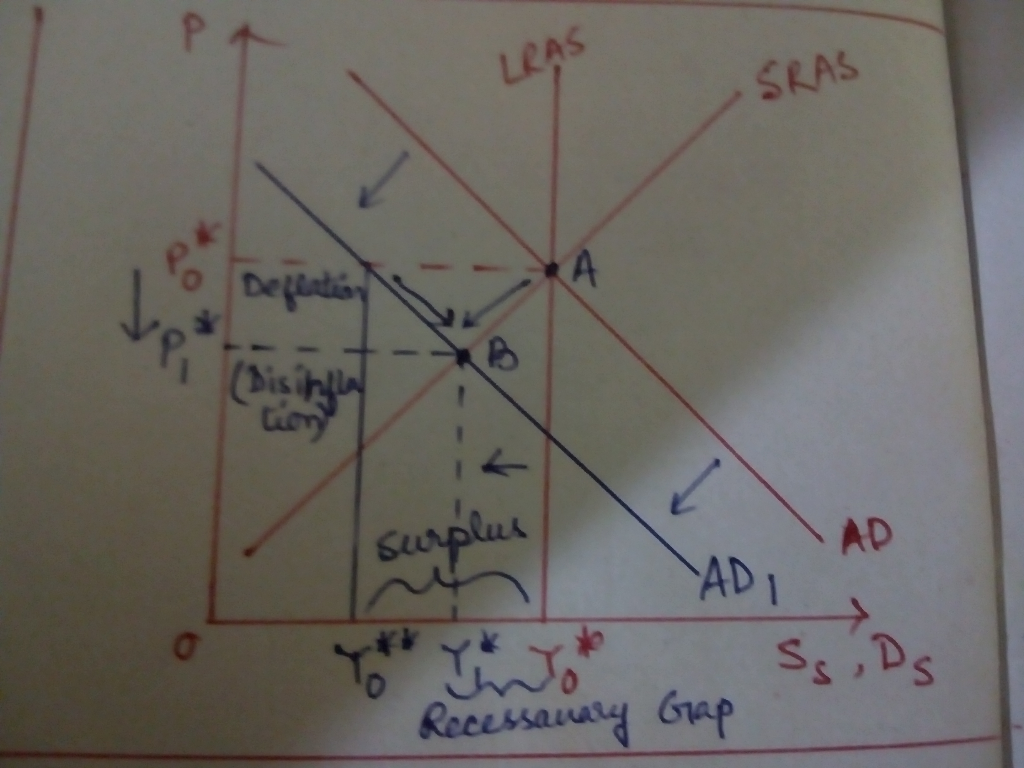
Negative Case :- A decrease in Aggregate Demand (AD) results from a decrease in Consumption (C), Investment (I), Govt. Expenditure (G) and Net Export (X-M). In this case, Recessionary Gap, Surplus and Deflation (Disinflationary situation) are created. Here is the respective figure.
Case of Aggregate Supply ( Positive & Negative ) :-
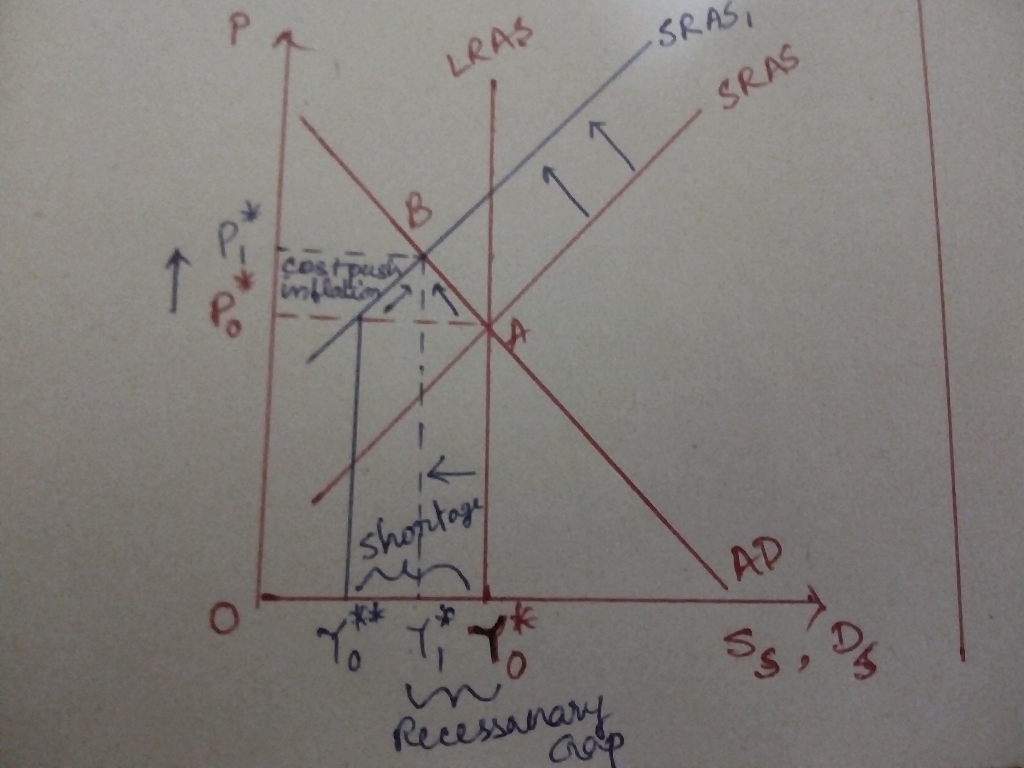
Negative Case :- An increase in the cost of production, it causes the decrease in Short-run Aggregate Supply (SRAS) curve. In this case, a situation of Cost-push Inflation, Shortage and Recessionary Gap are happened. Here is the respective diagram.
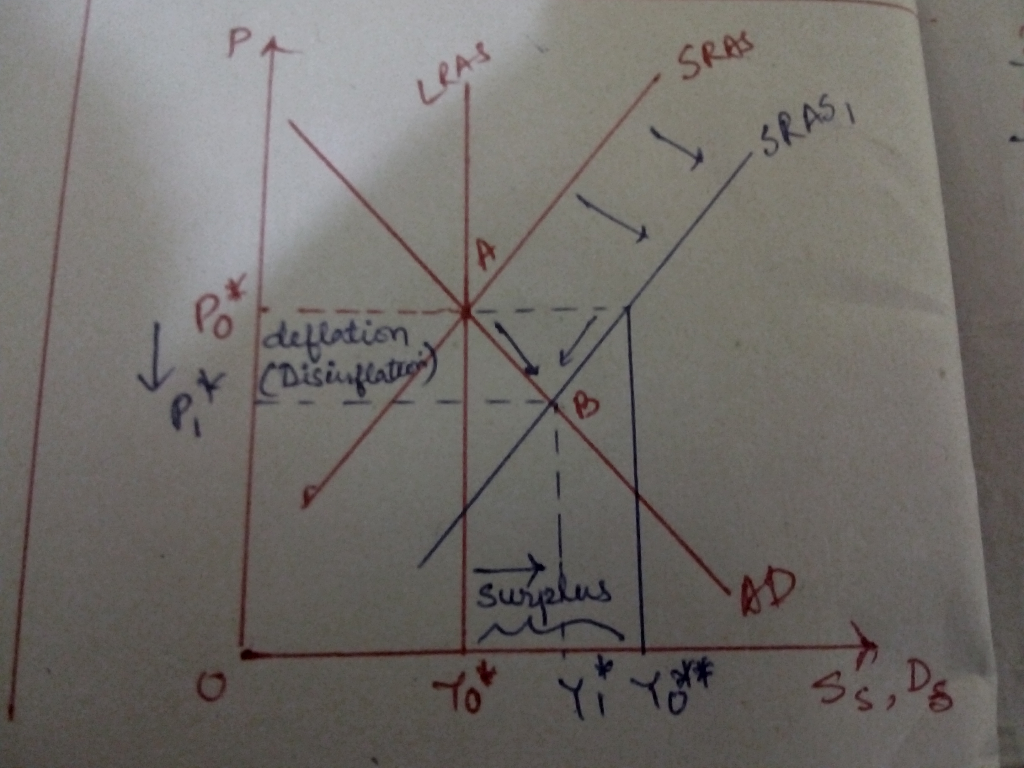
Positive Case :- A decrease in the cost of production, it causes the increase in Short-run Aggregate Supply (SRAS) curve. In this case, Deflation (Disinflationary situation) and Surplus are created. Here is the respective diagram.
 Rahul Sunny answered 3 weeks ago
Related Solutions
Economic policy makers are concerned with both economic growth and economic stabilization. Explain the distinction between them. Are...
Explain why economic forecasting is a critical component of discretionary stabilization policy, but not so critical...
Is there a trade-off between economic growth and stabilization policy? That is, do policy changes designed...
Essential Functions 1. What is meant by the term “essential functions?” Explain: 2. Review the essential...
Explain and (diagrammatically) illustrate the key aspects of “Complete v. Incomplete Contracts” in terms of US...
Monetary and fiscal policy play important roles in economic stimulation and or stabilization. In this regard:...
monetary and fiscal policy play important roles in economic stimulation and or stabilization. In this regard;...
When the economy is heading into a recession, illustrate and explain using diagrams, how economic policy...
Outline the association between back office functions and economic geography.
Illustrate and Explain the difference between Resource levelling and Resource Allocation
- Why is Tukey's method more powerful than Bonferroni's method?
- Why did the course of World War I turn out to be so different from what...
- A rural 6-lane divided highway with AADT = 30,000 veh/ day, with composition [(80% PC –...
- *VISUAL BASIC* Construct and instantiate an array of strings called afcSouth that contains the following information...
- LAG network inc. balance sheet and income statement are as follows: LAG network inc. income statement...
- Calculate the pH at the equivalence point in titrating 0.110 M solutions of each of the...
- why joints differ in their degree of mobility.