Question
In: Physics
A mass is attached to a string on a pulley, when the mass is falling what...
A mass is attached to a string on a pulley, when the mass is falling what direction is the pulley spinning? Which direction do the vectors for torque, angular acceleration, and angular velocity point? What about when the mass is going back up? Please draw a diagram showing these vectors.
Solutions
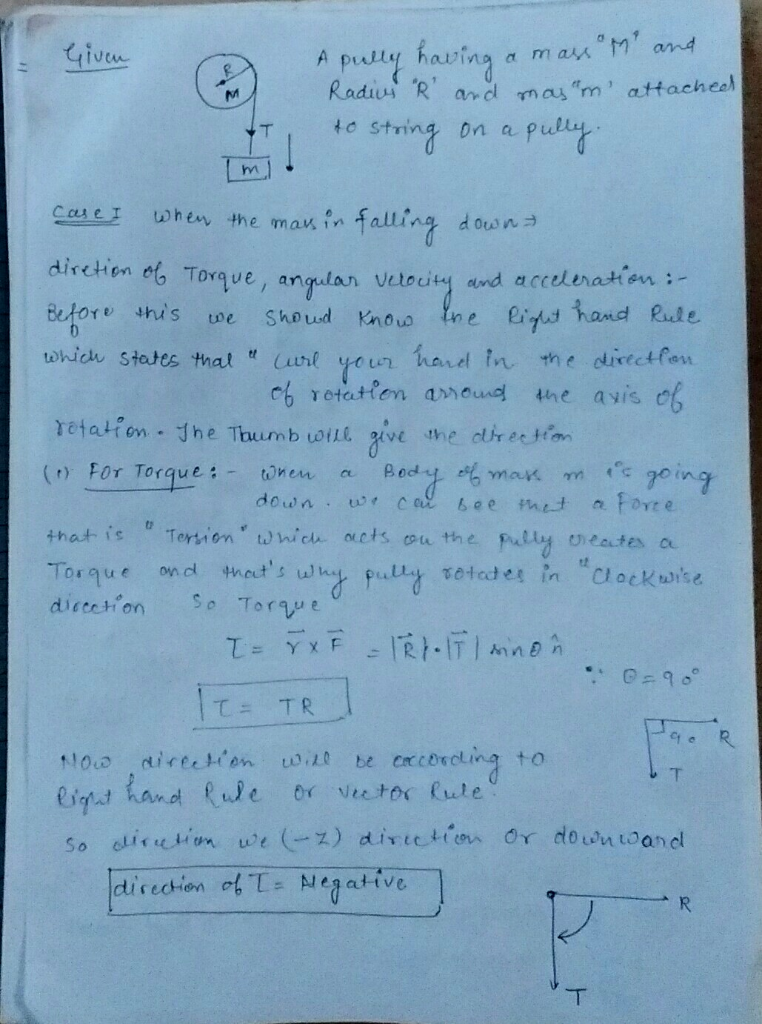 q
q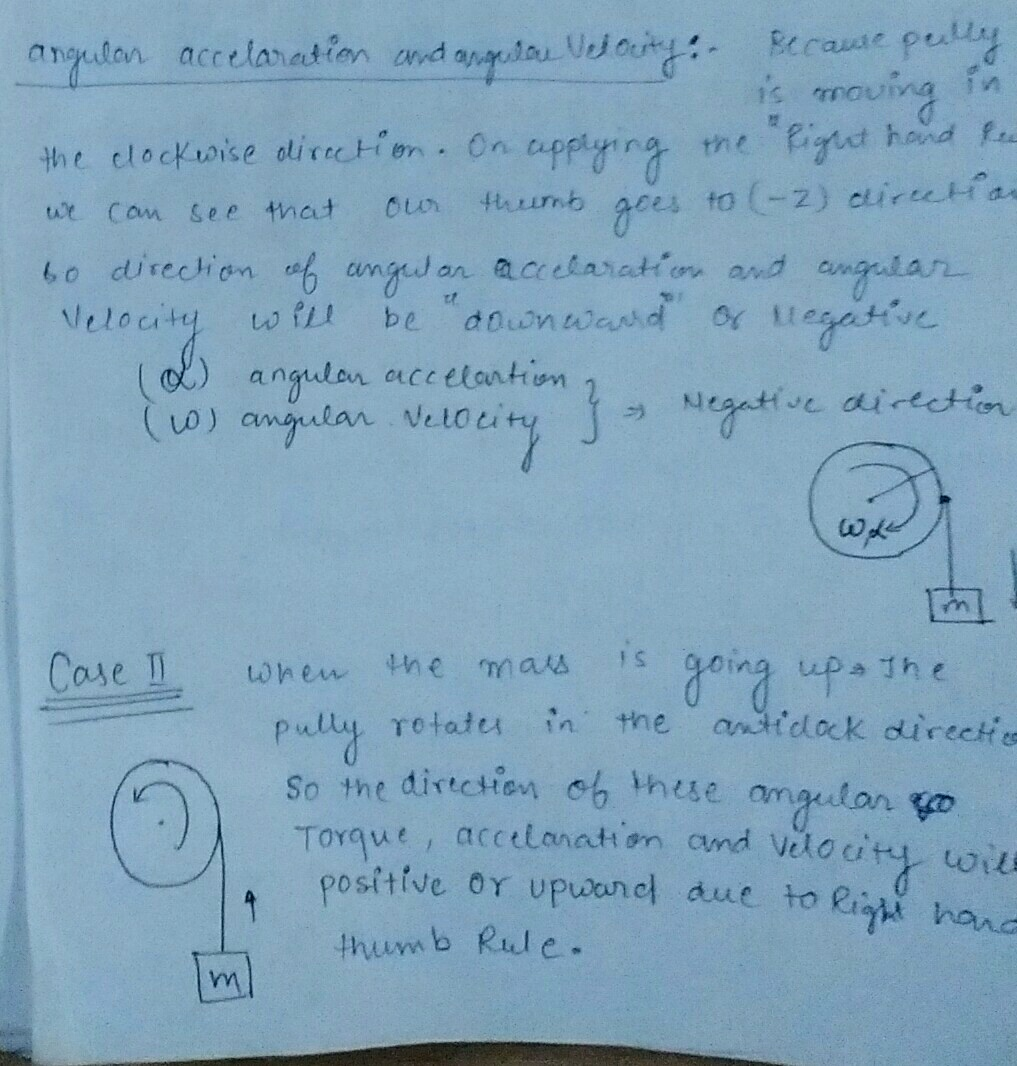
 genius_generous answered 1 month ago
Related Solutions
A cart is attached to a hanging mass by a string that passes over a pulley....
A cart is attached to a hanging mass by a string that passes
over a pulley. a) Draw free-body diagrams for the cart and the
hanging mass (Clearly label all forces present and indicate their
relative magnitudes) when the cart is moving:(i) on a horizontal
track.(ii) up a track inclined at an angle .b) When the cart moves
on an incline at constant speed, it is in equilibrium; i.e., the
net force on it is zero. Does it require more,...
A block hangs from a string that runs over a pulley and is attached to a...
A block hangs from a string that runs over a pulley and is
attached to a rolling cart. The cart, the block, and the pulley
each have the same mass (M) . The cart an pulley roll without
friction, and the pulley is a disk with moment of inertia:
Icm=12MR2
The hanging block is released from rest and allowed to evolve
freely under the influence of gravity.
Find the speed of the hanging mass, v, after the block has
fallen...
A compound wire is attached to a wall and hanging over a pulley with a mass...
A compound wire is attached to a wall and hanging over a pulley
with a mass attached to the end and hanging down off of a table.
The compound wire is made up of two different wires. The part
attached to the wall is made of aluminum and has a length of 60 cm,
a cross-sectional area of 1 × 10^-2 cm^2, and a density of 2.6
g/cm^3. The second part, which is a steel wire that has a density...
A string is tied to the ceiling and is attached to a 50 kg mass that...
A string is tied to the ceiling and is attached to a 50 kg mass
that hangs down freely. The 1.5-m-long string has a mass of 3.7
grams.
a. What is the speed of waves that exist on the string?
b. What is the frequency of the fundamental (m=1) harmonic of
standing waves on the string?
c. What is the frequency of the 3rd (m=3) harmonic of standing
waves on the string?
d. How much mass would have to be...
A ball of mass m is attached to a string of length L. It is swung...
A ball of mass m is attached to a string of length L. It is
swung in a vertical circle with enough speed to keep the string
taut throughout the motion. Assume the ball travels freely in the
circle with negligible loss of mechanical energy. Determine if the
following six statements are true or false; e.g., enter TTFFFF.
The tension in the string is less at the top of the circle than
at the bottom of the circle.
The acceleration...
Suppose a 1 kg mass is attached to the end of a string that is stretched...
Suppose a 1 kg mass is attached to the end of a string that is
stretched 0.2 m by a force of 500 N (newtons). An exterior force F0
cos 50t acts on the mass. Find the position function x(t) if the
initial conditions are given by x(0) = 0, x′(0) = 50.
A mass m1 on a horizontal shelf is attached by a thin string that passes over...
A mass m1 on a horizontal shelf is attached by a thin string
that passes over a frictionless pulley to a 2.4 kg mass (m2) that
hangs over the side of the shelf 1.2 m above the ground. The system
is released from rest at t = 0 and the 2.4 kg mass strikes the
ground at t = 0.86 s. The system is now placed in its initial
position and a 1.2 kg mass is placed on top of...
A small block with mass 0.350 kg is attached to a string passing through a hole...
A small block with mass 0.350 kg is attached to a string passing
through a hole in a frictionless, horizontal surface. The block is
originally revolving in a circle with a radius of 0.500 m about the
hole with a tangential speed of 1.50 m/s, uniformly. Consider the
block as a particle. Moment of inertia of a particle is I=mr2,
where r is the radius of the circle. Of course a tension force of
the string is holding the block...
In the system below, the rope and pulley have negligible mass, and the pulley is frictionless.
In the system below, the rope and pulley have negligible mass, and the pulley is frictionless. The two blocks have masses of 6.0 kg and 4.0 kg, as shown, and the coefficient of kinetic friction between the 6.0 kg block and the tabletop is μk = 0.230. The blocks are released from rest. a. Use energy methods to calculate the speed of the 4.0 kg block after it has descended 1.2 m. b. Use Newton's second law to calculate the speed of...
1.A 0.40-kg mass, attached to the end of a 0.75-m string, is whirled around in a...
1.A 0.40-kg mass, attached to the end of a 0.75-m string, is
whirled around in a circular horizontal path. If the maximum
tension that the string can withstand is 450 N, then what maximum
linear speed can the mass have if the string is not to break?
A.370 m/s
B.22 m/s
C.19 m/s
D.29 m/s
2.A point on the rim of a 0.25-m-radius rotating wheel has a
centripetal acceleration of 4.0 m/s2. What is the
angular speed of the wheel?...
ADVERTISEMENT
ADVERTISEMENT
Latest Questions
- Assume all temperatures to be exact, and neglect significant figures for small changes in dimension. When...
- why is Argentina a developing country ?
- Calculate the enthalpy of the reaction 4B(s)+3O2(g)?2B2O3(s) given the following pertinent information: B2O3(s)+3H2O(g)?3O2(g)+B2H6(g), ?H?A=+2035 kJ 2B(s)+3H2(g)?B2H6(g),  
- Do you think that CAFTA will have a major impact on the U.S. economy? Why?
- Assignment 4, Fraction Comparable Instructions For this assignment, you will be updating the Fraction class from...
- what crystal claim that English is doing across the world?
- Site map for your e-commerce site. How many webpages this site has? What’s the name of...
ADVERTISEMENT