Question
In: Accounting
QUESTION 31 The following financial information is given for Du Pont and Dow for fiscal year...
QUESTION 31
-
The following financial information is given for Du Pont and Dow for fiscal year 2001:
Du Pont
Dow
Closing Stock Price, Feb. 15, 2002
44.90
30.57
EPS (actual for 2001)
4.50
-0.46
EPS (forecast for 2002)
1.60
0.52
Dividend per share
1.40
1.34
5 year forecast earnings growth rate
10.2%
10.0%
Intrinsic value per share
103.84
33.38
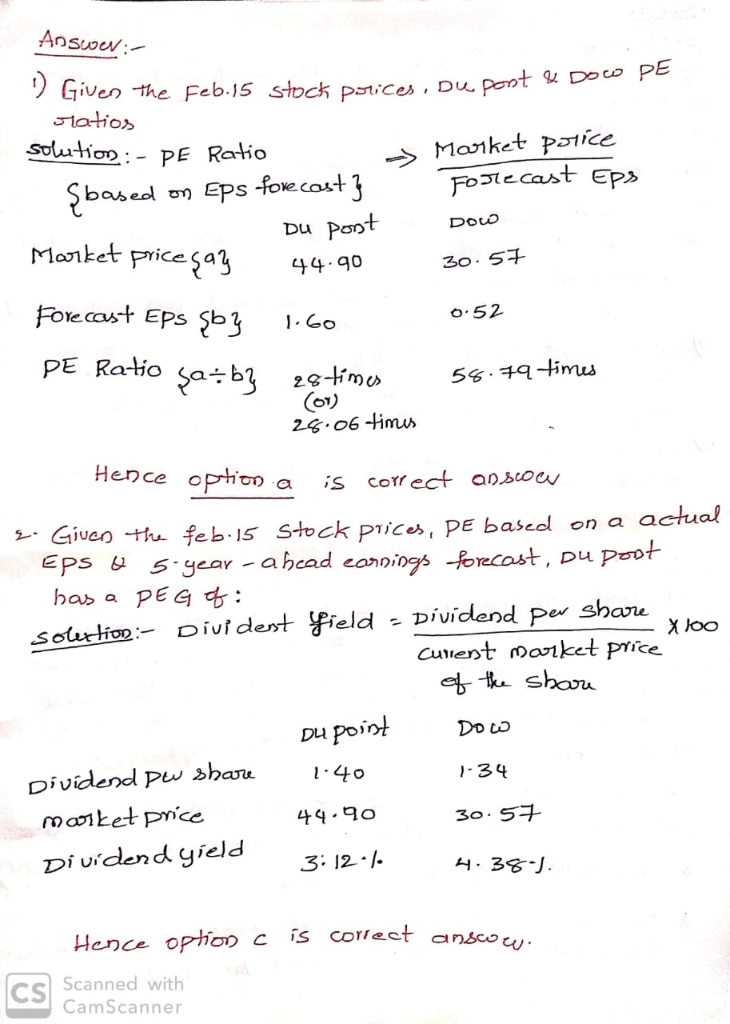
Given the Feb. 15 stock prices, Du Pont & Dow have PE ratios (based on year-ahead EPS forecast) of:
a. 28.06 & 58.79, respectively
b. 9.98 & 58.79, respectively
c. 28.06 & 66.46, respectively
d. 32.07 & 22.81, respectively
-
Following Question 31, given the Feb. 15 stock prices, Du Pont & Dow have dividend yields of:
a. 13.72% & 13.40%, respectively
b. 3.56% & 1.70%, respectively
c. 3.12% & 4.38%, respectively
d. 31.11% & 2.58%, respectively
-
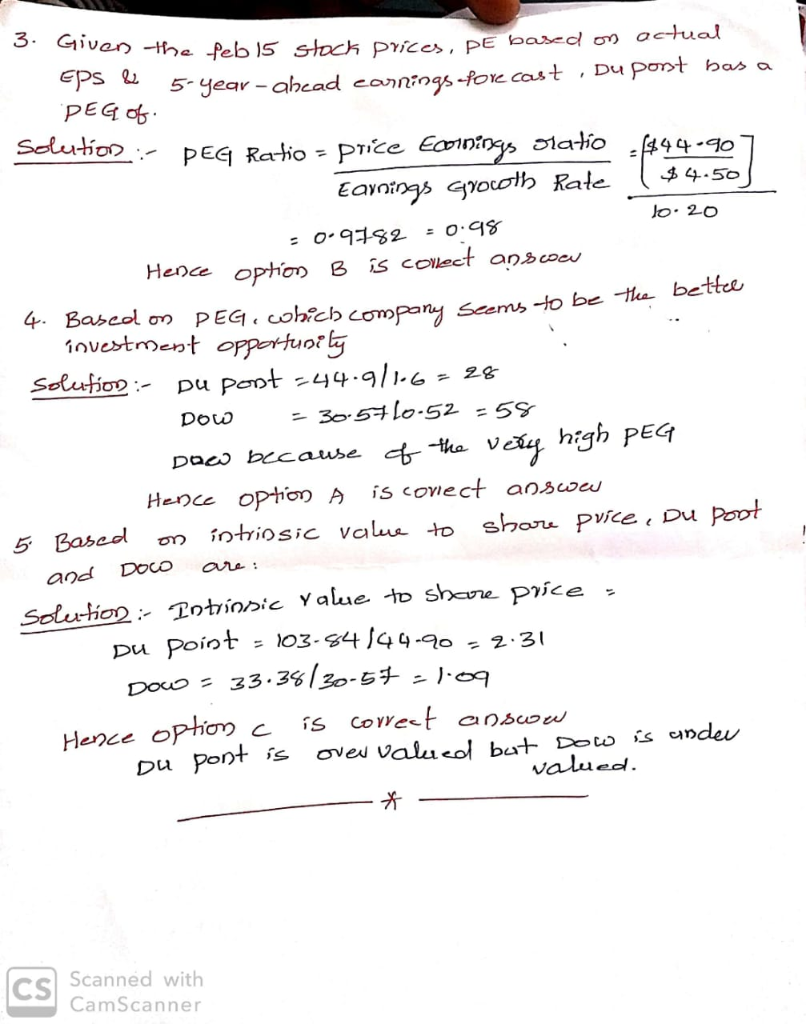
Following Question 31, given the Feb. 15 stock prices, PE based on actual EPS & 5-year-ahead earnings forecast, Du Pont has a PEG of:
a. 3.14
b. 0.98
c. 4.40
d. 2.75
-
Following Question 31, based on PEG, which company seems to be the better investment opportunity?
a. Dow because of the very high PEG
b. Du Pont because of the very high PEG
c. Dow because the PEG is less than the benchmark cutoff of 1
d. Du Pont because the PEG is less than the benchmark cutoff of 1
-
Following Question 31, based on intrinsic value to share price, Du Pont and Dow are:
a. Du Pont is undervalued but Dow is overvalued
b. Both are undervalued
c. Du Pont is overvalued but Dow is undervalued
d. Both overvalued
Solutions
 ekkarill92 answered 1 month ago
Related Solutions
You are asked to perform financial ratio analysis, including the use of Du Pont equation, to...
Using the Du Pont method, evaluate the effects of the following relationships for the Butters Corporation. ...
Using the Du Pont method, evaluate the effects of the following relationships for the Butters Corporation....
Using the Du Pont method, evaluate the effects of the following relationships for the Butters Corporation. ...
1. Use the following data concerning Grange Barley Company and the Du Pont system in problems...
Question 1 Apple has the following financial statement information for fiscal year 2001 (in millions): Income...
Selected financial information for the Bravo-Zulu Company for the fiscal year ended December 31, 2016 is...
Selected financial information for the Bravo Zulu company for the fiscal year ended December 31, 2016...
Question 1 Chaos Manufacturing had the following financial information for the year ended December 31 2018:...
The fiscal year 2015 and 2014 financial statements for AT&T's financial statements contained the following information:...
- Write program in C language using Pthreads API to simulate the real problem, the Sleeping Teaching...
- HF(g) + H2O(l) = H3O+(aq) + F-(aq) In the following equilibrium in a closed system, indicate...
- : Write a paragraph to reflect on what you have learned about Microsoft access in terms...
- Consider two markets: the market for cat food and the market for dog food. The initial...
- Why is business ethics unavoidable?
- mr. smith completed 9 years of fixed monthly payments of 3,333.28 on a 30 year loan...
- during the experiment, a student did not follow the procedure exactly as directed how will eact...