Question
In: Economics
Discuss the problems of monopoly and how to control monopoly firms with taxation. Show how a...
Discuss the problems of monopoly and how to control monopoly firms with taxation. Show how a monopolist discriminates two different markets with price(with graph)
Solutions
Expert Solution
Monopoly is a market situation where there is a single seller for a particular commodity and many buyers.
Problems of monopoly includes:
I) Monopoly charges a very high price for a good as compared to perfectly competitive firm.
II)It doesn't produce at full capacity which leads to inefficient allocation of resources.
III) It also leads to price discrimination.
To control monopoly firms with taxation there are two ways:
I) Imposition of a per unit or specific tax increases the cost of production and reduces the total output produced and the overall profit of the monopolist also reduces. Since it also increases the price so its burden falls on buyers.
II) Imposition of a lump some tax doesn't change price and output produced but it reduces profit as fixed cost is increased, so its burden falls totally on seller. So the efficient way to control a monopoly with taxation is to impose a lump some tax like licence fee or other duties.
Price discrimination is one of the most important features of a monopoly, price discrimination means charging different prices for a same good in two different markets, monopoly discriminates prices in order to gain a huge profit.
Price discrimination is possible because of the difference in
the elasticity of demand in different markets. A monopolist charges
a high price in a market where elasticity of demand is low and
charges a low price in the market where elasticity of demand is
high. This can also be seen from the graph.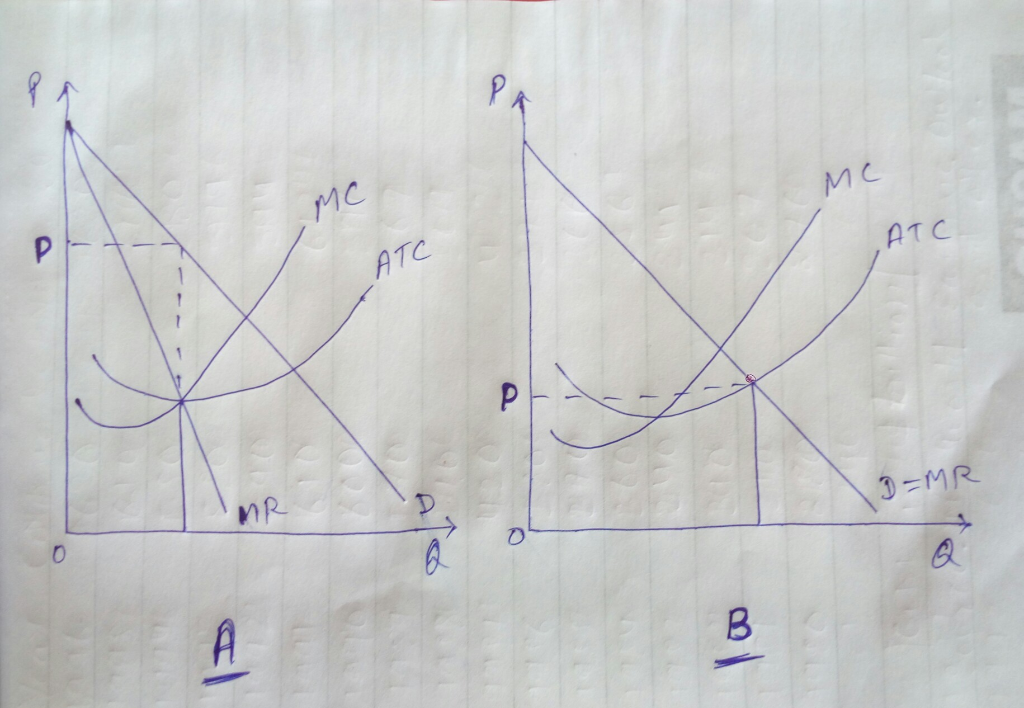 There are two markets A and B,
price elasticity of demand is high in market B, so here MR curve
equal to demand curve hence there is lower price and in market A
price elasticity is low so whatever the price there will be same
demand so the monopolist charges a high price here.
There are two markets A and B,
price elasticity of demand is high in market B, so here MR curve
equal to demand curve hence there is lower price and in market A
price elasticity is low so whatever the price there will be same
demand so the monopolist charges a high price here.
 Rahul Sunny answered 1 month ago
Related Solutions
Discuss the taxation history and problems. Explain Mankiew's point of view (in the EconTalk) on gasoline.
Discuss how the need for control over foreign operations varies with firms’ strategies and core competencies....
Take any of the firms mentioned in the Modern Monopoly discussion thread and discuss the actual...
MONOPOLY Firms clearly want to have a monopoly, or as much monopoly power as possible. (By...
1). Grouse in Russia show a recessive mutation “short-tail” that causes problems in the control of...
Grouse in Russia show a recessive mutation “short-tail” that causes problems in the control of direction...
How are the inbound and outbound taxation presented by taxation?
How does a natural monopoly differ from a standard monopoly (you should discuss the relationshipbetweencostcurves and...
How can the government regulate monopoly firms; what are the advantages and disadvantages of each governmental...
How does the ability-to-pay principle of taxation differ from the benefit principle? What problems are encountered...
- strlen(): strlen() counts the number of characters in a cstring. The algorithm works by looking at...
- give short description of each phase of the cardicac cycle where is blood going to and...
- Management Science Bank is the only bank in the small town of Sto Thomas. On a...
- What is the ultimate fate of the digested chicken and rice? What was the initial biological...
- how do corporations benefit from government regulation? *refer to Dean Baker's THE CONSERVATIVE NANNY STATE*
- ##Notice: write in HLA code . . Create an HLA Assembly language program that prompts for...
- The water used in this experiment is sparged with nitrogen to remove any dissolved oxygen. The...