Question
In: Biology
1. How do facilitated transport and active transport differ? How do they look similar? 2. How...
1. How do facilitated transport and active transport differ? How do they look similar?
2. How do simple diffusion and facilitated transport differ? How do they look similar?
3. What is the difference between diffusion and osmosis?
Solutions
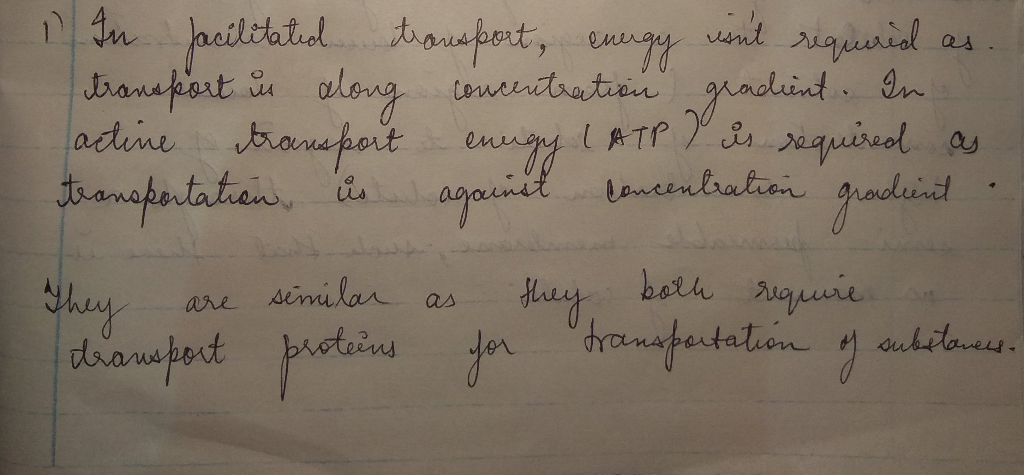
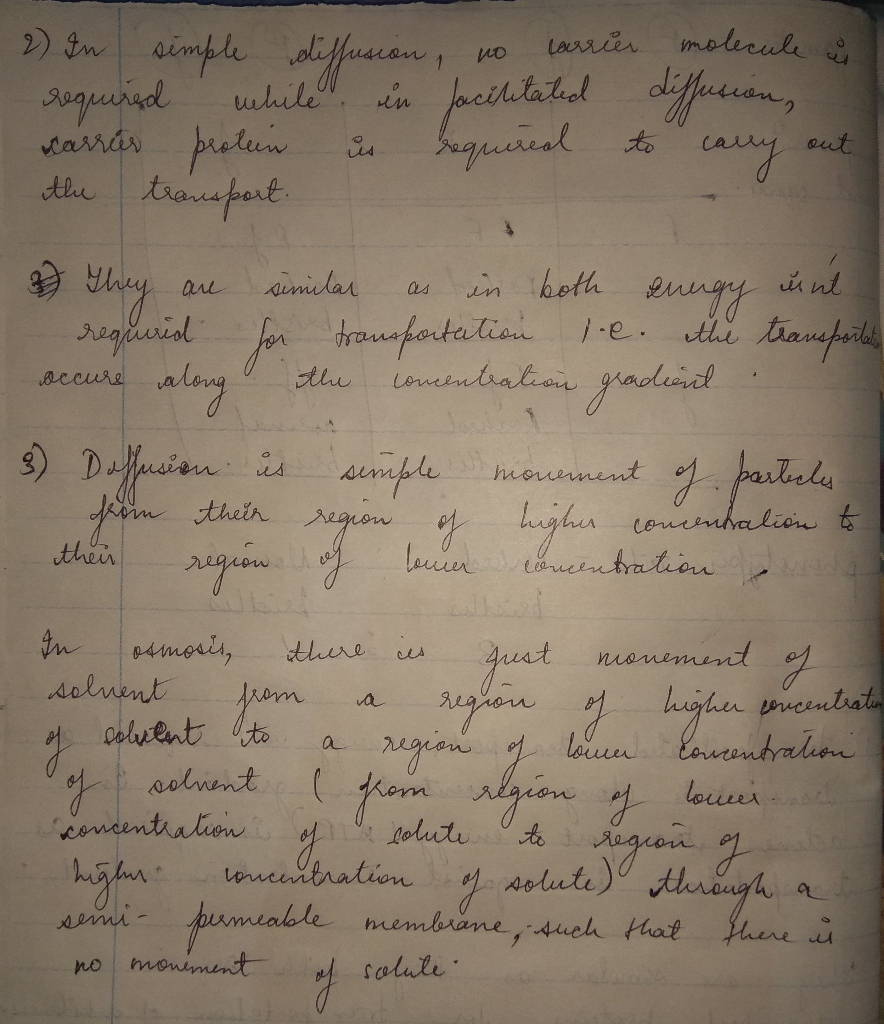
 gladiator answered 2 months ago
Related Solutions
Compare and contrast facilitated diffusion primary active transport and secondary active transport
Compare and contrast facilitated diffusion primary active transport
and secondary active transport
1: a) How is active transport different from facilitated diffusion? b) Describe the Na-K pump and...
1:
a) How is active transport different from facilitated
diffusion?
b) Describe the Na-K pump and the role of active transport
within this pump.
2. Energy requiring transport mechanisms include A. Primary active transport B. Diffusion C. Facilitated diffusion D....
2. Energy requiring transport mechanisms
include
A. Primary active transport
B. Diffusion
C. Facilitated diffusion
D. Both A and B are correct
E. Both A and C are correct
3. The fixation of nitrogen requires
_______.
A. Fe-Mo protein
B. Fe protein
C. Ferredoxin
D. Both A and B are correct
E. All of the above are correct
4. Membranes are rigid when they contain
A. Large amounts of cholesterol
B. Large amounts of unsaturated fatty acids
C. Large amounts...
Explain the different forms of membrane transport: Passive, Facilitated, Active. Describe the bulk transport mechanisms of...
Explain the different forms of membrane transport:
Passive, Facilitated, Active.
Describe the bulk transport mechanisms of Endocytosis
and Exocytosis.
What are the differences and similarities of “passive diffusion”, “facilitated diffusion” and “active transport”? What is...
What are the differences and similarities of “passive
diffusion”, “facilitated diffusion” and “active transport”?
What is endocytosis? Explain. What are the different types of
endocytosis?
What is exocytosis? Explain.
1. Which of the following processes requires energy input? a. Active Transport b. Facilitated Diffusion c....
1. Which of the following processes requires energy
input?
a. Active Transport
b. Facilitated Diffusion
c. Both Simple Diffusion and Facillitated Diffusion
d. Simple Diffusion
e. Osmosis
f. Both Active Transport and Facillitated Diffusion
2. Which of these processes require a protein in the
membrane for it to occur?
a. Both facillitated diffusion and active transport require a
protein in the membrane
b. Only active transport requires a protein in the membrane
c. Both osmosis and diffusion require a protein...
1. How do cellular Necrosis and Apoptosis differ? How are they similar? 2. Differentiate between Local...
1. How do cellular Necrosis and Apoptosis differ? How are they
similar?
2. Differentiate between Local vs. Systemic inflammatory
manifestations and give at least one example of each.
3. What are some differences between First intention and Second
intention healing patterns?
The most difficult concept of photosynthesis is arguably active transport and facilitated diffusion. Why? What is...
The most difficult concept of photosynthesis is arguably active
transport and facilitated diffusion. Why? What is a fundamental
property of the membrane that is necessary for photosynthesis to
occur?
Compare osmosis, simple diffusion, facilitated diffusion and active transport: A) describe their differences and B) explain...
Compare osmosis, simple diffusion, facilitated diffusion and
active transport: A) describe their differences and B) explain when
cells have to use each one.
How are Genzyme’s and Sanofi’s business models similar? How do they differ?
How are Genzyme’s and Sanofi’s business models similar? How do
they differ?
ADVERTISEMENT
ADVERTISEMENT
Latest Questions
- mr. smith completed 9 years of fixed monthly payments of 3,333.28 on a 30 year loan...
- during the experiment, a student did not follow the procedure exactly as directed how will eact...
- Assume all temperatures to be exact, and neglect significant figures for small changes in dimension. When...
- why is Argentina a developing country ?
- Calculate the enthalpy of the reaction 4B(s)+3O2(g)?2B2O3(s) given the following pertinent information: B2O3(s)+3H2O(g)?3O2(g)+B2H6(g), ?H?A=+2035 kJ 2B(s)+3H2(g)?B2H6(g),  
- Do you think that CAFTA will have a major impact on the U.S. economy? Why?
- Assignment 4, Fraction Comparable Instructions For this assignment, you will be updating the Fraction class from...
ADVERTISEMENT