Question
In: Math
John finds a bill on his desk. He has three options: ignore it and leave it...
John finds a bill on his desk. He has three options: ignore it
and leave it on his own desk, move the bill over to his wife Mary's
desk, or pay the bill immediately. The probability that he leaves
it on his own desk is 0.6. The probability that he moves it to
Mary's desk is 0.3. The probability that he pays the bill
immediately is 0.1.
Similarly, if Mary finds a bill on her desk she can choose to leave
it on her own desk, put it on John's desk, or pay it immediately.
The probability that it remains on her desk is 0.6. The probability
she moves it to John's desk is 0.1. The probability she pays it
immediately is 0.3.
Once a bill is paid it will not return to either of the desks. In
other words, there is a 0% chance that a bill will return to John's
desk or Mary's desk once it goes to the mailbox.
Assume this is a Markov Chain process. Set up the transition matrix
and use it to answer the following questions. (Hint: When
determining what your matrix labels should be, think of the
location of the bill, not the action done to it. For
example, the label "moves to the other desk" would
not be a valid label.)
(a) What is the probability that a bill currently on John's desk
will be paid within two days?
(b) What is the probability that a bill currently on John's desk
will be on Mary's desk 3 days later?
Solutions
Expert Solution
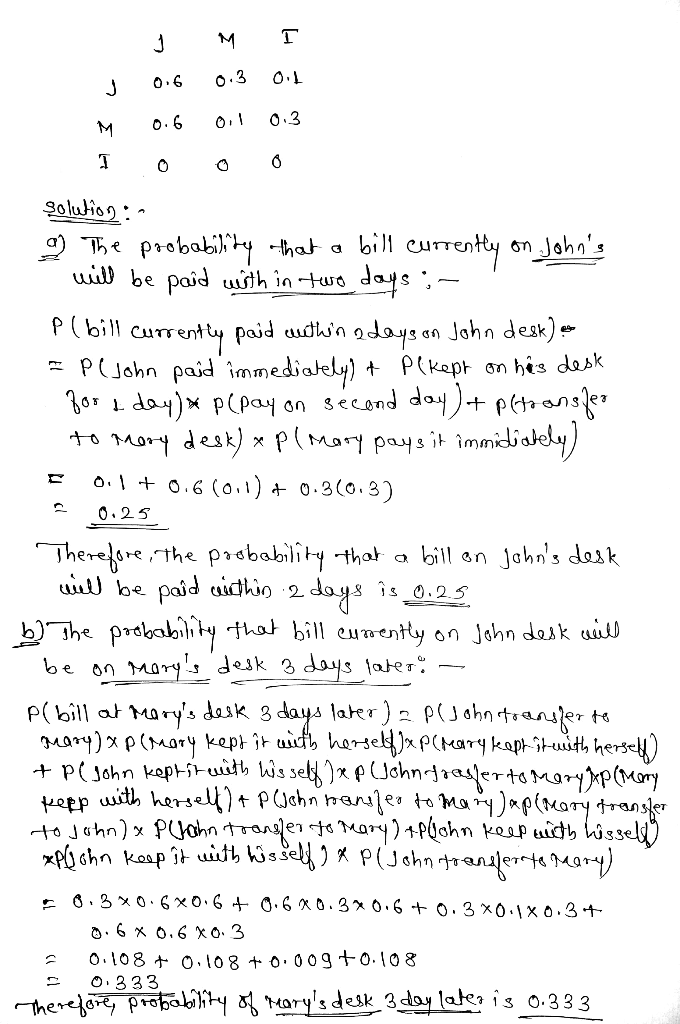
Answer: The transition Matrix will be
J represents John desk in matrix.
M represent Mary desk in matrix.
I represent immediate in matrix.
 milcah answered 2 months ago
Related Solutions
Bill has been accepted into a university and is looking into his housing options. He is...
5. Bill has come to you for genetic counseling. He is concerned that he and his...
Bill has come to you for genetic counseling. He is concerned that he and his sister (Alice)...
John has decided to organize his CD music collection. He wants to catalog his music by...
John finds the mass of his stacked coffee cups (including the stir bar) to be 12.05...
6. John has a car he wants to sell. His goal is to get as much...
Larry is a loan officer, He scanned a pile of documents from his desk for different...
Prem is a loan officer, He scanned a pile of documents from his desk for different...
John has always had problems with maintaining his weight, and he is used to counting kilocalories...
Bill sells t-shirts. He has 10 in stock and is currently cashless. His preference as given...
- A rural 6-lane divided highway with AADT = 30,000 veh/ day, with composition [(80% PC –...
- *VISUAL BASIC* Construct and instantiate an array of strings called afcSouth that contains the following information...
- LAG network inc. balance sheet and income statement are as follows: LAG network inc. income statement...
- Calculate the pH at the equivalence point in titrating 0.110 M solutions of each of the...
- why joints differ in their degree of mobility.
- How do customers typically respond to service failures? When a service failure occurs, what can firms...
- Some discarded solid chemical waste dissolves slowly in a large drain pipe in which the water...