Question
In: Computer Science
Please use Java only. Write the class TopResult, which keeps track of the best (highest numbered...
Please use Java only.
Write the class TopResult, which keeps track of the best (highest numbered or highest ordered) result it has seen so far. The class will be a generic type, so the type of results it sees depends on how it is declared.
TopResult Task:
There are a number of situations in which we want to keep track of the highest value we've seen so far - a highest score, a most recent entry, a name which is closest to the end (or the front) of a list, etc. We can imagine writing a simple class which will do this: a class which will let us enter new results one by one, and at any point will let us stop and ask for the highest value.
So far, so good, right? But what if we have a number of different applications for this sort of class - for example, we want to find the top (integer) score on a test, or the highest (decimal) temperature reading, or the GUI window which is closest to the top, etc. Subclassing isn't quite the way to go here, because a TopResult which holds Integers isn't an instance of a TopResult which holds Doubles, and vice versa. But simply writing a class for every possible type we may need may seem like overkill, since the structure of the code is essentially the same from class to class.
In situations such as these, generics come to our rescue. When we define a generic class, the data type we use is essentially represented as a wildcard - a generic type parameter, which we can call T for instance. We write the class assuming that we have a type T in mind, with the idea that we will fill in the type once we know what it is. This is how an ArrayList is implemented, for example. It is a dynamic array of some generic type T, and the exact type is decided (specialized) when we declare the ArrayList variable, for example ArrayList<String> a. If we write our entire class in terms of this unkown type parameter, we will be able to simply name the type later when we want to use it.
In this exercise, we will write the class TopResult. It will have a generic type parameter (you can call it T or something else). Type T must be a Comparable type (thus, the full generic type parameter would be <T extends Comparable<T>>).
A Comparable is an interface which is implemented by classes such as Integer, Double, Character, and String, which allow two members of the same type to be compared to one another to see which is larger. The interface has one method, compareTo, which returns a negative, zero, or positive result indicating whether the object is less than, equal to, or greater than the object it is being compared against:
> Integer three = 3, four = 4;
> three.compareTo(four)
-1
> four.compareTo(three)
1
> four.compareTo(four)
0
The TopResult task should implement the following public methods:
- TopResult, a default constructor. Initially there should be no top result since no results have been seen yet.
- newResult, which takes an object of type T, representing a new result, as a parameter, but does not return anything. This method will check whether the new result is better than the current top result, and if so, replace it, otherwise it will ignore it. If there is currently no top result (because no results had been seen yet), then the current result automatically becomes the top result.
- getTopResult, which does not take any parameters but returns the current top result. If there is currently no top result (because no results have been seen yet), then this method should return null.
- toString, which will return the toString value of the current top result, or a null if there have been no results yet.
The following shows an example use of this class:
> TopResult<Integer> tr = new
TopResult<Integer>();
> tr.getTopResult() // no results seen yet, should be null
null
> tr.newResult(7);
> tr.getTopResult()
7
> tr.newResult(3);
> tr.getTopResult()
7
> tr.newResult(4);
> tr.getTopResult()
7
> tr.newResult(9);
> tr.getTopResult()
9
> tr.newResult(20);
> tr.getTopResult()
20
> tr.toString() // this will print the toString() of the current
top result
"20"
Please make sure that it passes the following: https://repl.it/@micky123/SweetEmotionalExtraction
Please be sure that the work is your own, not a duplicate of somebody else's. Thank you.
Solutions
Expert Solution
// TopResult.java
public class TopResult<T extends Comparable<T>> {
private T result;
public TopResult()
{
result = null;
}
public void newResult(T new_result)
{
if(result == null || new_result.compareTo(result) > 0)
result = new_result;
}
public T getTopResult()
{
return result;
}
public String toString()
{
return result.toString();
}
public static void main(String[] args) {
TopResult<Integer> tr = new TopResult<Integer>();
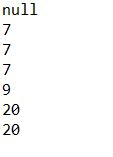
System.out.println(tr.getTopResult()); // null
tr.newResult(7);
System.out.println(tr.getTopResult()); // 7
tr.newResult(3);
System.out.println(tr.getTopResult()); // 7
tr.newResult(4);
System.out.println(tr.getTopResult()); // 7
tr.newResult(9);
System.out.println(tr.getTopResult()); // 9
tr.newResult(20);
System.out.println(tr.getTopResult()); //20
System.out.println(tr.toString()); // 20
}
}
//end of TopResult.java
Output:
 venereology answered 6 months ago
Related Solutions
Using Python 3, Write a class called GolfScore that keeps track of the score for a...
Write C++ a program that shows a class called gamma that keeps track of how many...
Write a program in java that does the following: Create a StudentRecord class that keeps the...
(USE C ++ AND class STRING ONLY!!!! No java, No cstring and No vector) Write a...
write a java program to evaluate the highest number input by user, cannot use math class,...
Write a Java program that implements a song database. The SongsDatabase class keeps tracks of song...
The following class keeps track of how many flavors are at an ice-cream place, and the...
Write a C++ program for Euclids Algorithm that keeps track of the number of iterations (%...
JAVA PLEASE Creating Classes Create a class that will keep track of a yes/no survey. You...
/////////////////JAVA PLEASE///////////////////////////////// Create a class called GVdate to keep track of a calendar date including month,...
- Two 10-cm-diameter charged rings face each other, 15cm apart. The left ring is charged to -29nC...
- Under what conditions would it be possible for an excise tax to have no efficiency cost...
- explain the difference between activities and financial statements of service businesses and merchandising businesses.
- 2. Compare and compare the matrix multiplication algorithm and the Floyd-Warshall algorithm to find all pairs...
- Q: 50.00 ml of 0.5216 M copper(II) nitrate solution is combined with 100.0 ml of 0.5580...
- This is a business law question. Explain how environmental laws regulate the use of toxic substances...
- A sky diver and her parachute system weigh a total of 800 N. She is falling...