Questions
Explain in detail some unique developmental aspects of the human brain. Give an example, important to...
Explain in detail some unique developmental aspects of the human brain. Give an example, important to human brain development when, “the loss of an inhibitor is equivalent to the gain of an activator.” This is a common theme in developmental biology.
In: Biology
How does culture affect the human life cycle? Choose one or more life stage (prenatal, infancy,...
How does culture affect the human life cycle? Choose one or more life stage (prenatal, infancy, childhood, adolescence, or adulthood), and give examples of culture’s impact on human life history.
In: Biology
Human resource management responses to global strategy in multinational enterprises by Peter Kidger. In 3-5 pages...
Human resource management responses to global strategy in multinational enterprises by Peter Kidger. In 3-5 pages analyze this article, identifying the key points and explain why they are significant to Human Resources Management
In: Operations Management
1. What happens to the human being when his/her temperature drops below 36 and 2. What...
1. What happens to the human being when his/her temperature drops below 36 and
2. What happens to them when their temperature goes above 49.
3. What changes happen to the human body especially when the body temperature drops much lower than 34 and much higher than 42 degrees Celsius? (Remember here we are
discussing the internal temperature of the human body and its effect on their being).
In: Biology
How do you address this situation with the professional who explained the situation?
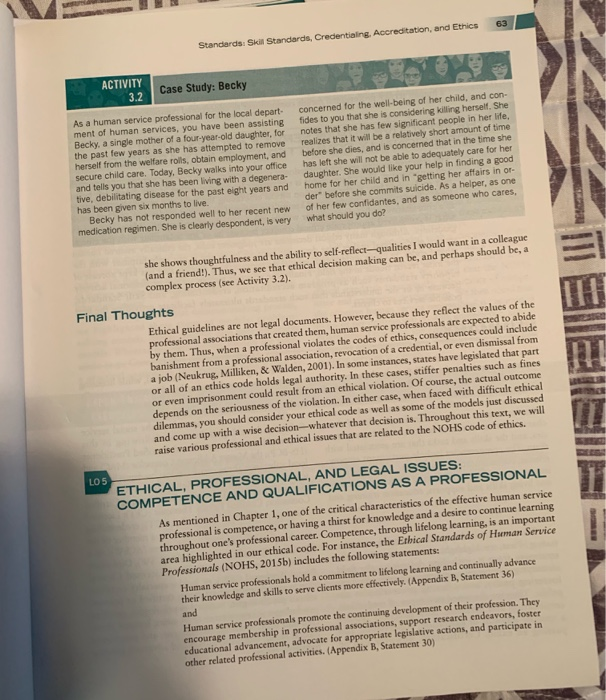
Read the Case Study of "Becky" on page 63 of your textbook: Theories, Practice, and Trends in Human Services Practice. Based upon the human services code of ethics, you are the supervisor of the human services professional who Becky confided in. How do you address this situation with the professional who explained the situation? In your answer, which model discussed in this lecture would be more appropriate and effective to use in this situation? State your reasons why.
In: Psychology
Identify and describe the various social and cultural factors of diversity that affect an individual’s institutional...
- Identify and describe the various social and cultural factors of diversity that affect an individual’s institutional prejudice and discrimination.
- Define cultural competence and evaluate the importance to administering quality human and social service care.
- Identify areas of potential conflict between human and social service providers and a patient's cultural beliefs and values.
- Assess the role of one's own personal social and cultural identity in relation to others of similar and different backgrounds in the delivery of human services.
In: Nursing
Find data for a given year on income per capita and income inequality for the following...
Find data for a given year on income per capita and income inequality for the following three groups of countries; (a) high human development, (b) medium human development and (c) low human development. Include about 8-10 countries in each group. Plot the data on the relationship between income per capita and inequality for each group. Is there any evidence of a Kuznets relationship? Explain. Please make sure to upload your graph
In: Economics
A 71-year-old ex-construction worker is admitted to a long-term care facility in his hometown. His wife...
A 71-year-old ex-construction worker is admitted to a
long-term care facility in his hometown. His wife and children are
no longer able to provide him care at home since he suffered a
brain attack (stroke). He has residual left-sided weakness and
dementia. He is unable to walk unassisted and gets confused at
times.
Based on Maslow’s hierarchy of human needs, how will
each of his basic human needs is met in the long-term care
facility?
Which of Maslow’s basic human needs takes priority on
admission and why?
How can the nursing staff include meeting Maslow’s
human needs when providing ongoing care to this patient
In: Nursing
21.In relation to the parts of the human resources management process, labor relations would fall under...
21.In relation to the parts of the human resources management process, labor relations would fall under __________.
a.human resources planning
b.attracting employees
c.developing employees
d.retaining employees
22.In relation to the parts of the human resources management process, job analysis would fall under __________.
a.human resources planning
b.attracting employees
c.developing employees
d.retaining employees
23.In relation to the parts of the human resources management process, orientation would fall under __________.
a.human resources planning
b.attracting employees
c.developing employees
d.retaining employees
24.In relation to the parts of the human resources management process, performance appraisal would fall under __________.
a.human resources planning
b.attracting employees
c.developing employees
d.retaining employees
In: Operations Management
Read the following paragraph: “The human genome sequence provides the underlying code for human biology. Despite...
- Read the following paragraph:
“The human genome sequence provides the underlying code for human biology. Despite intensive study, especially in identifying protein-coding genes, our understanding of the genome is far from complete, particularly with regard to non-coding RNAs, alternatively spliced transcripts and regulatory sequences. Systematic analyses of transcripts and regulatory information are essential for the identification of genes and regulatory regions and are an important resource for the study of human biology and disease. Such analyses can also provide comprehensive views of the organization and variability of genes and regulatory information across cellular contexts, species and individuals. The Encyclopedia of DNA Elements (ENCODE) project aims to delineate all functional elements encoded in the human genome. Operationally, we define a functional element as a discrete genome segment that encodes a defined product (for example, protein or non-coding RNA) or displays a reproducible biochemical signature (for example, protein binding, or a specific chromatin structure).” ENCODE Project Consortium (2012) An integrated encyclopedia of DNA elements in the human genome Nature 489:57074.
Consider the ENCODE definition of gene. What did you learn regarding the diversity of human physiognomy and physiology (both “normal” and pathologies) based on the genetic composition and gene expression in humans?
In: Biology