Questions
8) Write the quantity equation for money. What does V stand for? What assumption do monetarists...
8) Write the quantity equation for money. What does V stand for? What assumption do monetarists make about it? What is the resulting recommendation for monetary policy.
In: Economics
A 3500-pF air-gap capacitor is connected to a 25-V battery. If a piece of mica is...
A 3500-pF air-gap capacitor is connected to a 25-V battery. If a piece of mica is placed between the plates, how much charge will flow from the battery?
In: Physics
An inductor is connected to a 17 kHz oscillator that produces an rms voltage of 7.0...
An inductor is connected to a 17 kHz oscillator that produces an rms voltage of 7.0 V . The peak current is 70 mA .What is the value of the inductance L? answer in mH.
In: Physics
Perform the following arithmetic in Binary assuming 16 bit registers (67)10 + (-89)10 List the values...
Perform the following arithmetic in Binary assuming 16 bit registers
(67)10 + (-89)10
List the values of the status bits: C, V, N and Z
In: Computer Science
A voltaic cell consists of an Mn/Mn2+ half-cell and a Pb/Pb2+ half-cell. Calculate [Pb2+] when [Mn2+]...
A voltaic cell consists of an Mn/Mn2+ half-cell and a Pb/Pb2+ half-cell. Calculate [Pb2+] when [Mn2+] is 2.7 M and Ecell = 0.35 V.
In: Chemistry
You must use C Language. End Goal: HATFIELD, HEIDI KAISER, RUSSELL LIPSHUTZ, HOWARD PENKERT, DAWN WRIGHT,...
You must use C Language.
End Goal:
HATFIELD, HEIDI
KAISER, RUSSELL
LIPSHUTZ, HOWARD
PENKERT, DAWN
WRIGHT, ELIZABETH
The user inputs the students first name and last names separately but within one loop. The loop should end when the user presses enter on the first name without entering any text. Upon completing entry of data, the output pictured above should display on the output.
Using the code given, follow the steps:
1. You should be able to enter up to 20 student first names. Also, change the input array to an appropriate size of 18 for the length of the first name. Use a meaningful name for the storage of first names array. Change prompts as needed. The loop should exit when the user presses enter when inputing the first name without adding any text. Compile and make sure it works from main(). At this point, you should be able to enter and alphabetize a list of up to 20 first names! Alphabetizing the first name is just a test!!! In the end, you will alphabetize the whole name string.
2. Add another array and get input for last name INSIDE the loop for your first names. This last name array will also be an array of 20 elements but with room for up to 25 characters. Again, do not use another loop! Just add code to input the last name to the first loop. The program should now ask the user to input the student's first name and then last name in that order for each individual. Then the program will loop to continue adding student names until the user presses enter on the student's first name. Make sure the last name is converted to all caps. You do not need to alphabetize this array, but you may want to print it out to make sure everything is working just as a test.
3. Make changes to convert the first name to all upper case using a function. (Example: User enters bob on the first name, then on the last name enters jenkins, it will look like Bob Jenkins instead of bob jenkins)
Last step: Combine last and first into an third array. This code is most easily added to the first loop. You just had the user enter first and last names. So the current value of the subscript used for these arrays can be used to combine content and store in the third array. Alphabetize THIS array (instead of the first name array) which means you need to send a different pointer to the stsrt() function. Print out the end result. Test that everything is working on this program.
Given Code:
void rollsheet(void) {
int ct = 0;
char *ptstr[LIMIT];
char input[LIMIT][SIZE];
int k;
printf("Enter up to %d student names, and I will sort them!\n",
LIMIT);
printf("To stop, press the Enter key at a line's start.\n");
while (ct < LIMIT && s_gets(input[ct], SIZE) !=
NULL
&& input[ct][0] != '\0')
{
ptstr[ct] = input[ct]; /* set ptrs to strings */
ct++;
}
stsrt(ptstr,ct);
puts("\nHere's the sorted list:\n");
for (k = 0; k < ct; k++)
puts(ptstr[k]) ; /* sorted pointers */
}
void stsrt(char *strings[], int num)
{
char *temp;
int top, seek;
for (top = 0; top < num-1; top++)
for (seek = top + 1; seek < num; seek++)
if (strcmp(strings[top],strings[seek]) > 0)
{
temp = strings[top];
strings[top] = strings[seek];
strings[seek] = temp;
}
}
char * s_gets(char * st, int n)
{
char * ret_val;
int i = 0;
ret_val = fgets(st, n, stdin);
if (ret_val)
{
while (st[i] != '\n' && st[i] != '\0')
i++;
if (st[i] == '\n')
st[i] = '\0';
else // must have words[i] == '\0'
while (getchar() != '\n')
continue;
}
return ret_val;
}
In: Computer Science
Consider the circuit shown in (Figure 1) . Suppose that E = 15 V
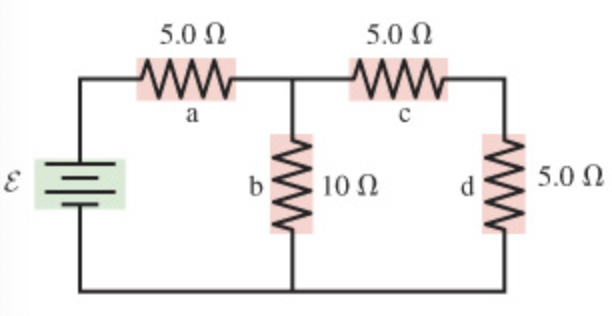
Consider the circuit shown in (Figure 1). Suppose that E = 15 V . include units with answers.
Part A: Find the current through the resistor a.
Part B: Find the potential difference across the resistor a. answer: 7.5 V
Part C: Find the current through the resistor b.
Part D: Find the potential difference across the resistor b.
Part E: Find the current through the resistor c.
Part F: Find the potential difference across the resistor c.
Part G: Find the current through the resistor d.
Part H: Find the potential difference across the resistor d.
In: Physics
Consider the circuit shown in (Figure 1) . Suppose that E = 15 V . include...
Consider the circuit shown in (Figure 1) . Suppose that E = 15 V . include units with answers.
Part A: Find the current through the resistor a.
Part B: Find the potential difference across the resistor a. answer: 7.5 V
Part C: Find the current through the resistor b.
Part D: Find the potential difference across the resistor b.
Part E: Find the current through the resistor c.
Part F: Find the potential difference across the resistor c.
Part G: Find the current through the resistor d.
Part H: Find the potential difference across the resistor d.

In: Physics
A doll sold for ?$215 in 1975 and was sold again in 1989 for $488. Assume...
A doll sold for ?$215 in 1975 and was sold again in 1989 for $488. Assume that the growth in the value V of the? collector's item was exponential.
?a) Find the value k of the exponential growth rate. Assume Vo=215.
?(Round to the nearest? thousandth.)
?b) Find the exponential growth function in terms of? t, where t is the number of years since 1975
?V(t)=
?c) Estimate the value of the doll in 2015.
?(Round to the nearest? dollar.)
?d) What is the doubling time for the value of the doll to the nearest tenth of a? year?
?(Round to the nearest? tenth.)
?e) Find the amount of time after which the value of the doll will be ?$3037
?(Round to the nearest? tenth.)
In: Math
14f) Fill in the blanks with the best possible answer listed One way countries try to...
14f) Fill in the blanks with the best possible answer listed
One way countries try to get out of debt is to Monetize their Debt. This Involves Increasing_________(Q, M, V, P) which Increases_________(Q, M, V, P). This effectively transfers wealth from the Citizens to the Government and also from_________(Debtors, Lenders) to_________(Debtors, Lenders).
In the long-term this hurts GDP growth as it decreases trust in the Government________(True, False). If you have a home loan or a car loan should you repay the loan quickly if you think Inflation is coming?___________(Yes, No). (Assuming you have no job concerns)
In: Economics