Questions
For each situation described below, identify the population and the sample, explain what p and p...
For each situation described below, identify the population and the sample, explain what p and p with modifying above represent, and tell whether it is appropriate to create a one-proportion z-interval. Complete parts a through d below.
a) Police set up an auto checkpoint at which drivers are stopped and their cars inspected for safety problems. They find that 25 of the 139
cars stopped have at least one safety violation. They want to estimate the percentage of all cars that may be unsafe.
Identify the population. Choose the correct answer below.
A. The passengers of those cars actually stopped at the checkpoint
B. All cars
C. All car passengers
D. Those cars actually stopped at the checkpoint
Identify the sample. Choose the correct answer below.
A. Those cars actually stopped at the checkpoint
B. All cars
C. All car passengers
D. The passengers of those cars actually stopped at the checkpoint
What does p represent?
A. The proportion of all cars with safety problems
B. The proportion of cars actually seen with safety problems
C. The sample size
D.The standard deviation of the proportion of cars actually seen with safety problems
What does p with modifying above represent?
A. The sample size
B. The standard deviation of the proportion of cars actually seen with safety problems
C. The proportion of cars actually seen with safety problems
D. The proportion of all cars with safety problems
Is it appropriate to create a one-proportion z-interval?
A. It is not appropriate because the sample is a simple random sample.
B. It is not appropriate because the sample is less than 10% of the population.
C. If the sample left parenthesis a cluster sample right parenthesis is representative comma then it is appropriate to create aIf the sample (a cluster sample) is representative, then it is appropriate to create a one dash proportion z dash interval.one-proportion z-interval.
D. It is appropriate because the sample is less than 10% of the population.
b) An online blog puts a poll on its website asking readers to rate the quality of its articles. Of the 568 people who voted, 395 rated the articles very highly. The blog is interested in gauging its users' satisfaction.
Identify the population. Choose the correct answer below.
A. Those who voted in the poll
B. All U.S. voters
C. Internet users
D. The blog's readers
Identify the sample. Choose the correct answer below.
A. Internet users
B. The blog's readers
C. All U.S. voters
D. Those who voted in the poll
What does p represent?
A. The proportion of people who use the internet
B. The proportion of those who voted in the poll who rated the articles very highly
C. The proportion of all the blog's readers who rate its articles very highly
D. The probability of a "failure"
What does p with modifying above represent?
A. The proportion of people who use the internet
B. The proportion of those who voted in the poll who rated the articles very highly
C. The probability of a "failure"
D. The proportion of all the blog's readers who rate its articles very highly
Is it appropriate to create a one-proportion z-interval?
A. If the sample (cluster sample) is representative, then it is appropriate to create a one-proportion z-interval.
B. It is appropriate because the sample is less than 10% of the population.
C. It is not appropriate because the sample is biased and nonrandom.
D. It is not appropriate because there not at least 10 "successes" and 10 "failures."
c) A school is considering requiring students to wear uniforms. The PTA surveys parent opinion by sending a questionnaire home with 1118 students. 485 surveys are returned, with 104 in favor of the change.
Identify the population. Choose the correct answer below.
A. The 1118 people who received questionnaires.
B. The U.S. population
C. The parents of students at the school
D. Those who returned the questionnaire
Identify the sample. Choose the correct answer below.
A. The U.S. population
B. The 1118 people who received questionnaires
C. The parents of students at the school
D. Those who returned the questionnaire
What does p represent?
A. The proportion of all parents who favor uniforms
B. The proportion of questionnaires returned
C. The proportion of parents of students at the school who favor the change
D. The proportion of respondents who favor uniforms
What does p with modifying above represent?
A. The proportion of respondents who favor uniforms
B. The proportion of all parents who favor uniforms
C. The proportion of parents of students at the school who favor the change
D. The proportion of questionnaires returned.
Is it appropriate to create a one-proportion z-interval?
A. If the sample (simple random sample) is representative, then it is appropriate to create a one-proportion z-interval.
B. It is not appropriate because there not at least 10 "successes" and 10 "failures."
C. It is not appropriate because the respondents' answers are independent.
D. It is not appropriate because this is not a simple random sample and there is a possible nonresponse bias.
d) A college admits 1743 freshmen one year, and four years later, 1502 of them graduate on time. The college wants to estimate the percentage of all their freshman enrollees who graduate on time.
Identify the population. Choose the correct answer below.
A. The 1502 students who graduated on time
B. Students at the college
C. All college students
D. The 1743 students who entered that year
Identify the sample. Choose the correct answer below.
A. The 1743 students who entered that year
B. The 1502 students who graduated on time
C. All college students
D. Students at the college
What does p represent?
A. The proportion of all students at the college who will not graduate on time
B. The proportion of students at the college who are freshmen
C. The proportion of all students at the college who will graduate on time
D. The proportion of that year's students who will graduate on time
What does p with modifying above represent?
A. The proportion of students at the college who are freshmen
B. The proportion of that year's students who will graduate on time
C. The proportion of all students at the college who will not graduate on time
D. The proportion of all students at the college who will graduate on time
Is it appropriate to create a one-proportion z-interval?
A. It is not appropriate because the sample is a simple random sample.
B. It is not appropriate because this is not a simple random sample and there is a possible nonresponse bias.
C. It is not appropriate because whether a student graduates on time is independent of whether another student graduates on time.
D. If that year's students (a cluster sample) are viewed as a representative sample of all possible students at the school, then it is appropriate to create a one-proportion z-interval.
In: Statistics and Probability
Water flows steadily from an open tank as shown in the figure
Water Flowing from a Tank
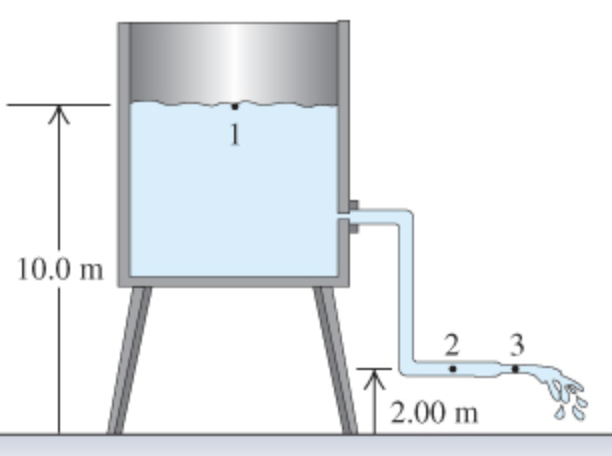
Water flows steadily from an open tank as shown in the figure. (Figure 1) The elevation of point 1 is \(10.0 \mathrm{~m},\) anc the elevation of points 2 and 3 is \(2.00 \mathrm{~m}\). The crosssectional area at point 2 is \(4.80 \times 10^{-2} \mathrm{~m}^{2} ;\) at point 3 where the water is discharged, it is \(1.60 \times 10^{-2} \mathrm{~m}^{2}\). The cross-sectional area of the tank is very large compared with the cross-sectional area of the pipe.
Part A
Assuming that Bernoulli's equation applies, compute the volume of water \(\Delta V\) that flows across the exit of the pipe in \(1.00 \mathrm{~s}\). In other words, find the discharge rate \(\Delta V / \Delta t\).
Express your answer numerically in cubic meters per second.
\(\frac{\Delta V}{\Delta t}= \mathrm{~m}^{3} / \mathrm{s}\)
In: Physics
A toboggan with two people on it weighs 300 lb. It starts from rest down a...
A toboggan with two people on it weighs 300 lb. It starts from rest down a slope, 1/4 mile long, from a height 200 ft above horizontal level. The coefficient of sliding friction is 3/100 and the force of the wind resistance is proportional to the square of the velocity. When the velocity is 30 ft/sec, this force is 6 lb.
(a) Find the velocity of the toboggan as a function of the distance and of the time.
(b) With what velocity will the toboggan reach the bottom of the slide?
(c) When will it reach the bottom?
(d) What would its terminal velocity be if the slide were infinite in length?
Answers:
(a) v= 74.1 (e^(0,105t)-1)/(e^(0.105t)+1), v^2=5484(1-e^(-0.0014s)
(b) 68 ft/sec
(c) 30 sec, approx.
(d) 74.1 ft/sec
I'm having trouble solving for v originally. Any help would be much appreciated.
In: Advanced Math
A voltaic cell consists of a Pb/Pb2+ half-cell and a Cu/Cu2+ half-cell at 25 ∘C. The...
A voltaic cell consists of a Pb/Pb2+ half-cell and a Cu/Cu2+ half-cell at 25 ∘C. The initial concentrations of Pb2+ and Cu2+ are 5.30×10⁻² M and 1.60 M , respectively.
Part A
What is the initial cell potential? Express your answer using two significant figures.
Ecell= ? V
Part B
What is the cell potential when the concentration of Cu2+ has fallen to 0.230 M ?
Express your answer using two significant figures.
Part B
What is the cell potential when the concentration of Cu2+ has fallen to 0.230 M ? Express your answer using two significant figures.
Ecell=? V
Part C
What are the concentrations of Pb2+ and Cu2+ when the cell potential falls to 0.360 V ? Enter your answers numerically separated by a comma. Express your answer using two significant figures.
[Pb2+],[Cu2+]= ? M
In: Chemistry
Cirrhosis Case Study Mr. V. is a 55-year-old alcoholic who checked into a clinic, complaining he...
Cirrhosis Case Study Mr. V. is a 55-year-old alcoholic who checked into a clinic, complaining he has been experiencing a persistent cough and has been feeling more fatigued, nauseous, and irritable. In addition, he is experiencing more frequent memory lapses. His abdomen is distended, but on palpation, his liver is small in size and firm, indicating cirrhosis. Lab tests indicate a decrease in hemoglobin, albumin, and prothrombin levels with elevated serum bilirubin and ammonia levels
. Case Study Questions
1. Differentiate the various stages that Mr. V.’s liver has progressed through and the implications of the current stage.
2. Examine specific rationale for each of Mr. V.’s manifestations and blood values.
3. Appraise whether it is possible to reverse the damage to the liver at this stage. What is Mr. V's prognosis?
4. Evaluate significant complications that are likely to occur, include a discussion on predisposing factors and effects on the liver.
In: Nursing
In this exercise, we will investigate the chemical potential μμ upon a change in volume. We...
In this exercise, we will investigate the chemical potential μμ upon a change in volume. We will use the fact that F=U−TSF=U−TS and μ=∂F/∂N. We will compute μ(Vf)−μ(Vi)μ(Vf)−μ(Vi)
In all questions, take N=20 moles (which is 20 times Avagodro's number of particles), T=300 K, Vi=0.01 m3,Vf=0.02 m3
1) For a gas with an excluded volume:
- U=3/2NkT+const
- S=Nkln(V−bN)+const
If bb=10-28 m3, compute μ(Vf)−μ(Vi)
2.) For a gas with an excluded volume and attraction between the particles:
- U=3/2NkT−aN^2/V+const
- S=Nkln(V−bN)+const
If aa=10-49 m3 and bb=10-28 m3, compute μ(Vf)−μ(Vi)
In: Physics
Two capacitors, C1 and C2, are connected in series and a battery, providing a voltage V,...
Two capacitors, C1 and C2, are connected in series and a battery, providing a voltage V, is connected across the two capacitors. (a) Find the equivalent capacitance, the energy stored in this equivalent capacitance, and the energy stored in each capacitor. (b) Show that the sum of the energy stored in each capacitor is the same as the energy stored in the equivalent capacitor. Will this equality always be true, or does it depend on the number of capacitors and their capacitances? (c) If the same two capacitors were connected in parallel, what potential difference would be required across them so that the combination stores the same energy as in the system of part (a)? Express everything in terms of the given quantities, C1, C2, and V. (d) If C1 =18μF,C2 = 36μF,V =12V, evaluate the equivalent capacitance and energy stored in the serial case of part (a), the equivalent capacitance and voltage of the parallel circuit of part (c). (e) In both cases, which capacitor stores more energy, C1 or C2?
In: Physics
1) Use cylindrical shells to find the volume of the solid obtained by rotating the region...
1) Use cylindrical shells to find the volume of the solid
obtained by rotating the region bounded by y=x^2, y=0, and x=5,
about the y-axis.
V=
2) Use cylindrical shells to find the volume of the solid
obtained by rotating the region bounded by y=x^2, y=0, and x=6,
about the yy-axis.
V=
3)The region bounded by f(x)=−3x^2+15x+18f(x)=-3x2+15x+18,
x=0x=0, and y=0y=0 is rotated about the y-axis. Find the
volume of the solid of revolution.
Find the exact value; write answer without decimals.
4) Use cylindrical shells to find the volume of the solid
obtained by rotating the region bounded on the right by the graph
of g(y)=4/y and on the left by the y-axis for 1≤y≤11, about the
x-axis. Round your answer to the nearest hundredth position.
V=
In: Math
(i) Rank the following five capacitors from greatest to smallest capacitance, noting any cases of equality....
(i) Rank the following five capacitors from greatest to smallest capacitance, noting any cases of equality. (Use only ">" or "=" symbols. Do not include any parentheses around the letters or symbols.)
(a) a 20-µF capacitor with a 4-V potential difference between
its plates
(b) a 30-µF capacitor with charges of magnitude 90 µC on each
plate
(c) a capacitor with charges of magnitude 80 µC on its plates,
differing by 2 V in potential
(d) a 10-µF capacitor storing energy 125 µJ
(e) a capacitor storing energy 250 µJ with a 10-V potential
difference
(ii) Rank the same capacitors in part (i) from largest to smallest
according to the potential difference between the plates.
(iii) Rank the capacitors in part (i) in the order of the
magnitudes of the charges on their plates.
(iv) Rank the capacitors in part (i) in the order of the energy
they store.
Please explain how you got your answer.
In: Physics
Question2. Let A = [2 1 1 1 2 1 1 1 2 ]. (a) Find...
Question2.
Let A = [2 1 1
1 2 1
1 1 2 ].
(a) Find the characteristic polynomial PA(λ) of A and the eigenvalues of A. For convenience, as usual, enumerate the eigenvalues in decreasing order λ1 ≥ λ2 ≥ λ3.
(b) For each eigenvalue λ of A find a basis of the corresponding eigenspace V (λ). Determine (with a motivation) whether V (λ) is a line or a plane through the origin. If some of the spaces V (λ) is a plane find an equation of this plane.
(c) Find a basis of R 3 consisting of eigenvectors if such basis exist. (Explain why or why not). Is the matrix A diagonalizable? If ”yes”, then write down a diagonalizing matrix P, and a diagonal matrix Λ such that A = PΛP −1 , P −1AP = Λ. Explain why the matrix P is invertible but do not compute P −1 .
(d) Consider the eigenvalues λ1 > λ3. Is it true that the orthogonal complements of the eigenspaces satisfy (Vλ1 ) ⊥ = Vλ3 , (Vλ3 ) ⊥ = Vλ1 ? Why or why not??
In: Advanced Math