Questions
3. Profit maximization and loss minimization BYOB is a monopolist in beer production and distribu...


In: Economics

Why do you think there is oftentimes a mismatch between dynamic cities and dynamic economies? I...

Why do you think there is oftentimes a mismatch between dynamic cities and dynamic economies?

I have a lot of family that lives in the Dallas-Fort Worth Area. No offense to the good people of North Texas, but DFW is not exactly the most livable place in America. The summers there are very hot and humid and the winters are cold and rainy but without snow. It's spread out, hard to navigate, and poor public transport. Houston, San Antonio, and Austin are all more culturally vibrant cities within the state of Texas. Sports in that city consist of talking so much about the 90s Cowboys that you wouldn't know they had four other sports teams that are fairly successful. There's some fun things to do, Six Flags and the Texas State Fair are a good time, but ask yourself, when you think of iconic American cities, does Dallas ever come to mind.

Despite this, DFW is one of the richest cities on earth. They have more millionaires than New York and have been one of the biggest hubs of innovation, finance, petroleum, transportation, and several other industries not just in the US, but worldwide for the past 40 years.

As mentioned in Chapter Six of New Geography of Jobs, there's oftentimes a mismatch between cities that are live-able and culturally vibrant, and those that become major hubs of innovation. Moretti sights Berlin as one of Europe's most interesting cities, but also as one with few jobs and high unemployment. Here in the US, cities such as Albuquerque, New Orleans, and Baltimore are far more interesting than Dallas, but struggle economically.

Why does this occur? Shouldn't firm be more interested in locating in more interesting places that workers would be attracted to, or are the dynamics of labor geography simply too multi varied and unpredictable to explain why Dallas is an economic hub and New Orleans is not.

In: Economics

BYOB is a monopolist in beer production and distribution in the imaginary economy of Hopsville. Suppose that BYOB cannot price discriminate; that is, it sells its beer at the same price per can to all customers.

 4. Profit maximization and loss minimization

 BYOB is a monopolist in beer production and distribution in the imaginary economy of Hopsville. Suppose that BYOB cannot price discriminate; that is, it sells its beer at the same price per can to all customers. The following graph shows the marginal cost (MC), marginal revenue (MR), average total cost (ATC), and demand (D) for beer in this market.

 Place the black point (plus symbol) on the graph to indicate the profit-maximizing price and quantity for BYOB. If BYOB is making a profit, use the green rectangle (triangle symbols) to shade in the area representing its profit. On the other hand, if BYOB is suffering a loss, use the purple rectangle (diamond symbols) to shade in the area representing its loss.
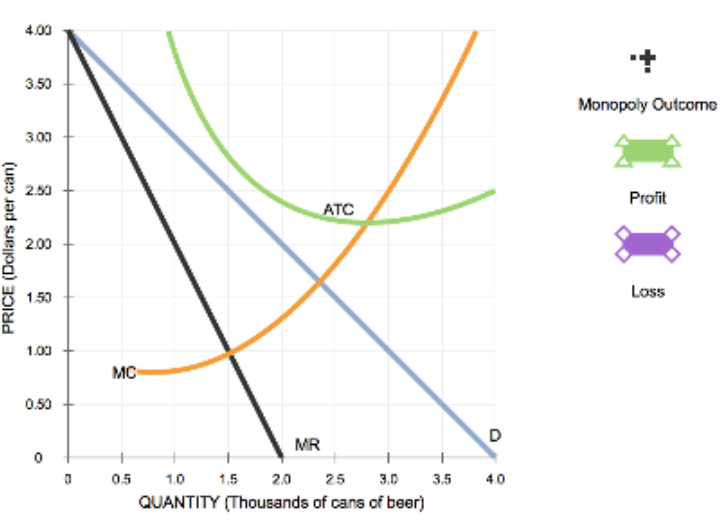
image.png

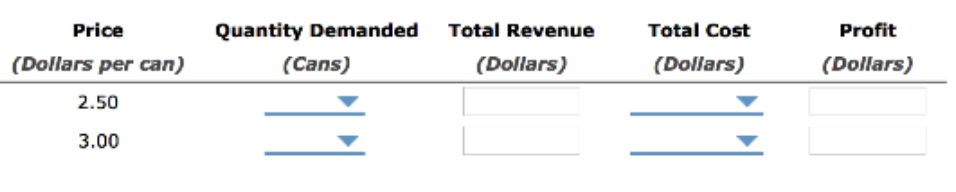
 Suppose that BYOB charges $2.75 per can. Your friend Paolo says that since BYOB is a monopoly with market power, it should charge a higher price of $3.00 per can because this will increase BYOB's profit.

 Complete the following table to determine whether Paolo is correct.

image.png

 Given the earlier information, Paolo _______  correct in his assertion that BYOB should charge $3.00 per can.

 Suppose that a technological innovation decreases BYOB's costs so that it now faces the marginal cost (MC) and average total cost (ATC) given on the following graph. Specifically, the technological innovation causes a decrease in average fixed costs, thereby lowering the ATC curve and moving the MC

 curve.

 Place the black point (plus symbol) on the following graph to indicate the profit-maximizing price and quantity for BYOB. If BYOB is making a profit, use the green rectangle (triangle symbols) to shade in the area representing its profit. On the other hand, if BYOB is suffering a loss, use the purple rectangle (diamond symbols) to shade in the area representing the loss.
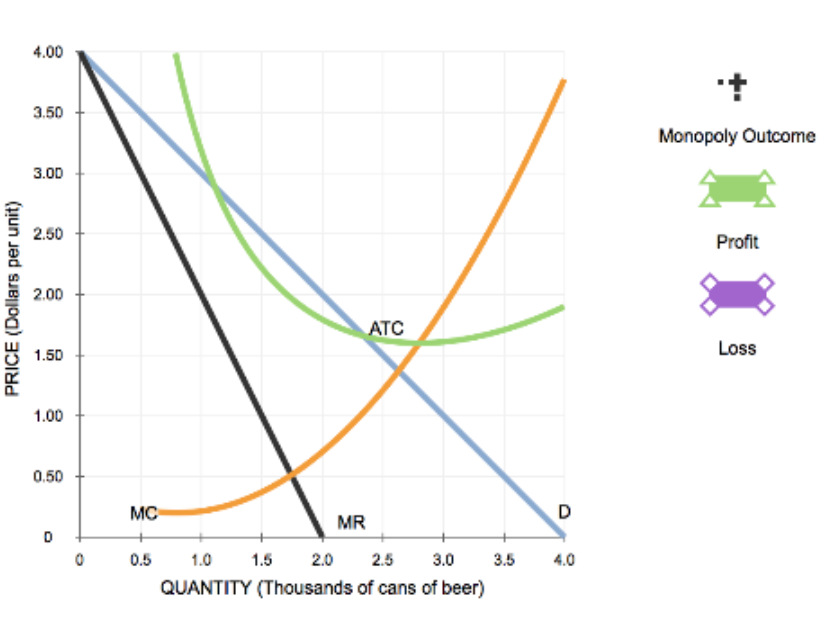
image.png


In: Economics

An example of a manager exhibiting transformational leadership is Kathy Savitt, founder and chief executive officer...

An example of a manager exhibiting transformational leadership is Kathy Savitt, founder and chief executive officer of Lockerz. The company operates an e-commerce website that uses social networking tools to engage teens in shopping online. Teens who visit the site can help themselves and their friends earn points toward discounts on the merchandise by clicking images of the items and viewing various kinds of promotional content. The company grew out of Savitt’s passion for serving this young demographic group. Savitt has a vision not only for the company’s place as an Internet marketer but also for the kind of company it should be for its employees. Her vision is of a business in which the employees respect one another and are fearless about innovation. In hiring, Savitt seeks people who not only are highly intelligent but also listen attentively, demonstrate respect for others, and can laugh at themselves. She models her vision of the workplace by addressing problems and setbacks frankly and with a focus on solutions, saying it takes courage to work through failure. Savitt expresses confidence that by bringing in people who have talent plus a drive to contribute, she can create a company culture that avoids cynical practices she has experienced at other companies in the past. For example, she has seen business meetings that play a kind of stump-the-chump game, in which if one employee tries to answer a question or offer an idea, others pile on with criticism. Savitt believes she can avoid that by communicating the values of courage, innovation, and results.

1) What kind of behaviour does Savitt exhibit in her actions?

Transformational leader or a transactional leader?

What effects does it have on her team?

2) What is the difference between transformational leadership and transactional leadership

3) What are different types of powers? Explain each with an example

In: Operations Management

Download the SwapMultidimensional.java file, and open it in jGrasp (or a text editor of your choice)....

Download the SwapMultidimensional.java file, and open it in jGrasp (or a text editor of your choice). This program contains two methods which you will need to write:

  • swapRows: Swaps the contents of two rows, given a two-dimensional array and the indices of the rows to swap.
  • swapCols: Swaps the contents of two columns, given a two-dimensional array and the indices of the columns to swap.

main contains some code which will call swapRows and swapCols, for the purpose of informal testing. With this in mind, example output of the program is below:

Before swapping rows 0 and 2:
0 1 2
3 4 5
6 7 8
After swapping rows 0 and 2:
6 7 8
3 4 5
0 1 2

Before swapping columns 1 and 2:
9 8 7
6 5 4
3 2 1
After swapping columns 1 and 2:
9 7 8
6 4 5
3 1 2

-----------------------------------------------------------------------

public class SwapMultidimensional {
    // You must write TWO methods:
    //
    // 1.) A method named "swapRows" that swaps the
    //     contents of two rows in a given two-dimensional
    //     array. This method MUST NOT use loops. As a hint,
    //     since a two-dimensional array is just an array of
    //     arrays where each inner array is a row, this means
    //     that you can swap entire rows just by swapping two
    //     elements of the outer array.
    //
    // 2.) A method named "swapCols" that swaps the contents
    //     of two columns in a given two-dimensional array.
    //     This method MUST use a loop.
    // TODO - write your code below this comment.


    // DO NOT MODIFY print2D!
    public static void print2D(int[][] array) {
        for (int row = 0; row < array.length; row++) {
            for (int col = 0; col < array[row].length - 1; col++) {
                System.out.print(array[row][col] + " ");
            }
            System.out.println(array[row][array[row].length - 1]);
        }
    }

    // DO NOT MODIFY main!
    public static void main(String[] args) {
        int[][] example1 = new int[][]{ new int[]{0, 1, 2},
                                        new int[]{3, 4, 5},
                                        new int[]{6, 7, 8} };
        int[][] example2 = new int[][]{ new int[]{9, 8, 7},
                                        new int[]{6, 5, 4},
                                        new int[]{3, 2, 1} };
        System.out.println("Before swapping rows 0 and 2:");
        print2D(example1);
        swapRows(example1, 0, 2);
        System.out.println("After swapping rows 0 and 2:");
        print2D(example1);

        System.out.println("\nBefore swapping columns 1 and 2:");
        print2D(example2);
        swapCols(example2, 1, 2);
        System.out.println("After swapping columns 1 and 2:");
        print2D(example2);
    }
}

In: Computer Science

INSTRUCTIONS 10. Prepare a post-closing trial balance as of April 30, 2020. Janet Stevens began her...

INSTRUCTIONS

10. Prepare a post-closing trial balance as of April 30, 2020.

Janet Stevens began her tax business, Stevens Tax Service, on February 1, 2020. Below is the Chart of Accounts for the company:

Acct # Account Title

11 Cash

12 Accounts receivable

14 Supplies

15 Prepaid Rent

16 Prepaid Insurance

18 Office Equipment

19 Accumulated Depreciation

21 Accounts Payable

23 Unearned Fees

31 Janet Stevens, Capital

32 Janet Stevens, Drawing

41 Fees Earned

51 Salary Expense

52 Rent Expense

53 Supplies Expense

54 Depreciation Expense

55 Insurance Expense

59 Miscellaneous Expense

After closing the books at the end of March, Stevens Tax Service had the following post-closing trial balance:

Stevens Tax Service

Post-Closing Trial Balance

March 31, 2020

Acct # Account Title Debit Credit

11 Cash 12,800

12 Accounts Receivable 9,750

14 Supplies 725

15 Prepaid Rent 5,000

16 Prepaid Insurance 2,250

18 Office Equipment 10,500

19 Accumulated Depreciation 700

21 Accounts Payable 1,510

23 Unearned Fees 1,800

31 Janet Stevens, Capital 37,015

Totals 41,025 41,025

During the month of April, 2020, Stevens Tax Service entered into the following transactions:

Apr. 3. Received cash from clients as advance payments for services to be provided and recorded it as unearned fees, $4,500.

5. Received cash from clients on account, $5,550.

8. Paid cash for an online advertisement for $600.

10. Paid Office Depot on account, $1,000.

12. Recorded services provided on account for the period of April 1-15, $9,450.

14. Paid receptionist for two weeks’ salary $1,500.

15. Recorded cash from cash clients for fees earned during the period of April 1-15, $8,300.

16. Purchased office supplies on account, $1,500.

20. Paid telephone bill, $500.

21. Paid electricity bill, $720.

25. Recorded cash received from clients on account, $6,200.

28. Paid receptionist for two weeks’ pay, $1,500.

30. Recorded cash from cash clients for fees earned for the period March 16-30, $8,900.

30. Recorded services on account for February 16-30, $10,600.

30. Janet withdrew $9,000 for personal use.

In: Accounting

Exercise 13-22 Culver Machinery Co. manufactures equipment to a very high standard of quality; however, it...

Exercise 13-22

Culver Machinery Co. manufactures equipment to a very high standard of quality; however, it must still provide a warranty for each unit sold, and there are instances where the machines do require repair after they have been put into use. Culver started in business in 2020, and as the controller, you are trying to determine whether to use the assurance-type or service-type warranty approach to measure the warranty obligation. You would like to show the company president how this choice would affect the financial statements for 2020, and advise him of the better choice, keeping in mind that the service-type approach is consistent with IFRS, and that there are plans to take Culver public in a few years.

You have determined that sales on account for the year were 1,100 units, with a selling price of $3,200 each. Ignore any cost of goods sold. The warranty is for two years, and the estimated warranty cost averages $210 per machine. Actual costs of servicing warranties for the year were $115,500. You have done some research and determined that if the service-type approach were to be used, the portion of revenue allocated to the warranty portion of the sale would be $350. Because the costs of servicing warranties are not incurred evenly, warranty revenues are recognized based on the proportion of costs incurred out of the total estimated costs.

A.) For the assurance-type approach, prepare the necessary journal entries to record all of the transactions described. Payments for completed warranty repairs are paid in cash.

Account Titles and Explanation Debit Credit
(Account Name)
(Account Name)
To record sales on account
(Account Name)
(Account Name)
To record payment of warranty expense
(Account Name)
(Account Name)
To accrue warranty expense

Determine the warranty liability and expense amounts on the financial statements at the end of 2020.

Warranty Liability: $________

Warranty Expense: $_________

B.) For the service-type approach, prepare the necessary journal entries to record all of the transactions described.

Account Titles and Explanation Debit Credit
(Account Name)
(Account Name)
(Account Name)
To record the sale
(Account Name)
(Account Name)
to record warranty cost incurred
(Account Name)
(Account Name)
To remeasure the unearned revenue account

Determine the unearned revenue and expense amounts on the financial statements at the end of 2020.

Unearned Revenue: $________

Warranty Expense: $_________

(List of Possible Accounts for all parts of question: No Entry, Accounts Receivable, Materials Cash Payables, Cash, Warranty Liability, Sales Revenue, Warranty Revenue, Unearned Revenue, Warranty Expense)

In: Accounting

Question 6        (Marks: 35) Structured Query Language (SQL) is a language that is widely used in...

Question 6        (Marks: 35) Structured Query Language (SQL) is a language that is widely used in industry to create, update and query data in relational databases. This question must NOT be done practically (i.e. in the computer room). You are required to write the SQL code in your answer book. Q.6.1 The below sample data in third normal form was provided by a database designer. Answer the below questions using this data. Table: Country Primary key: CountryID (auto number) All fields are mandatory CountryID Name Abbreviation CallingCode 1 South Africa ZA 27 2 Lesotho LS 266 3 Namibia NA 264 4 Egypt EG 20 Table: President Primary key: PresidentID (auto number) Foreign key: CountryID (mandatory) All fields are mandatory PresidentID CountryID Name Surname Year 1 1 Cyril Ramaphosa 2018 2 1 Jacob Zuma 2009 3 3 Hage Geingob 2015 4 3 Hifikepunye Pohamba 2005 18; 19; 20                       2020 © The Independent Institute of Education (Pty) Ltd 2020   Page 10 of 11    Q.6.1.1 Write a SQL statement to create the table President. Hint: The sample data should give you an indication of the data types you should use. (5)      Q.6.1.2 Write a SQL statement that will count the number of presidents that were inaugurated after 2009. (4)      Q.6.1.3 Write a SQL statement to insert the below row into table Country. CountryID Name Abbreviation CallingCode 5 Botswana BW 267 (4)      Q.6.1.4 Write a SQL statement to get the list of all the countries from the database, in alphabetical order by country name. Include all the columns from the Country table. (3)      Q.6.1.5 Write a SQL statement to get the list of all the presidents with a surname starting with the letter R. Include all fields from the President table. (3)      Q.6.1.6 Write a SQL statement to get the list of all the presidents, showing only the name and surname of the president, and the name of their country. (5) Q.6.2 What is the difference between the WHERE and HAVING clauses in SQL statements? (4) Q.6.3 What is the purpose of an index in a SQL database? (1) Q.6.4. The below ERD has been implemented in a SQL database. What will the result be of each of the below queries? Provide an explanation for your answer.   18; 19; 20                       2020 © The Independent Institute of Education (Pty) Ltd 2020   Page 11 of 11 Q.6.4.1 (2)      Q.6.4.2 (2)      Q.6.4.3  

In: Computer Science

After reviewing the case for Nature Bros. Ltd., answer the following questions. After reviewing this material,...

After reviewing the case for Nature Bros. Ltd., answer the following questions. After reviewing this material, make a list of additional information which should be supplied to support the sales projections. Comment on objectives: Are they reasonable, optimistic, or conservative? What marketing mix would best support this growth rate? Evaluate the information supplied regarding a new product development and physical assets in light of the pro forma income statements Morris developed. Is the capital sought appropriate for the circumstances? If more information is needed, state what it is and how it could be obtained. What sources should Morris approach for this amount of capital? Based on the current balance sheet, how much equity should he give up for the investment?

NATURE BROS. LTD. BACKGROUND Thanksgiving Day 1993 is the day that Dale Morris remembers as the “public debut” of his creation, a new seasoned salt mix. Although he was a salesman by temperament and career, his hobby was cooking. Having experimented with both traditional home cooking and more exotic gourmet cooking, Morris had developed an appreciation for many herbs and spices. He had also done a lot of reading about the health hazards of the typical American diet. When his mother learned that she had high blood pressure, Morris decided it was time for some action. He created a low-salt seasoning mix, based on a nutritive yeast extract, that could be used to replace salt in most cases. This Thanksgiving dinner, prepared for 25 family members and friends, would be his final testing ground. He used his mix in all the recipes except the pumpkin pie—everything from the turkey and dressing to the vegetables and even the rolls. As the meal progressed, the verdict was unanimously in favor of his secret ingredient, although he had a hard time convincing them that it was his invention and was only 10 percent salt. Everyone wanted a sample to try at home. Over the next two years, Morris perfected his product. Experiments in new uses led to “tasting parties” for friends and neighbors, and the holiday season found the Morris kitchen transformed into a miniature assembly line producing gift-wrapped bottles of the mix. Morris became something of a celebrity in his small town, but it wasn’t until the Ladies’ Mission Society at his church approached him with the idea of allowing them to sell his mix as a fund-raiser that he realized the possibilities of his creation. His kitchen-scale operation could support the sales effort of the church women for a short time, but if he wanted to take advantage of a truly marketable product, he would have to make other arrangements. Morris agreed to “test-market” his product through the church group while he looked for ways to expand and commercialize his operation. The charity sale was a huge success (the best the women had ever experienced), and, based on this success, Morris moved to create his own company. Naming his product “Nature Bros. Old Fashioned Seasoning,” he incorporated the company in 1995 as Nature Bros. Ltd. Morris used most of his savings to develop and register the trademarks, for packaging, and for product displays. He researched the cost of manufacturing and bottling his product in large quantities and concluded that he just didn’t have the cash to get started. His first attempts to raise money, in the form of a personal bank loan, were unsuccessful, and he was forced to abandon the project. For several years, he concentrated on his career, becoming a regional vice president of the insurance company he worked for. He continued to make “Nature Bros. Seasoning” in small batches, mainly for his mother and business associates. These users eventually enabled Morris to get financial support for his company. To raise $65,000 to lease manufacturing equipment and building space, he sold stock to his mother and to two other regional vice presidents of the insurance company. For their contributions, each became the owner of 15 percent of Nature Bros. Ltd. The process of getting the product to the retail market began in August 2002, and the first grocery store sales started in March 2003. The initial marketing plan was fairly simple—to get the product in the hands of the consumer. Morris personally visited the managers of individual supermarkets, both chains and independents, and convinced many to allow a tasting demonstration booth to be set up in their stores. These demonstrations proved as popular as the first Thanksgiving dinner trial nearly 10 years earlier. Dale Morris’s product was a hit, and in a short time, he was able to contract with food brokerage firms to place his product in stores in a 10-state region.

PRESENT SITUATION As indicated in the balance sheet (see Exhibit 1), more capital is needed to support the current markets and expand both markets and products. Two new products are being developed: a salt-free version of the original product and an MSG-based flavor enhancer that will compete with Accent. Morris worked with a business consultant in drawing up a business plan to describe his company, its future growth, and its capital needs. OVERALL PROJECTIONS The first section discusses the objectives and sales projections for 2004 and 2005 (Exhibits 2 and 3). The resulting pro forma income statements for 2004 to 2005 are in Exhibits 4 and 5. 2004

OBJECTIVES The company’s objectives for 2004 are to stabilize its existing markets and to achieve a 5 percent market share in the category of seasoned salt, a 10 percent market share in salt substitutes, and a 5 percent market share in MSG products. Although the original product contains less than 10 percent salt, the company has developed a salt-free product to compete with other such products. The dollar volume for the seasoned salt category in the seven markets the company is in will amount to $7,931,889 in 2004. In 2003, sales of the company in the Oklahoma market were 5.5 percent of the total sales for that market for the eight-month period that the company was operational. Since these sales were accomplished with absolutely no advertising, the company can be even more successful in the future in all seven current markets with a fully developed and funded advertising campaign. The marketing approach will include advertisements in the print media, with ads on “food day” offering cents-off coupons. This program will take place in all seven markets, while stores will continue to use floor displays for demonstrations. Nearly 100 percent warehouse penetration should be achieved in 2004 in these markets. The goal for the category of salt substitutes for 2004 is 10 percent of the market share. This larger market share can be achieved since there are only a few competitors, Mrs. Dash, AMBI Inc. with Cordia Salt Alternative, and RCN with No Salt. The company’s product is superior in all respects and has a retail price advantage of 10 to 20 cents per can. In addition, the company’s product is much more versatile than competitors’ products. Aggressive marketing and advertising will emphasize the tremendous versatility of usage as well as the great taste and health benefits of the product. The informal consumer surveys at demonstrations indicated that consumers prefer Nature Bros. to competitors’ products by a wide margin. A new product, which is already developed, will be added during this time. Called “Enhance,” it too is a dry-mixed, non cooked, low-overhead, high-profit food product. Its category of MSG products has a dollar volume of $1,957,090 in these markets. This category includes only one main competitor, Accent, made by Pet Inc. Accent has not been heavily advertised, and it is a one-line product with little initial name recognition. The company’s new product will have a 10- to 20-cent per can retail price advantage to help achieve a 5 percent share of this category. In summary, 2004 will be spent solidifying the company’s present market positions. 2005

OBJECTIVES The company intends to open eight new markets in 2005 that include Los Angeles, Phoenix, Portland, Sacramento, Salt Lake City, San Francisco, Seattle, and Spokane. These new markets make up 17.1 percent of grocery store sales, according to the Progressive Grocer’s Marketing Guidebook, the industry standard. In the category of seasoned salt, these markets have a dollar volume of $15,218,886 a year. Salt substitutes sell at a volume of $10,064,028, and the MSG category $3,285,528. With proper advertising, the company’s shares forecast in our current markets will also be realized. A 5 percent penetration of the seasoned salt category is a very conservative projection considering the strong health consciousness of the West Coast. The products will be introduced in shippers, used in store demonstrations, and supported with media advertising to achieve at least a 5 percent market share. This would result in sales of $760,943 in that category. A 10 percent penetration is targeted in the salt-free category. Using aggressive marketing, price advantage at retail, and better packaging, the company will be well positioned against the lower-quality products of our competitors. With the dollar volume of this category at $10,064,028, a conservative estimate of our share would be $1,006,420. In the category of MSG, a 5 percent share will be achieved. The main competitor in this category does very little advertising. Again, attractive packaging, aggressive marketing, high quality, and a retail price advantage of 30–40 cents per unit will enable the company to realize a 5 percent market penetration. This share of the West Coast markets will generate sales of $164,276. Total sales of all three products in these eight new markets will be around $1,931,639. The company plans to continue to solidify the markets previously established through the use of coupons, co-op advertising, quality promotions, and word-of-mouth advertising. Market share in these original markets should increase by another 2.5 percent in 2005. The dollar volume of the seasoned salt category in 2005 should be around $9,522,472, and our market share at 7.5 percent would amount to $714,185. The dollar volume for the salt substitute category would be $6,220,748, giving sales at 12.5 percent of $775,593. In the MSG category, a 7.5 percent market share of the $2,055,864 volume would give sales of $154,189. The company’s total sales for the existing markets in 2005 will be in excess of $1,643,967. The totals for 2005 sales of Nature Bros. Old Fashioned Seasoning will be $1,475,128. Nature Bros. Salt-Free volume should be $1,784,013. The sales of Enhance, our MSG product, should be $318,465. This will give us a total sales volume of $3,557,606 for all three products in 2005.

FINANCIAL NEEDS AND PROJECTIONS In this plan, Morris indicated a need for $100,000 equity infusion to expand sales, increase markets, and add new products. The money would be used to secure warehouse stocking space, do cooperative print advertising, give point-of-purchase display allowances, and pay operating expenses.

NEW PRODUCT DEVELOPMENT The company plans to continue an ongoing research and development program to introduce new and winning products. Four products are already developed that will be highly marketable and easily produced. Personnel are dedicated to building a large and profitable company and attracting quality brokers. The next new product targets a different market segment but can be brought online for about $25,000 by using our existing machinery, types of containers, and display pieces. A highly respected broker felt that the product would be a big success. The broker previously represented the only major producer of a similar product, Pet Inc., which had sales of $4.36 million in 1985. The company can achieve at least a 5 percent market share with this product in the first year. The company’s product will be at least equal in quality and offer a 17 percent price advantage to the consumer, while still making an excellent profit. Another new product would require slightly different equipment. This product would be initially produced by a private-label manufacturer. The product would be established before any major machinery was purchased. Many large companies use private-label manufacturers, or co-packers, as they are called in the trade. Consumer tests at demonstrations and food shows have indicated that each of these products will be strong. PLANT AND EQUIPMENT The company’s plant is located in a nearly new metal building in Rose, Oklahoma. The lease on the building limits payments to no more than $300 per month for the next seven years. The new computer-controlled filling equipment will be paid off in two months, and the seaming equipment is leased from the company’s container manufacturer for only $1 per year. The company has the capability of producing about 300,000 units a month with an additional $15,000 investment for an automatic conveyer system and a bigger product mixer. This production level would require two additional plant personnel, working one shift with no overtime. The company could double this production if needed with the addition of another shift. One of the main advantages of the company’s business is the very small overhead required to produce the products. The company can generate enough product to reach sales of approximately $4 million a year while maintaining a production payroll of only $37,000 a year. To meet the previously outlined production goals, the company will need to purchase another filling machine in 2005. This machine will be capable of filling two cans at once with an overall speed of 75 cans per minute, which would increase capacity to 720,000 units a month. A higher-speed seaming machine will also need to be purchased. The filling machine would cost approximately $22,000; a rebuilt seamer would cost $25,000, while a new one would cost $50,000. With the addition of these two machines, the company would have a capacity of 1,020,000 units per month on one shift. By 2006, the company will have to decide whether to continue the lease or buy the property where located and expand the facilities. The property has plenty of land for expansion for the next five years. The company has the flexibility to produce other types of products with the same equipment and can react quickly to changes in customer preferences and modify its production line to meet such demands as needed.

In: Economics

Calculation of pH after Titration of Weak Acid: Calculation of pH after Titration of Weak Acid:...

Calculation of pH after Titration of Weak Acid: Calculation of pH after Titration of Weak Acid: A compound has a p K a of 7.4. To 100 mL of a 1.0 M solution of this compound at pH 8.0 is added 30 mL of 1.0 M hydrochloric acid. What is the pH of the resulting solution?

Can you explain what to do after 3.98 = A/HA

In: Chemistry