Questions
Looking for assistance on these three quick questions as I can't seem to figure them out....
Looking for assistance on these three quick questions as I can't seem to figure them out. Thanks in advance for your help!
1. Which of the following would decrease the depth of breathing?
A. Increased arterial PCO2
B. Exercising
C. Increased action potential frequency in neurons from the ventral respiratory group
D. Acidic plasma pH
E. Decreased action potential frequency in neurons from the dorsal respiratory group
F. Overactivation of the respiratory center in the medulla
2. Which of the following would make oxygen unloading in the tissues more difficult?
Select all that apply
A. increased affinity of hemoglobin for oxygen
B. right shift of the oxyhemoglobin curve
C. lower blood pH
D. decreased metabolic rate
E. increased arterial PCO2
F. Left shift of the oxyhemoglobin curve
5. How does CO poisoning work?
A. CO inhibits the enzyme carbonic anhydrase (CA) and therefore prevents CO2 from being transported as bicarbonate ions to the lungs for excretion
B. CO paralyzes the diaphragm and therefore prevents the expansion of the lungs and ventilation
C. CO decreased hemoglobin oxygen saturation and prevents the delivery of O2 to the tissues.
D. CO destroys hemoglobin and therefore prevents CO2 from being transported to the lungs for excretion
E. CO decreased the plasma solubility of O2 and prevents the delivery of O2 to the tissues.
In: Anatomy and Physiology
QUESTION 31 Hyperventilation will increase blood pH. True False QUESTION 32 Which is the intrapulmonary pressure...
QUESTION 31
-
Hyperventilation will increase blood pH.
True
False
QUESTION 32
-
Which is the intrapulmonary pressure during inspiration?
760 mm Hg.
754 mm Hg.
758 mm HJg.
762 mm Hg.
QUESTION 33
-
Which occurs in response to contraction of the diaphragm?
The thoracic volume decreases and inspiration occurs.
The thoracic volume increases and expiration occurs.
The thoracic volume decreases and expiration occurs.
The thoracic volume increases and inspiration occurs.
QUESTION 34
-
Which is the major way carbon dioxide is transported in the body?
Bound to hemoglobin.
Dissolved in plasma.
Bound to myoglobin.
As bicarbonate ions in the blood.
QUESTION 35
-
The enzyme carbonic anhydrase catalyzes the reaction: carbonic acid --> hydrogen ions + bicarbonate.
True
False
QUESTION 36
-
Surfactant will increase the alveolar surface tenasion.
True
False
QUESTION 37
-
Which is the major type of connective tissue found in lymphatic tissue?
Reticular.
Adipose.
Dense irregular.
Areolar.
QUESTION 38
-
All are functions of the lymphatic system EXCEPT:
Regulation of interstitial fluid volume.
Absorption of dietary fats.
Immune functions.
Oxygen transport.
QUESTION 39
-
Which organ protects the body from blood pathogens?
Spleen.
Thyroid.
Thymus.
Lymph nodes.
QUESTION 40
-
All are characteristic of lymphatic vessels EXCEPT:
They have endothelial cells.
They have flaps that open and close.
They have valves.
Lymph fluid moves towards the tissues.
In: Anatomy and Physiology
Please refer to the Anova and Simple Regression Projects. Your company would like you to complete...
Please refer to the Anova and Simple Regression Projects.
Your company would like you to complete their sales prediction model. They would like you to ascertain if the other variables for which they have data also affect sales. A complete model will have to include advertising expenditures and package design along with the other variables listed above.
1. Create three dummy variables named DA, DB, and DC to capture
the effects of the four levels of the categorical variable. Then
use Tools > Data Analysis > Regression, to fit a regression
of Sales as a function of all the variables in your data set
(variables 3 through 7 above), plus the three dummies DA, DB, and
DC.
2. Conduct the F-test for model significance and report your
results.
3. Does your model appear to be adequate for the purpose intended?
(Refer to goodness-of-fit measures, in particular, R², adjusted R²,
and the standard error of estimate.)
4. Your boss wants to know what you predict will be the effect on
company sales if the company increases its price. What will be your
response?
5. Do changes in your competitor's price have a significant impact
on your company's sales and, if so, at what significance
level?
6. Are any of the other variables in your model significant in
determining sales at the 5% significance level or better?
7. Your boss also wants to know about the effectiveness of the
various advertising methods. Report your findings with regard to
this variable.
95.2 44.6 41.3 0.78 2.50 3.05 D
86.2 51.6 42.1 0.78 3.09 1.67 A
112.8 52.9 38.9 0.68 2.57 3.38 C
95.4 43.5 36.7 0.73 2.24 3.01 D
95.0 48.7 38.8 0.78 3.04 2.57 C
96.1 48.7 40.6 0.75 2.45 3.38 D
82.4 49.2 37.8 0.76 2.70 2.94 B
91.9 47.7 38.5 0.75 2.67 2.33 C
91.8 49.7 38.6 0.75 2.54 1.62 D
115.5 54.5 40.6 0.74 2.55 1.98 C
111.4 43.4 42.6 0.74 2.64 3.45 C
79.6 51.2 39.7 0.73 2.80 2.60 A
90.9 42.7 44.7 0.77 2.73 2.13 A
105.4 49.9 43.1 0.80 2.68 2.30 D
74.2 50.3 35.3 0.73 2.88 3.02 B
115.6 55.1 44.7 0.77 2.57 3.50 B
115.2 49.2 43.4 0.70 2.35 2.42 B
92.9 56.9 37.2 0.71 2.86 2.38 D
113.0 53.4 38.8 0.71 2.45 1.75 B
78.2 43.4 43.8 0.82 2.69 2.46 A
92.2 46.2 41.4 0.78 2.98 1.60 B
90.6 53.5 40.9 0.78 2.77 2.46 D
120.0 45.6 37.3 0.68 2.38 2.42 C
95.5 43.4 44.2 0.78 2.54 3.02 B
96.0 53.5 40.7 0.72 2.51 2.41 B
74.2 47.2 41.2 0.82 2.78 2.59 B
105.5 42.7 35.9 0.80 2.30 2.00 C
125.0 52.9 38.5 0.79 2.32 2.16 B
86.3 50.7 42.2 0.75 2.76 3.16 B
84.5 44.5 43.3 0.74 2.76 2.89 B
80.3 51.8 39.8 0.81 2.86 3.37 A
80.8 40.9 42.9 0.69 2.83 2.07 B
99.9 59.4 37.2 0.79 2.64 2.84 B
116.4 62.7 35.5 0.76 2.65 3.50 C
112.6 47.7 40.8 0.87 2.33 2.14 D
79.1 48.1 37.3 0.79 2.54 3.40 B
111.0 45.3 42.4 0.73 2.73 3.10 C
81.0 44.5 35.3 0.65 3.07 3.17 C
79.1 45.6 37.2 0.66 2.46 2.99 D
104.9 48.3 43.9 0.68 3.17 2.65 C
89.2 49.7 43.4 0.73 2.98 2.29 B
114.2 54.5 37.1 0.77 2.65 2.75 C
96.2 51.9 37.7 0.82 2.74 3.40 B
109.2 58.7 42.0 0.72 2.74 1.51 D
37.8 48.3 37.0 0.74 3.41 2.16 A
73.7 50.8 43.1 0.65 2.97 3.22 B
64.7 46.8 41.2 0.72 2.97 2.28 A
94.7 43.5 40.0 0.77 2.36 1.86 B
48.8 44.9 42.3 0.75 3.32 3.42 A
93.1 46.2 42.2 0.79 2.29 1.75 A
78.3 51.1 39.9 0.72 2.95 2.22 B
83.1 44.9 37.5 0.79 2.45 3.43 B
69.8 46.4 35.7 0.78 2.93 1.80 D
121.3 43.9 43.6 0.76 2.84 2.43 C
84.3 45.0 39.8 0.77 2.65 2.01 D
89.6 40.5 44.7 0.79 2.84 2.54 A
89.2 45.1 35.3 0.66 3.16 1.74 C
75.3 50.1 35.5 0.80 3.04 1.99 B
120.0 46.8 42.7 0.84 2.87 3.07 C
89.5 50.8 44.8 0.76 3.11 2.07 D
In: Statistics and Probability
1a. Write your Verilog program to implement the timer counter. HEX0 should show tenths of seconds...
1a. Write your Verilog program to implement the timer counter. HEX0 should show tenths of seconds from 0 to 9. HEX1 and HEX2 should show a count of seconds, from 00 to 59. The ones count is on HEX1 and the tens count is on HEX2.
1b. Count backwards and forwards. Add a button or switch to control counting direction. When counting forwards or backwards, your count should not stop but rollover appropriately at the correct time. When counting forward, at 59.9, the count should roll over to 00.0. When counting backwards at 00.0, the count should roll back to 59.9.
1c.Add a preset signal. Preset should set the display count to 59. 9. Use a button for the preset.
1d.Employ a start/stop switch for the counter. When the switch is in the stop position, the count should not be updated on the seven segment displays. The displays should not be turned off, but should maintain the last count shown when the count is stopped. Example: count is 42.3 and the switch is set to stop count. The hex display should show 42.3. When the switch is placed in the start position, the count should resume from where it stopped.
So far I have code for the following: a divide by 2 clock, divide by 5 clock, divide by 10 clock, a decimal counter (0-9), and have started this last top level. However, do not know how to finish it. Please help me. Thanks!
module divide_by_2(Clk,reset, D, Q); //Divide by 2 clock with
reset using D flip flop
input wire Clk, D, reset;
output wire Q;
reg Qnext;
assign Q = Qnext;
always @(posedge Clk, posedge reset) //always at the
positive edge of the clock or reset
if (reset)
begin //
asynchronous reset when reset is high
Qnext <=
1'b0;; //Q gets the value 0
end
else
begin
Qnext <= D;
// Q gets the value of D on posedge of clock
end
endmodule
module divide_by_5(Clk,reset,DA,DB,DC,DD,QA,QB,QC,QD,Y);
input wire DA,DB,DC,DD,Clk,reset;
output wire QA,QB,QC,QD,Y;
assign Y= QD | QB;
divide_by_2 inst0(Clk,reset,(~QA & ~QC),QA);
divide_by_2 inst1(Clk,reset,((QA & ~QB)|(~QA &
QB)),QB);
divide_by_2 inst2(Clk,reset,(QA & QB),QC);
divide_by_2_Inverse inst3(Clk,reset,QB,QD);
endmodule
module divide_by_10(Clk_in, Clk_out, reset);
input Clk_in, reset;
output Clk_out;
divide_by_2 inst0(Clk_in,reset, Clk_in, Q);
divide_by_5 inst1(~Q,reset,QA,QB,QC,QD,QA,QB,QC,QD,Y);
assign Clk_out= Y;
endmodule
module decimal_counter(OVERFLOW, CLK, RST,A);
input CLK,RST;
output OVERFLOW;
output [3:0] A;
reg OVERFLOW_reg;
reg[3:0]A_reg;
assign OVERFLOW = OVERFLOW_reg;
assign A = A_reg;
always @ (posedge CLK or negedge RST)
//asynchronous reset condition takes priority check
for that event first
if (RST == 1'd0) begin
OVERFLOW_reg <= 1'b0;
A_reg <= 4'b0000;
end
else if (A_reg < 4'd9)
begin
// as long as A is less than 9, add
1 to A
A_reg <=
A_reg + 1'b1;
// do not trigger overflow because
count A is still a single digit
OVERFLOW_reg
<= 1'b0;
end
else
begin
// Count A is double digit 10 here,
reset count to 0
// trigger overflow for the digit 1
that should be carried output
A_reg <=
4'b0000;
OVERFLOW_reg
<= 1'b1;
end
endmodule
module TopLevel(CLOCK_50, KEY, LEDR, HEX0, HEX1, HEX2);
input wire CLOCK_50;
input wire [2:0]KEY;
output wire [5:0]LEDR;
output wire [6:0]HEX0;
reg [6:0]rHEX0;
reg [6:0]rHEX1;
reg [6:0]rHEX2;
assign HEX0 = rHEX0;
assign HEX1= rHEX1;
assign HEX2= rHEX2;
/* (OVERFLOW, CLK, RST,A)*/
decimal_counter
inst0(HEX2,CLOCK_50,KEY[1],HEX0);
divide_by_5
inst1(Clk,KEY[1],A,DB,DC,DD,QA,QB,QC,QD,HEX1);
decimal_counter
inst2(HEX1,CLOCK_50,KEY[1],HEX2);
always @(HEX0,HEX1)
begin
case (A)
1'b0: rHEX0 = 7'h40;
1'b1: rHEX0 = 7'h79;
1'b2: rHEX0 = 7'h24;
1'b3: rHEX0 = 7'h30;
1'b4: rHEX0 = 7'h19;
1'b5: rHEX0 = 7'h12;
1'b6: rHEX0 = 7'h02;
1'b7: rHEX0 = 7'h78;
1'b8: rHEX0 = 7'h00;
1'b9: rHEX0 = 7'h18;
endcase
end
always @ (HEX2)
begin
case (A)
1'b0: rHEX2 = 7'h40;
1'b1: rHEX2 = 7'h79;
1'b2: rHEX2 = 7'h24;
1'b3: rHEX2 = 7'h30;
1'b4: rHEX2 = 7'h19;
1'b5: rHEX2 = 7'h12;
endcase
end
endmodule
In: Electrical Engineering
Please refer to the Anova and Simple Regression Projects. Your company would like you to complete...
Please refer to the Anova and Simple Regression Projects.
Your company would like you to complete their sales prediction model. They would like you to ascertain if the other variables for which they have data also affect sales. A complete model will have to include advertising expenditures and package design along with the other variables listed above.
1. Create three dummy variables named DA, DB, and DC to capture
the effects of the four levels of the categorical variable. Then
use Tools > Data Analysis > Regression, to fit a regression
of Sales as a function of all the variables in your data set
(variables 3 through 7 above), plus the three dummies DA, DB, and
DC.
2. Conduct the F-test for model significance and report your
results.
3. Does your model appear to be adequate for the purpose intended?
(Refer to goodness-of-fit measures, in particular, R², adjusted R²,
and the standard error of estimate.)
4. Your boss wants to know what you predict will be the effect on
company sales if the company increases its price. What will be your
response?
5. Do changes in your competitor's price have a significant impact
on your company's sales and, if so, at what significance
level?
6. Are any of the other variables in your model significant in
determining sales at the 5% significance level or better?
7. Your boss also wants to know about the effectiveness of the
various advertising methods. Report your findings with regard to
this variable.
63.6 44.4 40.6 0.73 2.90 2.76 D
75.8 53.8 36.0 0.76 2.68 2.37 B
88.7 54.5 38.7 0.77 2.94 1.96 D
79.3 44.8 37.1 0.77 2.41 1.96 A
101.5 59.0 42.4 0.75 2.42 2.78 D
119.0 46.7 39.6 0.68 2.33 2.52 C
76.6 46.3 39.2 0.76 2.81 1.61 D
114.5 50.7 44.7 0.78 3.01 2.36 C
103.1 55.3 38.3 0.66 2.86 2.05 C
108.3 48.0 43.1 0.77 2.63 2.18 D
83.9 53.7 38.1 0.70 2.94 2.92 D
126.2 49.9 39.8 0.85 2.57 2.37 C
101.7 50.8 40.8 0.68 2.55 1.90 D
76.0 52.1 37.1 0.66 2.81 1.88 A
84.8 43.3 43.6 0.72 2.39 3.38 A
52.6 53.8 38.5 0.86 3.32 1.96 A
70.5 51.0 38.1 0.70 2.81 3.37 B
78.9 47.7 39.6 0.78 3.11 1.96 B
69.8 54.7 37.7 0.76 2.87 2.53 A
78.3 54.4 35.0 0.80 2.61 2.71 B
77.0 40.7 36.1 0.78 2.93 2.34 C
45.8 49.5 36.1 0.74 3.04 1.77 A
71.3 43.8 39.6 0.80 2.78 2.22 B
96.2 40.1 42.1 0.79 2.81 2.38 C
90.0 49.9 39.9 0.81 3.37 2.95 C
73.3 52.3 42.7 0.68 3.31 2.26 B
83.9 50.0 42.2 0.72 2.76 2.72 A
81.0 49.9 36.2 0.71 2.51 1.56 D
83.9 52.8 36.8 0.82 2.82 2.30 B
147.5 54.3 43.3 0.64 2.00 2.36 C
124.5 62.1 42.5 0.72 2.19 2.72 D
103.2 51.0 36.2 0.74 2.77 2.09 D
110.9 47.3 44.1 0.79 2.67 3.39 D
92.6 45.8 41.0 0.76 2.72 2.86 B
98.5 53.4 37.0 0.83 2.83 2.48 D
108.6 52.6 36.1 0.80 2.76 3.05 C
76.8 53.5 38.3 0.82 2.95 2.11 D
103.4 49.7 40.4 0.69 2.52 3.07 B
74.4 39.8 38.9 0.76 2.64 3.05 D
123.7 51.9 44.7 0.83 2.94 3.25 C
81.3 37.4 43.8 0.79 2.65 2.19 D
105.1 52.0 35.5 0.69 2.55 3.14 C
123.8 59.7 44.0 0.77 3.14 2.06 C
65.5 39.3 39.1 0.74 2.67 2.70 A
97.6 50.4 44.9 0.68 2.82 3.19 B
31.9 40.6 35.1 0.68 3.05 2.13 A
78.9 51.3 35.5 0.75 2.85 1.93 B
94.8 52.9 38.7 0.75 3.15 3.23 C
110.6 43.9 41.7 0.78 2.55 2.11 C
65.5 43.4 35.1 0.72 2.84 1.87 A
63.7 52.4 40.0 0.81 3.08 1.88 A
89.7 52.1 42.8 0.68 3.08 1.66 A
93.1 55.0 39.1 0.79 2.87 2.91 B
82.6 42.2 35.6 0.80 2.89 1.59 B
123.7 48.9 41.1 0.84 2.39 2.65 C
106.7 47.3 41.6 0.76 2.64 2.59 C
108.4 59.1 35.9 0.76 2.37 3.47 D
83.6 54.0 35.8 0.72 2.53 2.40 A
90.3 45.4 36.0 0.76 2.91 2.43 C
120.0 52.3 40.3 0.81 2.54 3.40 C
In: Statistics and Probability
Assignment 2 Tic-Tac-Toe Game system design (10 marks) Introduction This document describes the functionalities of the...
Assignment 2 Tic-Tac-Toe Game system design
Introduction This document describes the functionalities of the system and its design requirements. As first introduced in the Lab_Exercise_1, Tic-Tac-Toe is a simple game for two players. In this 1 assignment, you will implement a text-based Tic-Tac-Toe (TTT) game system that offers two game modes: 1) two human players playing against each other and 2) one human player playing against a built-in computer player in the game system. Your mission is to ensure the game playing is straightforward and easy to use.
This game is played on the “console.” That is, it is played in a UNIX terminal like in Linux and MACOS or a Windows command window. You are required to perform a storytelling/storyboard analysis to identify different components (also called subsystems) in this game system. Each subsystem corresponds to one specific functionality/role/actor/character depending on how you analyze the interactions within the game system.
For example, the TTT Drawing Subsystem that you implemented in the Lab_Exercise_1 is the subsystem responsible for displaying and drawing the game board during the game. So the functionality of TTT Drawing Subsystem is to show and draw the game board and other complex drawings needed for the game system. It, in fact, should be a collection of functions. The main control of the game system, or, the game host, will invoke these functions when showing some complex drawings, say, the game board, are needed. Another way to describe the TTT Drawing Subsystem is that it functions like a local “library” for the game system.
2 Assignment Requirements
● Functional Requirements
1) The (game) system provides a system welcome message and shows
instructions on how to play this game. (10% ) 3
2) The system provides a virtual dice to allow the players to
decide the order of playing. (5%)
3) The system has the functionality of two humans to play the game
against each other. (10%)
4) The system also has the functionality of one human to play
against the built-in computer player. (5%)
5) The system has a built-in computer player that will try to win
when winning is possible. (20%)
6) During the game, the system checks and reports the outcome after
each move by either player. The outcome could be a win, a draw, or
a state of still in progress. (10%)
7) When the user enters the wrong input, the system will reject the
input and request a re-submission. (5%)
8) Additional Requirement
○ User interaction consideration: the system should be easy to
understand and easy to follow. (10%)
■ The information of the current state/stage of the game is
available to the user.
● The current state of the game (i.e., win, draw, or in progress),
if available.
● The current game board, if available. ● Whose turn now, if
available.
● Other information you think that is necessary for playing.
■ To interact:
● Are the instructions clear?
● Easy to perform the requested infractions without mistakes or
confusion?
● Required system execution flow of the game system
1) The system starts with a system welcome message.
2) Explain and provide the system commands to the user. If the user
enters an incorrect command, explain and provide the system
commands again. Here are the system commands: System
Command Action
0 Exit the system
1 Begin entering a new game
When the system command is 0, then exit the program. When the
system command is 1, go to step 3.
3) The system then asks the user to select the game mode. If the
user enters an incorrect game mode command, explain and provide the
game mode command screen again. Here are the game mode
commands:
Game Mode Command Action
1 The human player plays against the computer
player
2 Two human players play against each other
When the user enters incorrect input, the system will ask the user
to re-enter the selection.
4) Next, the system will interact with the user(s) to determine the
play order by throwing a virtual dice. Make sure to explain the
rule for determining the play order. The play order must be
determined after completing this step. Then, go to step 5.
5) The tic-tac-toe game starts. During the game, the players take
turns to select the cell he/she/it wants to take over. The system
will accept the input from the player each time and then shows the
current game board. If there is a win, the system will announce it
and then go to step 2. Otherwise, the system will continue until
all cells on the game board are filled. When this happens, the
system will announce a draw and then go to step 2. When the user
enters incorrect input, the system will ask the user to
re-enter
In: Computer Science
Facts E-Gardener is a company, which provides lawn and garden services through an app. The app...
Facts
E-Gardener is a company, which provides lawn and garden services through an app. The app matches between private and commercial residence owners (“Owners”) and talented gardeners (“Talented Gardeners”) in Ontario. The Owner, who uses the app, can choose from a variety of options to describe the work they are looking for and/or browse through the list of Talented Gardeners subscribed to the app, check their ratings and reviews, previous work, and choose who they would like to hire. The app may also make recommendation for “the perfect match” Talented Gardener based on the description of work. The Owner is then required to complete a detailed questionnaire on the app, which upon completion generates a customized contract for the Owner and Talented Gardener to sign online. A final non-refundable quote is also generated by the app. Once the Owner consents to the terms of contract and the price, the Talented Gardener may either accept or reject. The Owner then has to pay in full through the app; the Talented Gardener gets 70% and E-Gardening 30% of each transaction. Some Talented Gardeners own small gardening businesses or work for others and use the app for additional income. As per the terms signed by each Talented Gardener upon subscribing to the app, Talented Gardenrs are all “independent contractors”, responsible for acquiring tools that meet safety regulation and for obtaining liability insurance. In addition to around 2,500 Talented Gardeners, who offer their services through this app, E-Gardening employs in its Toronto office: 30 product development employees, 5 product managers, 10 marketing & sales employees, 20 employees in Customer Services and Communications department, 20 employees in Data Science & Analytics, and 5 employees in the Human Resources department.
Braydon is a Talented Gardener, who is unhappy with how E-Gardener is treated him and his work buddies. His neighbour, Khadija is a product development worker at E-Gardener and she has been unhappy as well (“long hours, hard work, no respect”, she says). Together they decide to turn to Unifor (the “Union”) for help in organizing their workplace. Unifor Local 222 files an application for certification with the Ontario Labour Relations Board (the “Board”) as the exclusive bargaining agent of “all employees of E-Gardener in Ontario, including Talented Gardeners who subscribed to the app, product development workers, marketing & sales employees, customer services and communications workers, employees in data science & analytics and human resources employees”. The Union estimates that the bargaining unit includes 2,585 employees and provides the Board with 40% signed cards (all by Talented Gardeners but 3, Khadija and her 2 friends from the human resources department). E-Gardener files its response submitting that: (1) the Talented Gardeners are “independent contractors” who cannot organize under the Ontario Labour Relations Act; (2) even if they can, it would not be appropriate to include them together with the other workers from the Toronto office; (2) product managers should be included because they “have no authority to fire anyone and only direct the work of product development workers; they may provide input on disciplinary action, which is often followed but not always”; (3) human resources employees should be excluded because “they might start working on salaries soon as we plan to terminate our contact with an external payroll service company”. E-Gardener estimates that the appropriate bargaining unit should include only 85 employees, with only one valid signed card of Khadija.
On the same day, the President of E-Gardener Ariel calls Khadija and then Braydon to an “emergency” one-on-one meeting. Based on what she hears from them, Ariel decides to give all workers (including independent contractors) a one-time bonus of $200. She also sent out an email to all workers to let them know that they are looking “deeply into changing things for the better and would welcome any suggestion that does not include unions because unions mean bad blood and no turning back”.
QUESTION 1) What do you think the Board will hold regarding the appropriate bargaining unit? Apply the relevant tests to determine the appropriate description.
2) If the Union loses the vote, what complaint can the Union file with the Board? What will the Union argue? What would E-Gardener argue? What do you think the Board will decide? What remedies it may award?
3) Are human resources and customer services and communications employees on a strike? If so, is that a legal strike? Can they be disciplined? Explain your answer.
In: Operations Management
The amount of meat in prehistoric diets can be determined by measuring the ratio of the isotopes nitrogen-15 to nitrogen-14 in bone from human remains.
The amount of meat in prehistoric diets can be determined by measuring the ratio of the isotopes nitrogen-15 to nitrogen-14 in bone from human remains. Carnivores concentrate 15N, so this ratio tells archaeologists how much meat was consumed by ancient people. Suppose you use a velocity selector (Figure 1) to obtain singly ionized (missing one electron) atoms of speed 513km/s and want to bend them within a uniform magnetic field of 0.510T. The measured masses of these isotopes are 2.35×10?26kg (14N) and 2.45×10?26kg (15N).
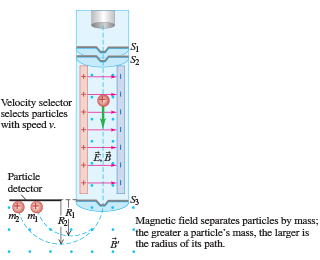
Part A
Find the separation of the 14N and 15N isotopes at the detector.
Express your answer with the appropriate units.
In: Physics
1.) Use ecological principles to explain why are big, fierce animals rare even in natural ecosystems....
1.) Use ecological principles to explain why are big, fierce animals rare even in natural ecosystems. What is the result when humans remove them entirely from wild areas?
2.) Explain the 4 major human causes of extinction.
3.) Describe an ecosystem service that you use and benefit from. How would you replace this service if the organisms providing it became extinct?
4.) Research and give an example of an indicator species, an umbrella species, a flagship species and a keystone species not described in the notes. Briefly explain their importance in their ecosystems.
5.) Explain the vegetation changes during primary succession and why they happen.
I need help on these 5 questions.
In: Biology
Topic 3. Patent protection for BRCA genes. On the Internet, read one or more articles about...
Topic 3. Patent protection for BRCA genes. On the Internet, read one or more articles about how the Supreme Court of the United States (SCOTUS) ruled in the case of Association for Molecular Pathology versus Myriad Genetics. In your answer, give must credit your source(s). Your answer must address the following:
(a) Why did the plaintiffs object to Myriad’s patent on the breast cancer-related genes (BRCA1 and BRCA2)?
(b) How did SCOTUS rule [Note: the rulings of lower courts are NOT of interest for our purposes. Please concentrate on SCOTUS's ruling].
(c) What is your view on the issue of whether we should allow human genes to be patented?
In: Biology