Questions
Mr Dumas is a famous French chef who moved from Paris to Sydney on 1 November...
Mr Dumas is a famous French chef who moved from Paris to Sydney on 1 November 2018 to work for an Australian fine dining restaurant. His remuneration includes a salary of $350,000 plus $50,000 bonus per year and a contractual term of two years. Mr Dumas would be paid a lump sum of $500,000 in return for his promise that, if he resigns, he would not set up in a business in Sydney in competition with an Australian fine dining restaurant for 3 years. Mrs Dumas moved to Sydney with her husband and three children. Mr Dumas obtained permanent residence since 1 November 2018 and bought the following assets in Sydney: A vintage motor vehicle built in 1961: acquired on 15 November 2018 at a cost of $150,000. Mr Dumas intended it to be kept as a long-term investment. A family house in Chatswood: acquired on 1 December 2018 at a cost of $1,200,000 10,000 Shares in BHP: acquired on 1 January 2019 at a cost of $300,000 were sold for $320,000 on 15 May 2020. During the financial year 2020, Mr Dumas signed the contract with SBS TV channel around November 2019 and agreed to travel to New Zealand in December 2019 for filming The Food Show. The fee of $100,000 will be paid out to him once the show is released on TV in August 2020. On 1 May 2020, Mr Dumas sold the following overseas assets which he bought before he came to Australia: 30,000 shares in a USA company: acquired on 1 July 1982 at a cost of $15,000 and was sold for $35,000 on 1 May 2020. The market value was $6,000 as at 1 November 2018. An investment flat in Paris: acquired on 15 July 2018 at a cost of $230,000 and was sold for $200,000 on 1 May 2020. Mr Dumas still maintains a bank account at the Bank of Paris in France which earned a total of $8,500(2018/2019) and $10,000(2019/2020) in interest income. He neither repatriated nor declared any part of the interest derived in France because he has paid 15% withholding tax. Hence, at the time of lodging his Australian tax return, Mr Dumas declared his Australian sourced income only. Mr Dumas lodged his 2018/19 tax return on 15 August 2019 and received a notice of assessment on 25 October 2019. On 15 February 2020, he received a notice of amended assessment which included his Australian taxable income the amounts derived in French. The amended assessment required Mr Dumas to pay $4,250 additional tax to the ATO. Mr Dumas and his family decided to relocate to New Zealand indefinitely and left Australia on 30 June 2020 to set up a high-end restaurant. On 10 July 2020, he also received a lump sum payment of $500,000 under the terms of his remuneration package with his Australian employer.
Required: Under what circumstances and on what grounds could the ATO issue the amended assessment for the year 2018/2019?
What should Mr Dumas do if he decides to dispute this amended assessment, and what time limits would apply for the dispute to be commenced?
Advise Mr Dumas on what amounts may be included in his Australian taxable income for the 2019/20 tax year.
Calculate his taxable income for the year ending 30 June 2020.
In: Accounting
You will make many purchases online in order to benefit from greater convenience or lower—prices, but...
You will make many purchases online in order to benefit from greater convenience or lower—prices, but you will likely set foot in a brickand mortar retail store at least occasionally, and you may have noticedsome changes brought by technology. A few decades ago, large retail chains started introducing computerized point-of-sale inventory systems consisting of checkout computers and an inventory control system. A simple bar code scancaptures a sale, and the item is automatically deducted from the store’s inventory, allowing real-time tracking of purchases so that the retailer knows when to reorder merchandise or restock shelves. In addition to a speedier checkout process, such systems help to reduce stockouts, increasing customer satisfaction. In many grocery stores, this system has been taken a step further, allowing the customers to conduct the checkout process themselves, saving time and labor costs. In Switzerland, grocery retailer Migros introduced a system that allows customers to scan items as they are placed into the shopping cart. At the checkout counter, all the customer has to do is swipe a credit card.
In the near future, many items may be equipped with radio frequency identification (RFID) tags (see Chapter 8), eliminating the need to scan each individual item, so that the total price for a cart full of merchandise can becalculated within a second, saving even more time and adding convenience for the customer. Imagine the time you’ll save when all you have to do is pass with your cart through an RFID reader and swipe your credit card.
Payment systems are also changing. A new “Pay by Fingerprint” system allows customers to complete a purchase by placing a finger onto a fingerprint scanner without the need to sign a sales slip or enter a personal identification number (PIN ); this makes the checkout process extremely convenient and secure. Another innovative way to pay for a purchase is via mobile phone. Using a technology called near-field communication (NFC; similar to Bluetooth), the customer’s mobile phone communicates with the retailer’s payment terminal, and the payment amount is automatically debited from the customer’s bank account. NFC-based payment systems have already begun to be implemented; major smartphone manufacturers such as Samsung, Nokia, Motorola, and HT C actively support this new technology by integrating it into new handsets.
Further, many brick-and-mortar retailers have had to respond to the phenomenon of showrooming, in which, as discussed earlier, customers examine products in person at a store and then leave to order the same product online for less. Retailers invest billions to build and maintain their storefronts, and online retailers can often undercut physical stores’ prices; when a customer takes advantage of this, the brick-andmortar retailer cannot recoup the cost of the storefront. Some retailers like Best Buy and Target are embracing this trend, however, by encouraging consumers to browse their shelves and compare prices online. By providing perks such as superior, personal customer service and instituting price-matching policies, these retailers prevent loss of customers due to price while benefiting by selling additional products. Other new and exciting in-store technologies include smart fitting rooms that use augmented reality technology to show how an item would look when worn or suggest complementary items. Finally, retail stores are increasingly using Bluetooth-enabled sales beacons to provide customers with real-time promotional offers.
As you can see, information systems have had a huge impact on retailing, and many more changes are yet to hit the shelves.
You may make many purchases online in order to benefit from greater convenience or lower prices, but you will likely set foot in a brick-and-mortar retail store at least occasionally, and you may have noticed some changes brought by technology. A few decades ago, large retail chains started introducing computerized point-of-sale inventory systems consisting of checkout computers and an inventory control system. A simple bar code scan captures a sale, and the item is automatically deducted from the store’s inventory, allowing real-time tracking of purchases so that the retailer knows when to reorder merchandise or restock shelves. In addition to a speedier checkout process, such systems help to reduce stockouts, increasing customer satisfaction. In many grocery stores, this system has been taken a step further, allowing the customers to conduct the checkout process themselves, saving time and labor costs. In Switzerland, grocery retailer Migros introduced a system that allows customers to scan items as they are placed into the shopping cart. At the checkout counter, all the customer has to do is swipe a credit card.
In the near future, many items may be equipped with radio frequency identification (RFID) tags (see Chapter 8), eliminating the need to scan each individual item, so that the total price for a cart full of merchandise can be calculated within a second, saving even more time and adding convenience for the customer. Imagine the time you’ll save when all you have to do is pass with your cart through an RFID reader and swipe your credit card.
Payment systems are also changing. A new “Pay by Fingerprint” system allows customers to complete a purchase by placing a finger onto a fingerprint scanner without the need to sign a sales slip or enter a personal identification number (PIN ); this makes the checkout process extremely convenient and secure. Another innovative way to pay for a purchase is via mobile phone. Using a technology called near-field communication (NFC; similar to Bluetooth), the customer’s mobile phone communicates with the retailer’s payment terminal, and the payment amount is automatically debited from the customer’s bank account. NFC-based payment systems have already begun to be implemented; major smartphone manufacturers such as Samsung, Nokia, Motorola, and HT C actively support this new technology by integrating it into new handsets.
Further, many brick-and-mortar retailers have had to respond to the phenomenon of showrooming, in which, as discussed earlier, customers examine products in person at a store and then leave to order the same product online for less. Retailers invest billions to build and maintain their storefronts, and online retailers can often undercut physical stores’ prices; when a customer takes advantage of this, the brick-andmortar retailer cannot recoup the cost of the storefront. Some retailers like Best Buy and Target are embracing this trend, however, by encouraging consumers to browse their shelves and compare prices online. By providing perks such as superior, personal customer service and instituting price-matching policies, these retailers prevent loss of customers due to price while benefiting by selling additional products. Other new and exciting in-store technologies include smart fitting rooms that use augmented reality technology to show how an item would look when worn or suggest complementary items. Finally, retail stores are increasingly using Bluetooth-enabled sales beacons to provide customers with real-time promotional offers.
As you can see, information systems have had a huge impact on retailing, and many more changes are yet to hit the shelves.
Help with an Introduction & Summary!!!!! Please!
In: Computer Science
XYZ Corporation, an Australian based carmaker, is considering an expansion into Asia after its expansion into...
XYZ Corporation, an Australian based carmaker, is considering an expansion into Asia after its expansion into the US last summer was highly successful. Currently, XYZ does export cars to Asia, but the increased demand raises the question of an expansion in Asia. XYZ is trying to decide whether to establish a car manufacturing plant and office in Japan where cars would be built and then sold across Asia.
All relevant data is given in the tables below. The cost of the expansion is Yen 80,000,000, which must be immediately expended. Three-year EBITDA are 35,000,000 45,000,000 and 55,000,000 respectively. Moreover, XYZ would have to fund additional working capital of Yen 5,000,000 at the time of the expansion. Further investment in net working capital would be Yen 5,000,000, Yen 8,000,000, and Yen 10,000,000 in year 1, 2, and 3 respectively. If it builds the plant, XYZ will depreciate it at a rate of Yen 4,000,000 per year (starting in year 1) and will have to fund additional capital expenditures of Yen 8,000,000 per year to maintain and improve the plant. Although the project is assumed to have an infinite life, cash-flows are only projected up to three years and the terminal value of the project is computed based on the year 3 free cash-flow (FCF) assuming a growth rate that equals the Japanese long-run GDP growth rate.
All taxes are paid in Japan in the year the income is earned. Tax treaties are in effect so that XYZ will have no tax obligations to the Australian Tax Office (ATO). The following information applies to the valuation.
|
Japan |
Australia |
|
|
Price Inflation |
2.00% |
3.00% |
|
Annual return on government bonds |
3.00% |
4.00% |
|
Corporate tax rate |
40.00% |
30.00% |
|
Equity market risk premium AUD |
6.00% |
|
|
Spot rate-S(AUD/Yen) |
0.01 |
|
|
Before tax cost of debt |
5.00% |
|
|
Debt-to-value ratio (D/V) |
0.5 |
|
|
Systematic risk (beta) |
1.2 |
|
|
Japanese long-run GDP growth rate |
3% |
|
|
WACC |
12.80% |
Required:
- Calculate the cost of capital, in Australia, for the project.
- Calculate the forward exchange rates, F1(AUD/Yen) through F3(AUD/Yen), for the years 1, 2, and 3 based on the spot rate and the interest rates given in the question. (round to 5 decimal places)
- Calculate the Free of Cash Flows of the project in Yen from year 1 to year 3.
- What is the terminal value as of year 3? Use a perpetuity formula, the Free Cash Flows in Yen for year 3, and the Japanese growth rate assumption given in the question. Assume the appropriate discount rate is WACC.
- Calculate the AUD value of FCF for the years 0, 1, 2 and 3 and the terminal value using the forward rates calculated in (b).
- What is the NPV of the project from XYZ's perceptive (in AUD)? Should XYZ expand into the Asian market?
In: Finance
The dataset for this assignment contains house prices as well as 19 other features for each...
The dataset for this assignment contains house prices as well as 19 other features for each property. Those features are detailed below and include information about the house (number of bedrooms, bathrooms…), the lot (square footage…) and the sale conditions (period of the year…) The overall goal of the assignment is to predict the sale price of a house by using a linear regression. For this assignment, the training set is in the file "house_prices_train.csv" and the test set is in the file "house_prices_test.csv"
Here is a brief description of each feature in the dataset:
- SalePrice: the property's sale price in dollars. This is the target variable that you're trying to predict.
- LotFrontage: Linear feet of street connected to property
- LotArea: Lot size in square feet
- YearBuilt: Original construction date
- BsmtUnfSF: Unfinished square feet of basement area
- TotalBsmtSF: Total square feet of basement area
- 1stFlrSF: First Floor square feet
- 2ndFlrSF: Second floor square feet
- LowQualFinSF: Low quality finished square feet (all floors)
- GrLivArea: Above grade (ground) living area square feet
- FullBath: Full bathrooms above grade
- HalfBath: Half baths above grade
- BedroomAbvGr: Number of bedrooms above basement level
- KitchenAbvGr: Number of kitchens
- TotRmsAbvGrd: Total rooms above grade (does not include bathrooms)
- GarageCars: Size of garage in car capacity
- GarageArea: Size of garage in square feet
- PoolArea: Pool area in square feet
- MoSold: Month Sold
- YrSold: Year Sold
I completed the code correctly for question 1a(Open the training dataset and remove all rows that contain at least one missing value (NA) & Return the new clean dataset and the number of rows in that dataset) but need help with the rest of the question. This is my code:
def clean_data():
import pandas as pd
data = pd.read_csv('house_prices_train.csv', index_col=0)
data_train = data.dropna()
nb_rows = data_train.shape[0]
return([nb_rows, data_train])
Question 1b:
For the training dataset, print a summary of the variables “LotArea”, “YearBuilt”, “GarageArea”, and “BedroomAbvGr” and “SalePrice”. Return the whole summary and a list containing (in that order):
- The maximum sale price
- The minimum garage area
- The first quartile of lot area
- The second most common year built
- The mean of BedroomAbvGr
Hint: Use the built-in method describe() for a pandas.DataFrame
Here's the sample code i was given to start off:
def summary(data_train):
# Code goes here
# max_sale = maximum sale price in the training dataset
# min_garea = mining garage area
# fstq_lotarea = first quartile of lot area
# scd_ybuilt = second most common year built
# mean_bed = mean number of bedrooms above ground
### YOUR CODE HERE
return([max_sale, min_garea, fstq_lotarea, scd_ybuilt,
mean_bed])
Question 1c:
Run a linear regression on "SalePrice" using the variables “LotArea”, “YearBuilt”, “GarageArea”, and “BedroomAbvGr”. For each variable, return the coefficient associated to the regression in a dictionary similar to this: {“LotArea”: 1.888, “YearBuilt”: -0.06, ...} (This is only an example not the right answer)
Compute the Root Mean Squared Error (RMSE) using the file "house_prices_test.csv" to measure the out-of-sample performance of the model.
################# Function to fit your Linear Regression Model
###################
def linear_regression_all_variables(data_train):
from sklearn import linear_model
# Code goes here
# dict_coeff = dictionnary (key = name of the variable, value =
coefficient in the linear
# regression model)
# lreg = your linear regression model
###
### YOUR CODE HERE
###
return([dict_coeff, lreg])
Question 1d:
Refit the model on the training set using all the variables and return the RMSE on the test set.
(The first column "unnamed: 0" is not a variable)
################# Function to compute the Root Mean Squared
Error ###################
def compute_mse_test(data_train, data_test):
from sklearn import linear_model, metrics
dict_coeff, lreg =
linear_regression_all_variables(data_train)
###
### YOUR CODE HERE
###
# rmse = Root Mean Squared Error
return(rmse)
def linear_regression_all(data_train, data_test)
from sklearn import linear_model, metrics
#Code goes here
#rmse = root mean squared error of the second linear regression on
the test dataset
###
### YOUR CODE HERE
###
rmse = np.sqrt(metrics.mean_squared_error(y_test, y_pred))
return (rmse)
In: Computer Science
Calculation of cost basis of a used machine
A used machine with a purchase price of $41,809, requiring an overhaul costing $9,833, installation costs of $6,615, and special acquisition fees of $32,417, would have a cost basis of
a. $139,539
b. $90,674
c. $51,642
d. $41,809
In: Accounting
An investment has an installed cost of $673.658
An investment has an installed cost of $673.658. The cash flows over the four year life of the investment are projected to be $228,701, $281,182, $219,209, and $190,376.
Requirement 1:
If the discount rate is zero, what is the NPV? (Do not round intermediate calculations.)
Requirement 2:
If the discount rate is infinite, what is the NPV? (Do not round intermediate calculations. Negative amount should be indicated by a minus sign.)
Requirement 3:
At what discount rate is the NPV just equal to zero? (Do not round intermediate calculations. Round your answer to 2 decimal places (e.g. 32.16).)
In: Finance
What is the appropriate cost of capital for the project?
Empress Inc. has issued a bond with a face value of $1,000 and an interest rate of 13% to fund a new project. The bond is secured by the cash flows from the project, which will be $950 with a probability of 60% and $1,200 otherwise. Assume risk neutrality.
What is the appropriate cost of capital for the project?
In: Finance
Consider the following “Total Cost” function:
Consider the following “Total Cost” function:
Total Cost = 4Q3 – 204Q2 + 700Q + 2500
a.) Solve for the “inflection point” of this function ( show your work).
b.) Which Q has the LOWEST “Marginal Cost” ( give a numerical answer; briefly
explain how your answer to a.) is relevant).
In: Economics
Different Cost Classifications for Different Purposes
Dozier Company produced and sold 1,000 units during its first month of operations. It reported the following costs and expenses for the month

Required:
1. With respect to cost classifications for preparing financial statements:
a. What is the total product cost?
b. What is the total period cost?
2. With respect to cost classifications for assigning costs to cost objects:
a. What is total direct manufacturing cost?
b. What is the total indirect manufacturing cost?
3. With respect to cost classifications for manufacturers:
a. What is the total manufacturing cost?
b. What is the total nonmanufacturing cost?
c. What is the total conversion cost and prime cost?
4. With respect to cost classifications for predicting cost behavior:
a. What is the total variable manufacturing cost?
b. What is the total fixed cost for the company as a whole?
c. What is the variable cost per unit produced and sold?
5. With respect to cost classifications for decision making:
a. If Dozier had produced 1,001 units instead of 1,000 units, how much incremental manufacturing cost would it have incurred to make the additional unit?
In: Accounting
Cost-push inflation is a situation in which the:
1.
Cost-push inflation is a situation in which the:
short-run aggregate supply curve shifts rightward.
short-run aggregate supply curve shifts leftward.
aggregate demand curve shifts leftward.
aggregate demand curve shifts rightward
2. Which of the following tends to make aggregate demand decrease by more than the amount that consumer spending decreases?
the interest rate effect
the crowding-out effect
the wealth effect
the multiplier effect
3.
(Figure: Aggregate Demand Shift)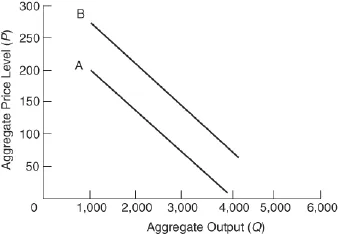 Which of the following may be an explanation for the shift in aggregate demand from line A to line B? |
Prices fall and increase real wealth.
Consumer confidence declines and consumption spending falls.
Interest rates fall and boost investments.
Goods and services become less competitive and exports fall.
In: Economics