Questions
The table that follows lists four pairs of initial and final angles of a wheel on...
The table that follows lists four pairs of initial and final angles of a wheel on a moving car. The elapsed time for each pair of angles is 1.5 s. For each of the four pairs, determine the average angular velocity (magnitude and direction as given by the algebraic sign of your answer).
| Initial angle θ0 | Final angle θ | |
| (a) | 0.51 rad | 0.70 rad |
| (b) | 0.88 rad | 0.59 rad |
| (c) | 5.8 rad | 3.7 rad |
| (d) | 2.7 rad | 3.8 rad |
In: Physics
Tulia Company manufactures agricultural implements. At the beginning of the third quarter of 2018, the company...
Tulia Company manufactures agricultural implements. At the beginning of the third quarter of 2018, the company had planned to produce 400 units of output during the quarter; this level of demand was considered “normal” for the period and reflected the average demand in the third quarter for the previous three years. However, a marketing decision by Tulia’s management to cut prices by 5 percent during the quarter led to an uptick in demand, with the result that the company increased production to 450 units for the quarter. The company tracks four factory inputs: direct materials, direct labor, variable factory overhead, and fixed factory overhead. Both variable and fixed factory overhead are applied using predetermined rates based on direct labor hours. For each of the following cost components, an examination of the records revealed the following amounts:
Direct materials: Standard cost per unit of direct materials: $3.50 per pound.
Direct materials price variance: $350 U.
Total pounds of standard direct materials allowed for the actual output achieved: 2,700 pounds. Direct materials quantity variance: $70 U. Actual quantity of direct material purchased: 3,500 pounds.
1. Compute the following amounts (make sure you indicate the direction of any variance computed):
a. Standard cost of direct material allowed per unit of output: $_______________ .
b. Actual cost per pound of direct materials purchased: $_______________.
c. Actual quantity of materials used in production: _______________ pounds.
In: Advanced Math
The following information is provided by Exemplar Pty Ltd (tax rate 30%). Date Transaction Amount ($)...
The following information is provided by Exemplar Pty Ltd (tax rate 30%).
|
Date |
Transaction |
Amount ($) |
|
07.07.19 |
Franking deficit tax relating to 2018/19 |
7,000 |
|
28.07.19 |
PAYG instalment paid for June quarter 2018/19 |
13,000 |
|
30.09.19 |
Paid final dividend from 2018/19 – 80% franked |
14,000 |
|
25.10.19 |
PAYG instalment paid for Sep quarter 2019/20 |
3,500 |
|
28.10.19 |
Refund of net tax from 2018/19 income tax return |
12,500 |
|
15.12.19 |
Received fully franked dividend |
7,000 |
|
28.02.20 |
PAYG instalment paid for Dec quarter 2019/20 |
3,500 |
|
15.03.20 |
Paid interim dividend – fully franked |
14,000 |
|
28.04.20 |
PAYG instalment paid for March quarter 2019/20 |
3,500 |
|
30.05.20 |
Paid 2019/20 Fringe benefit tax |
4,600 |
|
30.06.20 |
Final dividend declared for 2019/20 |
9,000 |
|
30.06.20 |
PAYG instalment payable for June quarter 2019/20 |
3,500 |
The company bench mark percentage is 80%
Taxable income of the company for the 2019/20 tax year was $90,000
The franking deficit tax paid on 7 July was applied against the 2018/19 tax liability (FDT).
Required
Prepare the franking account of Exemplar Pty Ltd for the 2019/20 franking year.
Calculate the company net tax payable/refundable for 2019/20
In: Accounting
JAVA PROGRAMMING Implement a class Purse. A purse contains a collection of coins. For simplicity, we...
JAVA PROGRAMMING
Implement a class Purse. A purse contains a collection of coins.
For simplicity, we will only store the coin names in an
ArrayList<String>.
- Supply a method void addCoin(String coinName).
- Add a method toString to the Purse class that prints the coins in the purse in the format Purse[Quarter,Dime,Nickel,Dime].
- Write a method reverse that reverses the sequence of coins in a purse.
- Implement a TestPurse class with a main method in it. It will use the toString method to test your code. For example, if reverse is called with a purse Purse[Quarter,Dime,Nickel,Dime], then the purse is changed to Purse[Dime,Nickel,Dime,Quarter].
- MUST BE TWO SEPERATE CLASSES
IMP: This is what I have so far. Please correct it.
PURSE CLASS:
import java.util.Collections;
import java.util.ArrayList;
public class Purse {
private ArrayList<String> coins;
public Purse() {
coins = new
ArrayList<String>();
}
public void addCoin(String nameofCoin)
{
}
public String toString()
{
return coins.toString();
}
public String reverse()
{
ArrayList<String> pl = new
ArrayList<String>(coins);
Collections.reverse(pl);
return pl.toString();
}
}
//TEST PURSE CLASS:
public class TestPurse {
public static void main(String[] args) {
Purse pu = new Purse();
pu.addCoin("Dime");
pu.addCoin("Dime");
pu.addCoin("Nickel");
pu.addCoin("Quarter");
System.out.println(pu);
System.out.println("Expected the
Purse: Dime, Dime, Nickel, Quarter");
System.out.println(pu.reverse());
}
}
In: Computer Science
Analyzing Inventories Using LIFO Inventory Footnote The footnote below is from the 2014 10 -K report...
Analyzing Inventories Using LIFO Inventory
Footnote
The footnote below is from the 2014 10 -K report of Whole Foods
Market, Inc., a Texas-based retail grocery chain.
Inventories
The Company values inventories at the lower of cost or market. Cost
was determined using the dollar value retail last-in, first-out
("LIFO") method for approximately 93.5 % and 92.8 % of inventories
in fiscal years 2014 and 2013, respectively. Under the LIFO method,
the cost assigned to items sold is based on the cost of the most
recent items purchased. As a result, the costs of the first items
purchased remain in inventory and are used to value ending
inventory. The excess of estimated current costs over LIFO carrying
value, or LIFO reserve, was approximately $54 million and $47
million at September 28, 2014 and September 29, 2013, respectively.
Costs for remaining inventories are determined by the first-in,
first-out method. Cost before the LIFO adjustment is principally
determined using the item cost method, which is calculated by
counting each item in inventory, assigning costs to each of these
items based on the actual purchase cost (net of vendor allowances)
of each item and recording the actual cost of items sold.
Whole Foods operates the world's largest chain of natural and organic food stores. In 2014, Whole Foods reported sales revenue of $13,988 million and cost of goods sold of $8,755 million. The following information was extracted from the company's 2014 and 2013 balance sheets:
| ($ millions) | 2014 | 2013 | |||
|---|---|---|---|---|---|
| Merchandise inventories | $399 | $352 | |||
a. Calculate the amount of inventories purchased by Whole Foods in
2014. $Answer million
b. What amount of gross profit would Whole Foods have reported if the FIFO method had been used to value all inventories? $Answer million
c. Calculate the gross profit margin (GPM) as reported and assuming that the FIFO method had been used to value all inventories.
Round to the nearest percentage (i.e., 0.453 = 45 %) Answer%
In: Accounting
Analyzing Inventories Using LIFO Inventory Footnote The footnote below is from the 2014 10 -K report...
Analyzing Inventories Using LIFO Inventory Footnote
The footnote below is from the 2014 10 -K report of Whole Foods
Market, Inc., a Texas-based retail grocery chain.
Inventories
The Company values inventories at the lower of cost or market. Cost
was determined using the dollar value retail last-in, first-out
("LIFO") method for approximately 93.5 % and 92.8 % of inventories
in fiscal years 2014 and 2013, respectively. Under the LIFO method,
the cost assigned to items sold is based on the cost of the most
recent items purchased. As a result, the costs of the first items
purchased remain in inventory and are used to value ending
inventory. The excess of estimated current costs over LIFO carrying
value, or LIFO reserve, was approximately $45 million and $29
million at September 28, 2014 and September 29, 2013, respectively.
Costs for remaining inventories are determined by the first-in,
first-out method. Cost before the LIFO adjustment is principally
determined using the item cost method, which is calculated by
counting each item in inventory, assigning costs to each of these
items based on the actual purchase cost (net of vendor allowances)
of each item and recording the actual cost of items sold.
Whole Foods operates the world's largest chain of natural and organic food stores. In 2014, Whole Foods reported sales revenue of $12,852 million and cost of goods sold of $7,632 million. The following information was extracted from the company's 2014 and 2013 balance sheets:
| ($ millions) | 2014 | 2013 | |||
|---|---|---|---|---|---|
| Merchandise inventories | $432 | $399 | |||
a. Calculate the amount of inventories purchased by Whole Foods in 2014. $Answer million
b. What amount of gross profit would Whole Foods have reported if the FIFO method had been used to value all inventories? $Answer million
c. Calculate the gross profit margin (GPM) as reported and assuming that the FIFO method had been used to value all inventories.
Round to the nearest percentage (i.e., 0.453 = 45 %) Answer%
In: Accounting
Figure is an edge-on view of a 14 cm diameter circular loop rotating in a uniform...
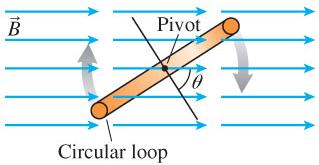 Figure is an edge-on view of a 14
cm diameter circular loop rotating in a uniform
Figure is an edge-on view of a 14
cm diameter circular loop rotating in a uniform
3.8×10⁻² T magnetic field. I solved part a by using
φ= B A cos θ = Bπr2 cosθ = (3.8 x 10⁻²) π (.07)2cos (0 degrees)= 5.8 x 10⁻⁴ Wb and got correct answer,
but having trouble finding the right answer for part B. I used same equation for part B and used cos (30)= got wrong answer. Is there another equation for finding the answer with the other angles?
Part A
What is the magnetic flux through the loop when is 0 degrees ?
Express your answer to two significant figures and include the
appropriate units.
=5.8×10⁻⁴ Wb
Correct
Part B
What is the magnetic flux through the loop when is 30 degrees
?
Express your answer to two significant figures and include the
appropriate units.
=
Part C
What is the magnetic flux through the loop when is 60 degrees
?
Express your answer to two significant figures and include the
appropriate units.
=
Part D
What is the magnetic flux through the loop when is 90 degrees
?
Express your answer to two significant figures and include the
appropriate units.
In: Physics
The home run percentage is the number of home runs per 100 times at bat. A...
The home run percentage is the number of home runs per 100 times at bat. A random sample of 43 professional baseball players gave the following data for home run percentages.
| 1.6 | 2.4 | 1.2 | 6.6 | 2.3 | 0.0 | 1.8 | 2.5 | 6.5 | 1.8 |
| 2.7 | 2.0 | 1.9 | 1.3 | 2.7 | 1.7 | 1.3 | 2.1 | 2.8 | 1.4 |
| 3.8 | 2.1 | 3.4 | 1.3 | 1.5 | 2.9 | 2.6 | 0.0 | 4.1 | 2.9 |
| 1.9 | 2.4 | 0.0 | 1.8 | 3.1 | 3.8 | 3.2 | 1.6 | 4.2 | 0.0 |
| 1.2 | 1.8 | 2.4 |
(a) Use a calculator with mean and standard deviation keys to find x and s. (Round your answers to two decimal places.)
| x = | % |
| s = | % |
(b) Compute a 90% confidence interval for the population mean
μ of home run percentages for all professional baseball
players. Hint: If you use the Student's t
distribution table, be sure to use the closest d.f. that
is smaller. (Round your answers to two decimal
places.)
| lower limit | % |
| upper limit | % |
(c) Compute a 99% confidence interval for the population mean
μ of home run percentages for all professional baseball
players. (Round your answers to two decimal places.)
| lower limit | % |
| upper limit | % |
In: Statistics and Probability
The home run percentage is the number of home runs per 100 times at bat. A...
The home run percentage is the number of home runs per 100 times at bat. A random sample of 43 professional baseball players gave the following data for home run percentages.
| 1.6 | 2.4 | 1.2 | 6.6 | 2.3 | 0.0 | 1.8 | 2.5 | 6.5 | 1.8 |
| 2.7 | 2.0 | 1.9 | 1.3 | 2.7 | 1.7 | 1.3 | 2.1 | 2.8 | 1.4 |
| 3.8 | 2.1 | 3.4 | 1.3 | 1.5 | 2.9 | 2.6 | 0.0 | 4.1 | 2.9 |
| 1.9 | 2.4 | 0.0 | 1.8 | 3.1 | 3.8 | 3.2 | 1.6 | 4.2 | 0.0 |
| 1.2 | 1.8 | 2.4 |
(a) Use a calculator with mean and standard deviation keys to find x and s. (Round your answers to two decimal places.)
| x = | % |
| s = | % |
(b) Compute a 90% confidence interval for the population mean
μ of home run percentages for all professional baseball
players. Hint: If you use the Student's t
distribution table, be sure to use the closest d.f. that
is smaller. (Round your answers to two decimal
places.)
| lower limit | % |
| upper limit | % |
(c) Compute a 99% confidence interval for the population mean
μ of home run percentages for all professional baseball
players. (Round your answers to two decimal places.)
| lower limit | % |
| upper limit | % |
In: Statistics and Probability
The home run percentage is the number of home runs per 100 times at bat. A...
The home run percentage is the number of home runs per 100 times at bat. A random sample of 43 professional baseball players gave the following data for home run percentages. 1.6 2.4 1.2 6.6 2.3 0.0 1.8 2.5 6.5 1.8
2.7 2.0 1.9 1.3 2.7 1.7 1.3 2.1 2.8 1.4
3.8 2.1 3.4 1.3 1.5 2.9 2.6 0.0 4.1 2.9
1.9 2.4 0.0 1.8 3.1 3.8 3.2 1.6 4.2 0.0
1.2 1.8 2.4
(a) Use a calculator with mean and standard deviation keys to find x and s. (Round your answers to two decimal places.) x = % s = %
(b) Compute a 90% confidence interval for the population mean μ of home run percentages for all professional baseball players. Hint: If you use the Student's t distribution table, be sure to use the closest d.f. that is smaller. (Round your answers to two decimal places.) lower limit % upper limit %
(c) Compute a 99% confidence interval for the population mean μ of home run percentages for all professional baseball players. (Round your answers to two decimal places.) lower limit % upper limit %
In: Statistics and Probability