Questions
A farmer has been in the habit of always planting potatoes on his farm. In previous...
A farmer has been in the habit of always planting potatoes on his farm. In previous years, the seeds for the potatoes were planted in the spring, and were ready to harvest in mid-July. After that, a second planting took place in late July, which was ready to harvest in early October.
This year, however, there is concern that a blight might destroy some or all of the potato crop. One thing he could do would be to plant a different crop such as peas which would not be affected by the blight. The peas would have only a single planting at a cost of $40,000. This planting would yield a crop in October worth $70,000 if the weather turns out to be good, or $30,000 if the weather turns out to be poor. There is a 60% chance that the weather will be good.
If, however, he decides to plant potatoes, he will have to worry about the blight (but the weather has little effect on the potato crop and can be ignored). The potato crop would cost $60,000 to plant. There is a 10% chance of a severe blight, which would destroy the crop, and render any attempt at a second planting in late July not worth doing. A mild blight (20% chance) would partially destroy the crop, making it worth only $35,000, while having no blight (70% chance) would produce a crop worth $80,000. After either a mild blight or no blight, a second planting could be undertaken, with the same costs and revenues as the first. The probability of a severe, mild, or no blight would be 15%, 30%, and 55% if the first planting had a mild blight, but would be 0%, 5%, and 95% if the first planting had no blight.
NOTE: The crop planted in the Spring will be either peas or potatoes; doing a bit of both is not an option in this problem.
Draw the tree, solve it using the rollback procedure, and state the recommen- dation and the ranking payoff. When drawing the tree, use payoff nodes for inter- mediate payoffs.
Please show all workings and show where the numbers come from.
In: Operations Management
On March 1, Showcase Co., a furniture wholesaler, sells merchandise to Balboa Co. on account, $254,500, terms n/30.
Instructions
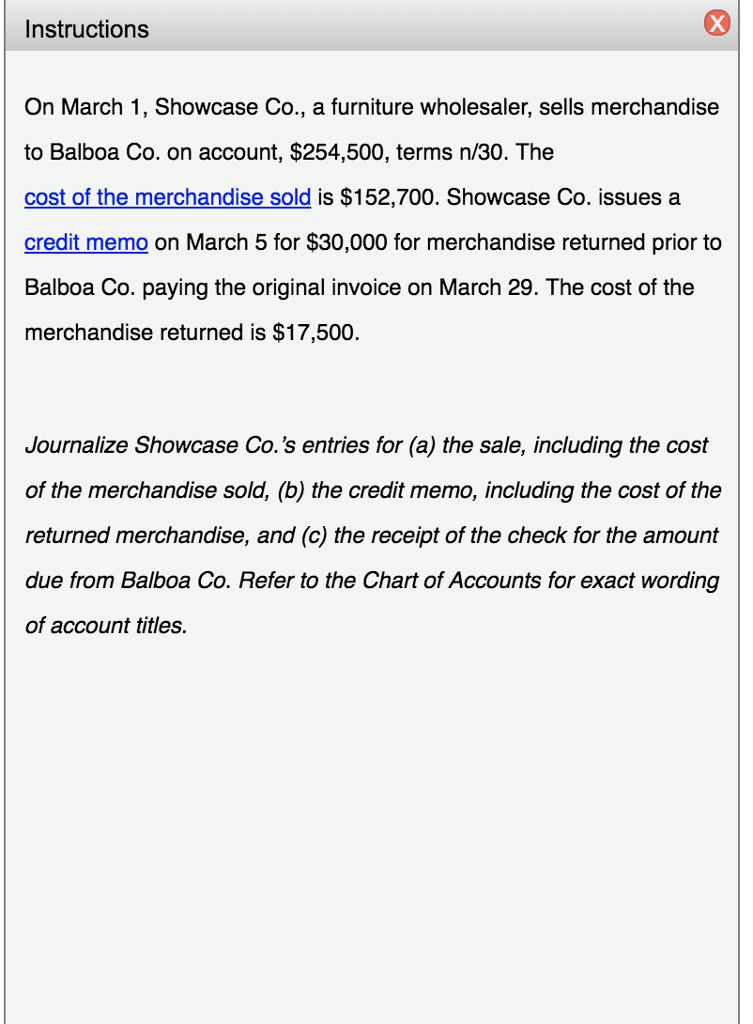
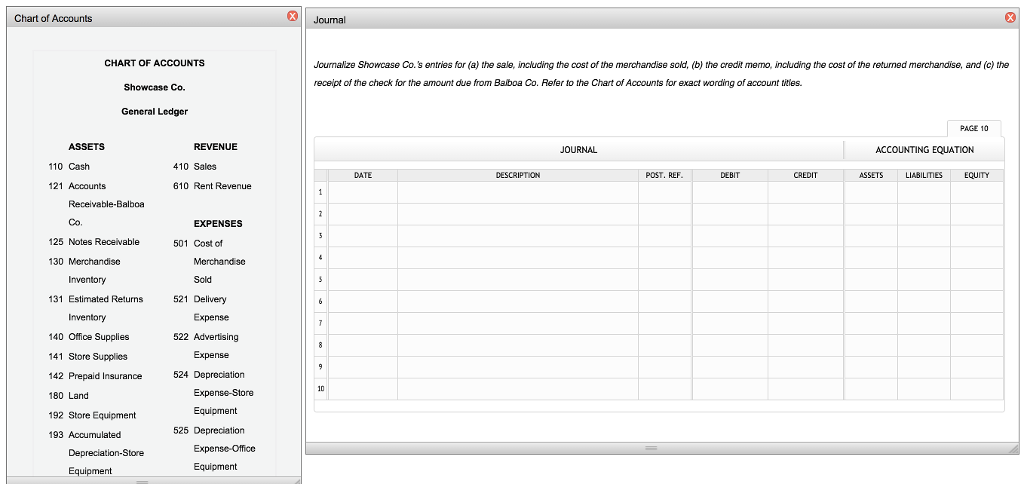
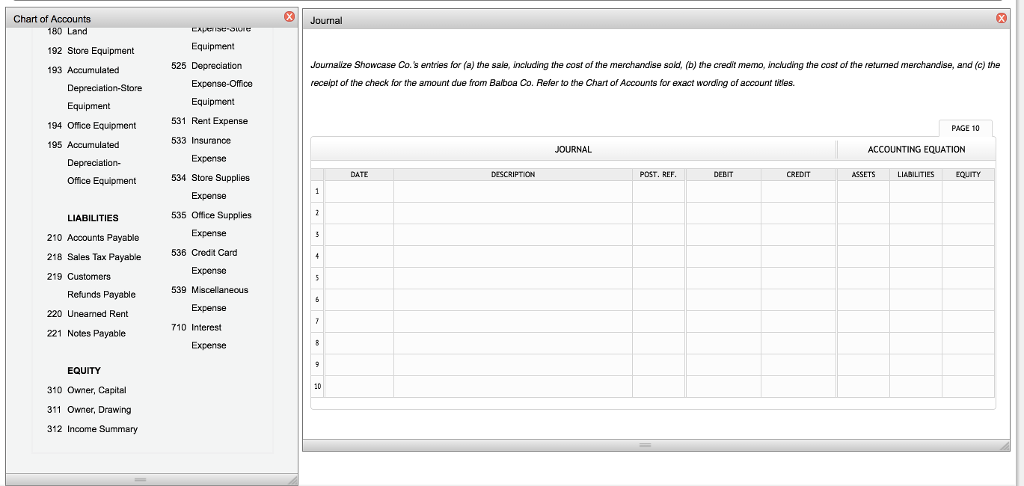
On March 1, Showcase Co., a furniture wholesaler, sells merchandise to Balboa Co. on account, $254,500, terms n/30. The cost of the merchandise sold is $152,700. Showcase Co. issues a credit memo on March 5 for $30,000 for merchandise returned prior to Balboa Co. paying the original invoice on March 29. The cost of the merchandise returned is $17,500.
Journalize Showcase Co.'s entries for (a) the sale, including the cost of the merchandise sold, (b) the credit memo, including the cost of the returned merchandise, and (c) the receipt of the check for the amount due from Balboa Co. Refer to the Chart of Accounts for exact wording of account titles.
In: Accounting
Al-bracken Co. began the year with an accounts receivable balance of $78,000, and ended the year...
Al-bracken Co. began the year with an accounts receivable balance of $78,000, and ended the year with an accounts receivable balance of $54,000. During the year, Al-bracken Co. recorded $445,400 of sales on account. How much cash did Al-bracken Co. collect from its customers during the year?
Elle’s Soap Co. began the year with an accounts payable balance related to inventory purchases of $15,000. The balance in the account at the end of the year was $26,800. During the year, Elle’s Soap Co. purchased $118,000 of inventory on account. How much cash did Elle’s Soap Co. pay for inventory purchases during the year?
In: Accounting
Firms often employ price discrimination. They try to segment their markets and charge different prices to...
Firms often employ price discrimination. They try to segment their markets and charge different prices to customers with different demand elasticities. The theory is simple. Identify those customers with highly-elastic demands (they're the ones who are very sensitive to price and will be driven into the arms of your competitors by high prices), and cut prices. Next, identify customers with less-elastic demands (they're the ones who are insensitive to price and are likely to buy anyway), and drive the price to them up. In other words, charge $40 for a new tire in your shop, but charge $60 for the same tire to the motorist stranded on the highway.
Such discrimination is fairly common. Discounts for children and/or senior citizens and special introductory rates for new magazine subscribers are more benign examples. But segmenting the market is not easy. Publix cannot easily identify which customers will acquiesce to a higher price for broccoli; nor can Target easily detect which customers have an inelastic demand for throw rugs.
Car dealers practice haggle-every-time discrimination. They try to guess the maximum price each individual customer is willing to pay, and charge accordingly. They ask strategic questions about occupation, address, family, and what other dealerships shoppers have visited. All are designed to help predict what a consumer might be willing to pay.
More recently, the Georgia Department of Transporation (GDOT) will complete an EZ-Pass lane that will have an interchangeable lane going South during the morning rush hours and North during rush hours in the afternoon. The "price" usually set on a per-mile basis will be determined solely on what...you guessed it, "demand." The fewer the amount of commuters the lower the rate will be. This is an example of third-degree price discrimination.
Provide at least one example of price discrimination and explain whether it falls under first, second, or third-degree price discrimination. Please make sure this is answered in a paragraph format with supplemental materials
In: Economics
Task: 2.1 : Shell Scripting Task1 :Traditional hello world script Open terminal create Lab01 directory and...
Task: 2.1 : Shell Scripting
Task1 :Traditional hello world script
- Open terminal create Lab01 directory and use cd command to move into the directory
- Open a new file script hello.sh using vi editor
# vi hello.sh
- Type the following lines
#!/bin/bash echo Hello World
- Save the file and return back to terminal
How to Runhello.sh
Adding Execute Permission
- Checking current permission
# ls -la hello.sh
- Adding Execute permission
# chmod u+x hello.sh
- Check whether execute permission is added
# ls -la hello.sh
- Running or executing the script
# ./hello.sh
Description : This script has only two lines. The first indicates the system which program to use to run the file. The second line is the only action performed by this script, which prints 'Hello World' on the terminal.
Task2.2 :In this lab exercise, you will create a bash shell script and execute it. The studentswillalso use bash variables to customize their shell prompts.
- Open a new file script calc.sh using vi editor
# vi calc.sh
- Type the following lines
#!/bin/bash #a simple script
echo "$1 + $2 = $(($1 + $2)) "
- Save the file
- Change the permissions of calc.sh to executable with
#chmod u+x calc.sh
- From the terminal, run the script with
# ./calc.sh 2 2
Task 2.3: Write a script that will create a file that is named when you execute the shell script and direct the o/p of ls to that file
- Open a new file script myshell.sh using vi editor
# vi myshell.sh
- Type the following lines
#!/bin/bash touch $1 ls > $1
- Add the execute permission
- Run the script
# ./myshell.sh testfile
- Check whether testfile is created
- Check the contents of the file
- Run the script again and create a testfile1
Task 2.4 : Write a script that will create a file using today’s date and the date format is ddmmmyy.dat
- Open a new file script date.sh using vi editor # vi date.sh
- Type the following lines
#!/bin/bash touch `date +%d%b%y`.dat FILENAME=`date +%d%b%y`.dat touch $FILENAME
- Add the execute permission
- Run the script
#./date.sh
- Check whether file is created
Task 2.5: Write a script that will ask the user for to input a file name and then create the file and echo to the screen that the file name inputted had been created
- Open a new file script creafile.sh using vi editor
# vi creafile.sh
- Type the following lines
#!/bin/bash echo ‘enter a file name: ‘ read FILENAME touch $FILENAME echo “$FILENAME has been created”
- Add the execute permission
- Run the script
#./creafile.sh
- Enter the file name you want to create
- Check whether file is created
Task 2.6 : In this exercise, you will create a script to echo users, based on a list of usernames in a file.
- create a new file called userlist.
#viuserlist
- Insert a short list of usernames, such as the following. Make sure that none are the names of existing users.
moe larry curly
binny
- create a script file userscript.sh and type the following lines
#!/bin/bash
for TheUSER in $(cat userlist) do
echo The user is $TheUSER
done
- Add the permissions and run the script
In: Computer Science
Run the time complexity.cpp, which you can find at directory Code/Chapter 1. For different input n,...
Run the time complexity.cpp, which you can find at directory Code/Chapter 1. For different input n, i.e., n = 1, n = 10, n = 20, write down the final value of counter for function1, function2, and function3. Explain the counter result through math calculation.

#include <iostream>

using namespace std;

void function1(int n){
    int count = 0;
    for(int x = 0; x < 12; x++){
        cout<<"counter:"<< count++<<endl;
    }
}

void function2(int n){
    int count = 0;
    for(int x = 0; x < n; x++){
        cout<<"--- x="<<x<<"------"<<endl;
        for(int i =0; i < n; i++){
            cout<<"counter:"<< count++<<endl;
        }
    }
}

void function3(int n){
    int count = 0;
    for(int x = 0; x < n; x++){
        cout<<"--- x ="<<x<<"------"<<endl;
        for(int i = 0; i < x; i++){
            cout<<"counter:"<< count++<<endl;
        }
    }
}


int main()
{
    int input = 10;
    cout<<"********function 1*********"<<endl;
    function1(input);
    cout<<"********function 2*********"<<endl;
    function2(input);
    cout<<"********function 3*********"<<endl;
    function3(input);

    return 0;
}
In: Computer Science
A testbench is provided in the following directory (~lab_work/verification/task3) without the Device Under Test (DUT).(see testbench...
- A testbench is provided in the following directory (~lab_work/verification/task3) without the Device Under Test (DUT).(see testbench below)
`timescale 1ns/10ps
module tb_detector ;
reg clk, rst, datain;
wire det;
detector DUT ( .clk(clk), .rst(rst), .datain(datain), .det(det)
);
initial
begin
#0 clk = 0;
datain = 0;
forever #5 clk = ~clk;
end
initial
begin
#0 rst = 0;
@ (negedge clk);
@ (negedge clk);
rst = 1;
@ (negedge clk);
datain = 1;
@ (negedge clk);
datain = 0;
@ (negedge clk);
datain = 1;
@ (negedge clk);
datain = 1;
@(posedge clk)
#2 if (det == 1)
$display ("det = %b, correct output", det);
else
$display ("det = %b, incorrect output", det);
@ (negedge clk);
datain = 1;
@ (negedge clk);
datain = 1;
@ (negedge clk);
datain = 0;
@ (negedge clk);
datain = 0;
@ (negedge clk);
datain = 0;
@(posedge clk)
#2 if (det == 0)
$display ("det = %b, correct output", det);
else
$display ("det = %b, incorrect output", det);
@ (negedge clk);
datain = 1;
@ (negedge clk);
datain = 0;
@ (negedge clk);
datain = 1;
@ (negedge clk);
datain = 1;
@(posedge clk)
#2 if (det == 1)
$display ("det = %b, correct output", det);
else
$display ("det = %b, incorrect output", det);
@ (negedge clk);
datain = 1;
#100 $finish;
end
endmodule
- Write a verilog code for the DUT that will do the following:
i) receive clk, rst dan datain signals from the provided testbench
ii) reset the output signal to LOW synchronously with the positive (rising) edge of clk when rst is set LOW
iii) produce an output signal similar to datain when rst is HIGH and the output transition occurs at the negative (falling) edge of clk.
- Verify the design using the testbench.
In: Electrical Engineering
Currently, COVID-19 has taken over what we consider to be our normal social and economic life....
Currently, COVID-19 has taken over what we consider to be our normal social and economic life. Compare and contrast how the European Union and the North American (Canadian and American) governments are handling the current crisis and how this could have a long- term global effect.
In: Economics
What was the American Revolution really about? What turned a colonial revolt over taxes into a...
In: Economics
15. The American Cancer Society had the following costs during the year ended December 31, 2018:...
15. The American Cancer Society had the following costs during the year ended December 31, 2018:
Fund-Raising $650,000
Administrative (Including 90,000 for data processing) 390,000
Research 130,000
What should the American Cancer Society report as program service expenses? Explain
In: Accounting