Questions
The BooksteinCompany began business on 1/1/2016 when they sold 5000 shares of stock for $46,000 During...
| The BooksteinCompany began business on 1/1/2016 when they sold 5000 shares of stock for $46,000 | ||||||||
| During 2016 Bookstein: | ||||||||
| a) on 1/13/2016 Bookstein purchased 100 books for $14 each | ||||||||
| b) on 7/1/2016 Bookstein purchased 400 books for $15 each | ||||||||
| c) On 10/1/2016 Bookstein purchased 300 books for $16 each | ||||||||
| On December 31, 2016 a count of the warehouse showed 270 books | ||||||||
| On average Bookstein sold books for $23 each | ||||||||
| At the end of the year Booksteinhad no receivables or payables. | ||||||||
| Booksteinis in the 40% tax rate | ||||||||
| PART 1: FOR 2016 DETERMINE | ||||||||
| A) COST OF GOODS SOLD FOR BooksteinIF SHE USES FIFO | ||||||||
| B) ENDING INVENTORY FOR BooksteinIF SHE USES FIFO | ||||||||
| C) NET INCOME IF Bookstein USES FIFO (DON'T FORGET ABOUT TAXES) | ||||||||
| D) ENDING CASH IF Bookstein USES FIFO | ||||||||
| E) COST OF GOODS SOLD FOR BooksteinIF SHE USES LIFO | ||||||||
| F) ENDING INVENTORY FOR BooksteinIF SHE USES LIFO | ||||||||
| G) NET INCOME IF BooksteinUSES LIFO (DON'T FORGET ABOUT TAXES) | ||||||||
| H) ENDING CASH IF MARY POPPINTS USES LIFO | ||||||||
| I) HOW MUCH DID BooksteinSAVE BY USING LIFO INSTEAD OF FIFO FOR HER UMBRELLAS | ||||||||
In: Accounting
Problem 3-7 Financial Statements (LO1) Here are the 2015 and 2016 (incomplete) balance sheets for Newble...
Problem 3-7 Financial Statements (LO1)
Here are the 2015 and 2016 (incomplete) balance sheets for Newble Oil Corp.
| BALANCE SHEET AT END OF YEAR | ||||||||||||||
| (Figures in $ millions) | ||||||||||||||
| Assets | 2015 | 2016 | Liabilities and Shareholders' Equity | 2015 | 2016 | |||||||||
| Current assets | $ | 326 | $ | 500 | Current liabilities | $ | 290 | $ | 256 | |||||
| Net fixed assets | 1,360 | 1,500 | Long-term debt | 910 | 1,080 | |||||||||
a&b. What was owners’ equity at the end of 2015 and 2016? (Enter your answers in millions.)
c. If Newble paid dividends of $180 million in 2016 and made no stock issues, what must have been net income during the year? (Enter your answer in millions.)
d. If Newble purchased $380 million in fixed assets during 2016, what must have been the depreciation charge on the income statement? (Enter your answer in millions.)
e. What was the change in net working capital between 2015 and 2016? (Enter your answer in millions.)
f. If Newble issued $232 million of new long-term debt, how much debt must have been paid off during the year? (Enter your answer in millions.)
In: Finance
Pearl Company began operations on January 2, 2016. It employs 12 individuals who work 8-hour days...
-
Pearl Company began operations on January 2, 2016. It employs 12 individuals who work 8-hour days and are paid hourly. Each employee earns 13 paid vacation days and 8 paid sick days annually. Vacation days may be taken after January 15 of the year following the year in which they are earned. Sick days may be taken as soon as they are earned; unused sick days accumulate. Additional information is as follows.
|
Actual Hourly |
Vacation Days Used |
Sick Days Used |
||||||||||
|
2016 |
2017 |
2016 |
2017 |
2016 |
2017 |
|||||||
|
$13 |
$15 |
0 |
12 |
5 |
7 |
|||||||
Pearl Company has chosen not to accrue paid sick leave
until used, and has chosen to accrue vacation time at expected
future rates of pay without discounting. The company used the
following projected rates to accrue vacation
time.
|
Year in Which Vacation |
Projected Future Pay Rates |
|
|
2016 |
$14.19 |
|
|
2017 |
15.31 |
-
Prepare journal entries to record transactions related to compensated absences during 2016 and 2017.
2016: 1. To accrue expense and liability for vacations
2. To record sick leave paid
|
Date |
Accounts |
DR |
CR |
|
1. |
|||
|
2. |
|||
2017: 1. To accrue expense and liability for vacations
2. To record sick leave paid
3. To record vacation time paid
|
Date |
Accounts |
DR |
CR |
|
1. |
|||
|
2. |
|||
|
3. |
|||
-
Compute the amounts of any liability for compensated absences that should be reported on the balance sheet at December 31, 2016 and 2017.
|
2016 |
2017 |
|||
|
Accrued liability |
$ |
$ |
In: Accounting
Williams Company is a manufacturer of auto parts having the following financial statements for 2016. Balance...
|
Williams Company is a manufacturer of auto parts having the following financial statements for 2016. |
| Balance Sheet | ||
| December 31, 2016 | ||
| 2016 | ||
| Cash | $ | 280,000 |
| Accounts receivable | 170,000 | |
| Inventory | 405,000 | |
| Total current assets | $ | 855,000 |
| Long-lived assets | 1,840,000 | |
| Total assets | $ | 2,695,000 |
| Current liabilities | 420,000 | |
| Long-term debt | 920,000 | |
| Shareholder equity | 1,355,000 | |
| Total debt and equity | $ | 2,695,000 |
| Income Statement | ||
| For the years ended December 31, 2016 | ||
| 2016 | ||
| Sales | $ | 3,700,000 |
| Cost of sales | 2,900,000 | |
| Gross margin | 800,000 | |
| Operating expenses* | 520,000 | |
| Operating income | 280,000 | |
| Taxes | 98,000 | |
| Net income | $ | 182,000 |
| Cash Flow from Operations | |||||
| 2016 | |||||
| Net income | $ | 182,000 | |||
| Plus depreciation expense | 160,000 | ||||
| +Decrease (-inc) in Accounts receivable and Inventory | (155,000 | ) | |||
| +Increase (-dec) in Current liabilities | 125,000 | ||||
| Cash flow from operations | $ | 312,000 | |||
| *Operating expenses include depreciation expense. |
| Additional financial information, including industry averages for 2016, where appropriate includes: |
| 2016 | Industry 2016 | |||||||
| Capital expenditures | $ | 165,000 | ||||||
| Income tax rate | 35 | % | 35.0 | % | ||||
| Depreciation expense | $ | 160,000 | ||||||
| Dividends | $ | 30,000 | ||||||
| Year-end stock price | $ | 4.25 | 25.00 | |||||
| Number of outstanding shares | 2,000,000 | |||||||
| Sales multiplier | 1.50 | |||||||
| Free cash flow multiplier | 18.00 | |||||||
| Earnings multiplier | 9.00 | |||||||
| Cost of capital | 5 | % | ||||||
| Accounts receivable turnover | 11.10 | |||||||
| Inventory turnover | 10.50 | |||||||
| Current ratio | 2.30 | |||||||
| Quick ratio | 1.90 | |||||||
| Cash flow from operations ratio | 1.20 | |||||||
| Free cash flow ratio | 1.10 | |||||||
| Gross margin percentage | 30.0 | % | ||||||
| Return on assets (net book value) | 20.0 | % | ||||||
| Return on equity | 30.0 | % | ||||||
| Required: |
|
Develop a business valuation for Williams Company for 2016 using the following methods: (1) book value of equity, (2) market value of equity, (3) discounted cash flow (DCF), (4) enterprise value, and (5) all the multiples-based valuations for which there is an industry average multiplier. For the calculation of the DCF valuation, you may use the simplifying assumption that free cash flows will continue indefinitely at the amount in 2016. |
In: Accounting
CASE-STUDY Jessica Silliman Rachel Bailey was quickly hired out of Santa Clara University during the dot-com...
CASE-STUDY
Jessica Silliman
Rachel Bailey was quickly hired out of Santa Clara University during the dot-com boom to a company of 100 employees that ran an innovative social networking website in Silicon Valley. She was immediately put in charge of email communication to customers-both existing and potential.
The Internet was quite new to everyone and online communication (via email) had little corporate regulation or set social protocol. Privacy policies were yet to be established. With thousands of individuals discovering the Internet everyday, business was booming for the small Silicon Valley firm.
Rachel handled all online contact with existing users and was asked to market to these existing online community members via email. But she struggled with finding a balance of the right amount of marketing. With Internet competition growing everyday within the social networking websites, these users had plenty of alternatives. And flooding their email inboxes, she thought, wasn't the best way to attract them.
Unfortunately, Rachel's boss had a different approach. The Vice President of Marketing wanted results-he wanted existing customers to upgrade their networking packages and follow through on advertisements. He told Rachel to be as aggressive as possible with her email campaigns. But at the same time, Rachel spoke with coworkers who didn't want to work for a company known for its email spam. They prided themselves on working at an organization that respected its users and didn't abuse the ease of email communication-even within the competitive market.
Rachel found subtle alternatives to the mass emails. She developed links on the company website to advertisements, but she wasn' t getting the results her boss demanded.
One day when Rachel arrived at the office, her boss said he had a brilliant idea. He said that everybody knew someone named Cindy Anderson, so they could send emails to their users from that name to trick them into opening the email, which would display a link to their website.
Rachel was incensed with her boss's idea. "A lot of people are very casual with the truth," she said.
Rachel felt very uncomfortable with the thought of implementing what she considered to be her boss's deceptive idea.
"People trust you with their email addresses," said Rachel. "You have to be responsible and not take advantage of that access."
She worried that existing customers would begin to resent the company and unsubscribe. But she also had a commitment to drawing in as many new customers as she could-and her more subtle tactics weren't working.
Rachel made the decision to stand up to her boss. The following week she told him that his idea was deceitful and would cause customers to lose trust and faith in the company. In the end, it wouldn't be a financially viable solution to their problem.
Rachel proved to be convincing. Her boss took her advice and began to realize that it was a bad idea.
"In the end, we had happy customers and our company gained more value in the highly competitive market," said Rachel.
Discussion Questions:
- Describe the ethical dilemma or dilemmas Rachel faced.
- Do you think Rachel's boss' "Cindy Anderson" strategy is ethically acceptable? Why or why not?
- What is Rachel's obligation to her customers and what are Rachel 's obligations to the company?
- What do you think is the most important factor in how Rachel responded to the situation: That she thought the proposed "Cindy Anderson" strategy was deceitful or that she thought the strategy would cost the company customers?
Jessica Silliman was a 2006-07 Hackworth Fellow at The Markkula Center for Applied Ethics.
In: Economics
Four capacitors are arranged in the circuit shown in the figure
Four capacitors are arranged in the circuit shown in the figure. The capacitors have the values C1 = 23.5 μF, C2 = 45.5 μF, C3 = 50.5 μF, and C4 = 40.5 μF, and the power supply is at voltage V = 27.5 V.
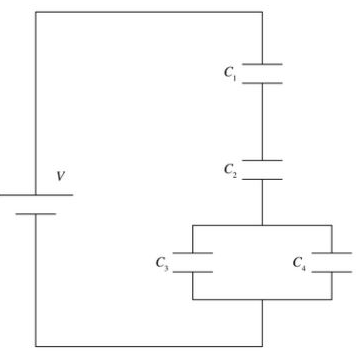
What is the equivalent capacitance of the circuit?
equivalent capacitance: _______ μF
What is the charge on capacitor C2?
charge on C2:_______ C
What is the potential difference across capacitor C3?
potential difference across C3: _______ V
What is the potential energy stored in capacitor C4?
potential energy stored in C4: _______ J
In: Physics
A solid insulating sphere of radius R has a charge of Q, (Q > 0) placed...
A solid insulating sphere of radius R has a charge of Q, (Q > 0) placed on it, uniformly distributed throughout its volume. Surrounding the sphere is a spherical conducting shell with inner radius 2R and outer radius 3R and has a charge of −2Q placed on it. The sphere and the shell share the same center.
1A: Determine the magnitude of the electric field, E(r), where r is the distance from the center of the sphere
1B: Determine the electric potential, V (r), setting V (∞) = 0
3C: Graph V (r)
In: Physics
Two capacitors C1 = 6.8 μF, C2 = 14.6 μF are charged individually to V1 =...
Two capacitors C1 = 6.8 μF, C2 = 14.6 μF are charged individually to V1 = 19.6 V, V2 = 3.5 V. The two capacitors are then connected together in parallel with the positive plates together and the negative plates together.Calculate the amount of charge (absolute value) that flows from one capacitor to the other when the capacitors are connected together. By how much (absolute value) is the total stored energy reduced when the two capacitors are connected? The final potential difference across the plates of the capacitors once they are connected was calculated to be 8.616 V
In: Physics
1. A 0.294 m radius, 486-turn coil is rotated one-fourth of a revolution in 3.88 ms,...
1. A 0.294 m radius, 486-turn coil is rotated one-fourth of a revolution in 3.88 ms, originally having its plane perpendicular to a uniform magnetic field. Find the magnetic field strength needed to induce an average emf of 13,000 V.
2. An American traveler in a foreign country carries a transformer to convert that country's standard 175 V to 120 V so that she can use some small appliances on her trip. What is the ratio of turns in the primary and secondary coils of her transformer?
In: Physics
A proton travels through uniform magnetic and electric fields. The magnetic field is in the negative...
A proton travels through uniform magnetic and electric fields. The magnetic field is in the negative x direction and has a magnitude of 3.52 mT. At one instant the velocity of the proton is in the positive y direction and has a magnitude of 2600 m/s. At that instant, what is the magnitude of the net force acting on the proton if the electric field is (a) in the positive z direction and has a magnitude of 5.40 V/m, (b) in the negative z direction and has a magnitude of 5.40 V/m, and (c) in the positive x direction and has a magnitude of 5.40 V/m?
In: Physics