Questions
Suppose an Employee has the utility function where x stands for income in dollars. There are two...
Suppose an Employee has the utility function where x stands for income in dollars. There are two employment options available. Option A is receiving $2200 for sure. Option B on the other hand depends on the overall success in the market. If everything goes well in the economy, the Employee will receive $3600. Everything will go well in the economy with probability 0.6. If things do not go well, then the Employee will only be paid $400.
a) Graph the Employee’s utility function. Is the Employee risk averse? Explain.
b) Which option offers the Employee the highest expected return? Calculate.
c) Which option offers the highest expected utility to the Employee? Calculate. Which option will the Employee choose?
In: Economics
Question 17- Chapter 10 (Internet and World Wide Web 5th Edition) You will use random number...
Question 17- Chapter 10 (Internet and World Wide Web 5th Edition)
You will use random number generation to develop a simulation for the classic race of the tortoise and the hare. The contenders begin the race at square 1 of 70 squares. Each square represents a possible position along the race course. The finish line is at square 70. The first contender to reach or pass square 70 is rewarded with a pail of fresh carrots and lettuce. The course weaves its way up the side of a slippery mountain, so occasionally the contenders lose ground. Assume that there is a clock that ticks once per second. With each tick of the clock, your script should adjust the position of the animals according to the rules in Table 1 below:
Animal Move type Percentage of time Actual move Tortoise Fast plod 50% 3 squares to the right Slip 20% 6 squares to the left Slow plod 30% 1 square to the right Hare Sleep 20% No move at all Big hop 20% 9 squares to the right Big slip 10% 12 squares to the left Small hop 30% 1 square to the right Small slip 20% 2 squares to the left
Use variables to keep track of the positions of the animals (i.e., position numbers are 1 – 70). Start each animal at position 1. If an animal slips left before square 1, move the animal back to square 1. Generate the percentages in Table 1 by producing a random integer i in the range 1 ≤ i ≤ 10. For the tortoise, perform a “fast plod” when 1 ≤ i ≤ 5, a “slip” when 6 ≤ i ≤ 7, and a “slow plod” when 8 ≤ i ≤ 10. Use a similar technique to move the hare. Provide a button labeled “Start Race”, on which the user clicks to start the race. Begin the race by printing: ON YOUR MARK, GET SET BANG!!! AND THEY’RE OFF!!! Then for each tick of the clock (i.e., each repetition of a loop), print a 70-position line showing the letter T in the position of the tortoise and the letter H in the position of the hare. Occasionally, the contenders will land on the same square. In this case, the tortoise bites the hare, and your script should print OUCH!!! at that position. All print positions other than the T, the H, or the OUCH!!! should be blank. After each line is printed, test whether either animal has reached or passed square 70. If so, print the winner and terminate the simulation. If the tortoise wins, print TORTOISE WINS!!! YAY!!! If the hare wins, print HARE WINS. YUCK! If both animals win on the same tick, print IT’S A TIE. Also, print the time elapsed (the number of ticks) of the race. If neither animal wins, perform the loop again to simulate the next tick of the clock. Separate your script (.js file) and your CSS rules (.css file – if any) from the HTML5 file. Note: Later in the book, we introduce a number of Dynamic HTML capabilities, such as graphics, images, animation and sound. As you study those features, you may enjoy enhancing your tortoise-and-hare contest simulation. [
In: Computer Science
Suppose that the number of drivers who travel between a particular origin and destination during a...
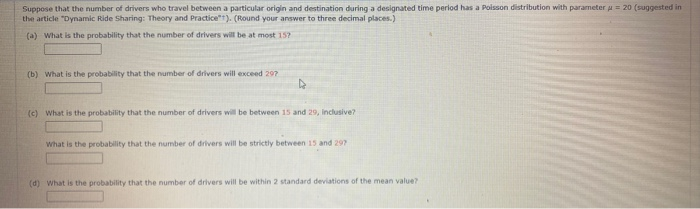
Suppose that the number of drivers who travel between a particular origin and destination during a designated time period has a Poisson distribution with parameter = 20 (suggested in the article "Dynamic Ride Sharing: Theory and Practice"). (Round your answer to three decimal places.)
(a) What is the probability that the number of drivers will be at most 152
(b) What is the probability that the number of drivers will exceed 297
(c) What is the probability that the number of drivers will be between 15 and 29, inclusive?
What is the probability that the number of drivers will be strictly between 15 and 297
(d) What is the probability that the number of drivers will be within 2 standard deviations of the mean value?
In: Math
Suppose that the number of drivers who travel between a particular origin and destination during a...
Suppose that the number of drivers who travel between a particular origin and destination during a designated time period has a Poisson distribution with parameter μ = 20 (suggested in the article "Dynamic Ride Sharing: Theory and Practice"†). (Round your answer to three decimal places.)
(a)
What is the probability that the number of drivers will be at most 13?
(b)
What is the probability that the number of drivers will exceed 26?
(c)
What is the probability that the number of drivers will be between 13 and 26, inclusive?
What is the probability that the number of drivers will be strictly between 13 and 26?
(d)
What is the probability that the number of drivers will be within 2 standard deviations of the mean value?
In: Math
Why is it important to have an elevator pitch, or in other words, being able to...
Why is it important to have an elevator pitch, or in other words, being able to quickly summarize what you do or your team does for your organization? Linking back to the greater organizational strategy from what you do in your role?
In: Operations Management
Consider a company that selects employees for random drug tests. The company uses a computer to...
Consider a company that selects employees for random drug tests. The company uses a computer to randomly select employee numbers that range from 1 to 6296.
(a) Find the probability of selecting a number less than 1000
(b) Find the probability of selecting a number greater than 1000
© Find the probability of selecting a number divisible by 1000
(d) Find the probability of selecting a number that is not divisible by 1000
In: Statistics and Probability
Suppose the scores on a recent paper in your statistics class were as follows: 66, 66,...
Suppose the scores on a recent paper in your statistics class were as follows:
66, 66, 86, 75, 57, 70, 77, 73, 76, 96, 87, 60, 98, 76, 83, 94, 88, 59, 90, 77, 76, 31, 58, 75, 92, 80, 82, 80 (a) Create a five-number summary.
Lowest Value:
Lowest quartile:
Median:
Highest quartile:
Highest value:
In: Statistics and Probability
(14.43) One reason why the Normal approximation may fail to give accurate estimates of binomial probabilities...
|
(14.43) One reason why the Normal approximation may fail to give accurate estimates of binomial probabilities is that the binomial distributions are discrete and the Normal distributions are continuous. That is, counts take only whole number values, but Normal variables can take any value. We can improve the Normal approximation by treating each whole number count as if it occupied the interval from 0.5 below the number to 0.5 above the number. For example, approximate a binomial probabilityP(X⩾10)P(X⩾10)by finding the Normal probabilityP(X⩾9.5)P(X⩾9.5). Be careful: binomialP(X>10)P(X>10)is approximated by NormalP(X⩾10.5)P(X⩾10.5). Adding 0.5 to the length of the interval is called continuity correction. One statistic used to assess professional golfers is driving accuracy, the percent of drives that land in the fairway. In 2013, driving accuracy for PGA Tour professionals ranged from about 45% to about 75%. Tiger Woods, the highest money winner on the PGA tour in 2013, only hits the fairway about 57 % of the time. We will assume that his drives are independent and that each has probability 0.57 of hitting the fairway. Suppose Woods drives 24 times. (a)Does this setting satisfies the rule of thumb for use of the Normal approximation (just barely)
(b) The exact binomial probability that he hits 17 or more fairways is (±±0.001) (c) What is the Normal approximation (±±0.0001 (use software)) to P(X⩾17)P(X⩾17) without using continuity correction? (d) What is the Normal approximation (±±0.0001 (use software)) to P(X⩾17)P(X⩾17) using the continuity correction? |
In: Statistics and Probability
If volume changes (for example, piston is pushed down or moved up), how would the total...
If volume changes (for example, piston is pushed down or moved up), how would the total pressure change (T=constant)? How would mole fraction of the components change: in vapor? in liquid?
In: Other
Shaver Manufacturing Inc. offers dental insurance to its employees. A recent study by the human resource...
- Shaver Manufacturing Inc. offers dental insurance to its employees. A recent study by the human resource director shows that the annual cost per employee per year followed the normal distribution, with a mean of $1280 and a standard deviation of $420 per year.
- What is the probability the employees’ dental expenses will be more than $1500 per year?
- What is the probability the employees’ dental expenses will be between $1500 and $2000 per year?
- What was the minimum cost for the 10 percent of employees that incurred the highest dental expenses? (1 mark) Please provide correct answers.
In: Statistics and Probability