Questions
Designing a global organization structure to operate effi ciently across many countries is a critical issue...
Designing a global organization structure to operate effi ciently across many countries is a critical issue for multinational companies, as Ford has discovered over time. Ford realized early in its history that a major opportunity to increase its profi tability was to take its American car-manufacturing skills and apply them in countries abroad. Over time, it established car-manufacturing divisions in different countries in Europe, Asia, and Australia. Ford decentralized decision-making authority to each global division, which controlled its own activities and developed cars suited to the local market. The result was that each division came to operate independently from its United States parent company. Ford of Europe, for example, became the largest and most profi table carmaker in Europe. Ford remained a highly profi table company until Japanese carmakers began to fl ood the world with their small, reliable, low-priced cars in the 1980s. As car buyers began to buy the Japanese imports in large numbers, Ford tried to draw on the skills of its European unit to help build smaller, more fueleffi cient cars for the United States market. But it had never before tried to get its United States and European design and manufacturing units to cooperate; this proved diffi cult to achieve because its decentralized global organizational structure did not encourage them to cooperate. In the 1990s, Ford embarked on a massive project to create a new global-matrix structure that would solve the decentralized task and authority problems that were preventing it from utilizing its resources effectively. In the 2000 plan, Ford laid out a timetable of how all its global carmaking units would learn to cooperate using one set of global support functions, such as design, purchasing, and so on. Country managers continued to resist the changes, however, to preserve their country empires and forced Ford to redesign its proposed global structure again and again. By the mid-2000s, Ford’s United States, European, and Asia/Pacifi c divisions were still operating as a collection of different autonomous “empires.” Ford had failed to lower its cost structure or design and make a profi table “world car” that could be sold to customers around the globe.
Once again, Ford decided to restructure itself. It moved to a “world structure,” in which one set of managers was given authority over the whole of a specifi c global operation such as manufacturing or car design. Then Ford began to design cars for the global market. Its new structure never worked to speed car design and production, even as it constantly changed global lines of authority and the locations in which it operated to increase profi tability. Ford went through multiple reorganizations to try to meet the Japanese challenge, but nothing worked. Losing billions of dollars, Ford announced in 2006 a revamped “Way Forward” plan to turn around its United States and global operations, a plan that called for cutting 44,000 jobs; closing 16 plants; and freshening 70% of the company’s Ford, Mercury, and Lincoln car lineup. In October 2006, Ford also appointed a new president and CEO, Alan Mulally, an expert in organizational design, to help turn around its operations. Mulally, a former Boeing executive, had led that company’s global reorganization effort. He began to work out how to change Ford’s global structure to reduce costs and speed product development. In the structure Mulally inherited, Ford’s American unit reported to the CEO, but its other global and functional operations reported to the next two most senior executives, Mark Fields, president of Ford’s Americas operation, and Mark Schulz, president of international operations. Mulally decided that Ford’s downsizing should be accompanied by a major reorganization of its hierarchy, and he decided to fl atten Ford’s structure and recentralize control. At the same time, however, he put the focus on teamwork and adopted a cross-functional approach to handling the enormous value chain challenges that still confronted the organization. The position of president of international operations was eliminated, and Mark Fields continues to report to Mulally but so also do the heads of the other two world regions: Lewis Booth, head of Ford of Europe, and John Parker, head of Ford of Asia Pacifi c and Africa and Mazda. Two levels in the hierarchy are gone, and Mulally’s new organizational design clearly defi nes each global executive’s role
in the company’s hierarchy. Ford can begin acting like one
company instead of separate global units, each with their own
interests.33 In addition, the heads of its global value chain
functions also now report directly to Mulally, not to Fields. These
heads include Tony Brown, global head of purchasing; Nick Smither,
head of IT; Richard Parry-Jones, chief technical offi cer; and
Bennie Fowler, head of quality and advanced manufacturing
engineering. Mulally’s goal is to provide a centralized focus on
using the company’s global functional assets to better support its
carmaking business units. At the same time, Mulally also took a
major restructuring step, announcing the creation of a new
position, global product development chief, who is responsible for
overseeing the development of Ford’s entire global lines of
vehicles. He appointed Derrick Kuzak, head of product development
in the
Americas, to head Ford’s new global engineering design effort, and
he also reports directly to Mulally. Kuzak oversees efforts to
streamline product development and engineering systems around the
world. As Mulally commented, “An integrated, global product
development team supporting our automotive business units will
enable us to make the best use of our global assets and
capabilities and accelerate development of the new vehicles our
customers prefer, and do so more effi ciently.”34 Mulally’s goal
was to force a cross-functional app roach on all his top
managers—one that he will
personally oversee—to standardize its global carmaking and allow
functional units to continuously improve quality, productivity, and
the speed at which new products can be introduced. But beyond
streamlining and standardizing its approach, its new- product
development group must also ensure that its new vehicles are
customized to better meet the needs of regional customers. All
Ford’s executives now understand the company’s very survival was at
stake; they had to work together to accelerate efforts to reduce
costs and catch up to more effi cient competitors such as Toyota.
Despite the fact that in 2009 Ford was still losing billions of
dollars as the 2008 recession continued, its new global
organizational structure did seem to be working. Ford was in the
best competitive position of any United States carmaker, and it had
not needed to borrow billions of dollars from the United States
government so that it could continue to operate. Only time will
tell, but Mulally remains confi dent.35
1. What kind of global strategy did Ford pursue at the beginning? What kind of global strategy does it pursue now?
2. In what main ways has Ford changed its global structure to allow it to coordinate the production and sale of its products more effectively around the world? In particular, what different forms of organizational structure has it adopted?
In: Operations Management
Was Robert Eaton a Good Coach? Robert Eaton was CEO and chairman of Chrysler from 1993...
Was Robert Eaton a Good Coach?
Robert Eaton was CEO and chairman of Chrysler from 1993 to
1998, replacing Lee Iacocca who retired after serving in this
capacity since 1978. Eaton then served as cochairman of the
newly merged DaimlerChrysler organization from 1998 to 2000.
With 362,100 employees, DaimlerChrysler achieved revenues
of EUR 136.4 billion in 2003. DaimlerChrysler’s passenger car
brands include Maybach, Mercedes-Benz, Chrysler, Jeep,
Dodge, and Smart. Commercial vehicle brands include
Mercedes-Benz, Freightliner, Sterling, Western Star, and Setra.
From the beginning of his tenure as CEO, Eaton communicated
with the people under him. He immediately shared
his plans for the future with his top four executives and then
took the advice of his colleague, Bob Lutz, to look around the
company before making any hasty decisions concerning the
state of affairs at Chrysler. Eaton and Lutz ascertained that
Chrysler was employing the right staff and that they did not
need to hire new people; they just had to lead them in a different
manner, that is, in a more participative style.
Eaton listened to everyone in the organization, including
executives, suppliers, and assembly-line workers, to
determine how to help the company succeed. Eaton also
encouraged the employees at Chrysler to talk with one
another. The atmosphere of collaboration and open-door
communication between Eaton and Lutz (the two men sat
across the hall from one another and never closed their doors)
permeated the entire organization. Eaton and Lutz’s walkaround
management style indicated to employees that they
were committed to and engaged in the organization.
Furthermore, Eaton and Lutz held meetings with their executive
team on a regular basis to exchange ideas and information
from all areas of the organization.
Eaton even reorganized the manner in which Chrysler
designed cars based on a study, previously disregarded by
Iacocca, that indicated that Chrysler needed to be more
flexible and its executives needed to be in constant communication
with the product design team. One employee was
quoted as saying, “Bob Eaton does not shoot the messenger
when he hears something he doesn’t like or understand. He
knows that not every idea is right. But Bob is off-the-wall
himself. . . . He’ll say something, and we’ll tell him that it’s a
crazy idea. . . . He may not change his mind in the end, but
he’ll spend the time explaining to you what is behind
his thought processes. Do you know what kind of confidence
that inspires?” This type of open communication at the top
proved extremely successful, as summed up by one
designer: “It’s a system that recognizes talent early and
rewards it, and that creates a sense of enthusiasm for your
work, and a sense of mission.”
Another program that Eaton describes as empowering
employees at Chrysler includes requiring all employees,
including executives, to participate in the process of building
a new vehicle. Eaton explains that this shows all of the employees
in the plant that executives are concerned about the
proper functioning of new cars, and it gives executives the
opportunity to understand and solve problems at the factory
level. Eaton states, “When we’re done with our discussions,
these guys know where we want to go and how we want to
get there, and they go back and put the action plans together
to do that. This goes for every single thing we do.” He concludes,
“Clearly at a company there has to be a shared
vision, but we try to teach people to be a leader in their own
area, to know where the company wants to go, to know how
that affects their area, to benchmark the best in the world,
and then set goals and programs to go after it. We also
encourage people not only to go after the business plan
objectives but to have stretch goals. And a stretch goal by
definition is a fifty-percent increase . . . . If we go after fifty
percent, something dramatic has to happen. You have to go
outside of the box.”
Based on the above description, please evaluate Bob
Eaton’s coaching skills using the accompanying table. If a
certain coaching behavior or function is missing, please
provide recommendations about what he could have done
more effectively.
Based on Case Study 9-1: Was Robert Eaton a Good Coach on pages 256-257 in the textbook and the Major Functions and Key Behaviors tables on page 257, evaluate Eaton’s coaching skills. In your response address the following elements:
What major functions were missing?
What key behaviors were missing?
Based on your evaluation, provide specific recommendations on how he could have been a more effective coach.
the text book is Performance Management (3rd Edition) - Herman Aguinis and the case study is as mentioned above
In: Operations Management
Which of the following would cause both the equilibrium price and equilibrium quantity of potatoes (assume...
- Which of the following would cause both the equilibrium price
and equilibrium quantity of potatoes (assume that potatoes are an
inferior good) to decrease?
- an increase in consumer income
- a freeze that sharply reduces potato output
- a decrease in consumer income
- a technological advancement that results in a bumper crop of potatoes
- Prices of Golden Eggs (assume that this is a normal good) have
risen steadily in recent years. Over this same period, prices for
regular eggs have dropped and consumer incomes have risen. Which of
the following best explains the rising prices of Golden Eggs?
- The supply curve for Golden Eggs has shifted to the right while the demand curve for Golden Eggs has shifted to the left.
- The demand curve for Golden Eggs has shifted to the right more than the supply curve has shifted to the right.
- The demand curve and the supply curve for Golden Eggs have both shifted to the left..
- The supply curve for Golden Eggs has shifted to the right more than the demand curve has shifted to the right
- Because of a sharp increase in the price of boys, the demand
for bread (for giant consumption) has decreased. So, the high price
of food leads to a
- leftward shift of the demand curve for bread and the supply curve of bread.
- leftward shift of the demand curve for bread and no shift in the supply curve of bread.
- leftward shift of the demand curve for bread and a rightward shift of the supply curve of bread.
- leftward shift of the supply curve of bread and no shift in the demand curve for bread.
- rightward shift of the supply curve of bread and no shift in the demand curve for bread.
- Consider the market for bread made of grinded bones. Which of
the following shifts the demand curve leftward?
- Studies show eating bread causes diabetes
- A decrease in the price of bread
- A decrease in the quantity demanded of bread
- An increase in hunger
In: Economics
Task 1. For each table on the list, identify the functional dependencies. List the functional dependencies....
Task 1.
For each table on the list, identify the functional dependencies. List the functional dependencies. Normalize the relations to BCNF. Then decide whether the resulting tables should be implemented in that form. If not, explain why. For each table, write the table name and write out the names, data types, and sizes of all the data items, Identify any constraints, using the conventions of the DBMS you will use for implementation. Write and execute SQL statements to create all the tables needed to implement the design.
Create indexes for foreign keys and any other columns that will be used most often for queries. Insert about five records in each table, preserving all constraints. Put in enough data to demonstrate how the database will function. Write SQL statements that will process five non-routine requests for information from the database just created. For each, write the request in English, followed by the corresponding SQL command. Create at least one trigger and write the code for it.
Tables / DDL and Insert Data have been provided below:
-- DDL to create the MS SQL tables for initial relational model
for Theater Group
CREATE DATABASE Theater;
CREATE TABLE Member(
memId INT,
dateJoined DATETIME,
firstname VARCHAR(15),
lastName VARCHAR(20),
street
VARCHAR(50),
city
VARCHAR(15),
state
CHAR(2),
zip
CHAR(5),
areaCode CHAR(3),
phoneNumber CHAR(7),
currentOfficeHeld VARCHAR(20),
CONSTRAINT Member_memId_pk PRIMARY
KEY(memid));
CREATE TABLE Sponsor(
sponID INT,
name
VARCHAR(20),
street
VARCHAR(50),
city
VARCHAR(15),
state
CHAR(2),
zip
CHAR(5),
areaCode CHAR(3),
phoneNumber CHAR(7),
CONSTRAINT Sponsor_sponId_pk PRIMARY
KEY(sponID));
CREATE TABLE Subscriber(
subID INT,
firstname VARCHAR(15),
lastName VARCHAR(20),
street
VARCHAR(50),
city
VARCHAR(15),
state
CHAR(2),
zip
CHAR(5),
areaCode CHAR(3),
phoneNumber CHAR(7),
CONSTRAINT Subscriber_subId_pk PRIMARY
KEY(subID));
CREATE TABLE Play(
title
VARCHAR(100),
author
VARCHAR(35),
numberOfActs SMALLINT,
setChanges
SMALLINT,
CONSTRAINT Play_title_pk PRIMARY
KEY(title));
CREATE TABLE Production(
year
SMALLINT,
seasonStartDate VARCHAR(7),
seasonEndDate VARCHAR(7),
title
VARCHAR(100),
CONSTRAINT Prod_year_seasStDate_pk primary
key(year, seasonStartDate),
CONSTRAINT Prod_title_fk FOREIGN KEY(title)
REFERENCES Play(title));
CREATE TABLE Performance(
datePerf
VARCHAR(7),
timePerf
VARCHAR(10),
year
SMALLINT,
seasonStartDate VARCHAR(7),
CONSTRAINT Performance_date_pk PRIMARY
KEY(datePerf,year),
CONSTRAINT Performance_yr_seasStart_fk FOREIGN
KEY(year,seasonStartDate) REFERENCES Production(year,
seasonStartDate));
CREATE TABLE TicketSale(
saleID INT,
saleDate DATETIME,
totalAmount DECIMAL(6,2),
perfDate VARCHAR(7),
perfYear SMALLINT,
subId INT,
CONSTRAINT TicketSale_ID_PK PRIMARY
KEY(saleId),
CONSTRAINT TicketSale_perfDate_fk FOREIGN
KEY(perfDate,perfYear) REFERENCES Performance(datePerf,year),
CONSTRAINT TicketSale_subId_fk FOREIGN
KEY(subId) REFERENCES Subscriber(subId));
CREATE TABLE DuesPayment(
memId INT,
duesYear SMALLINT,
amount
DECIMAL(5,2),
datePaid DATETIME,
CONSTRAINT DuesPayment_memId_year_pk PRIMARY
KEY(memid, duesyear),
CONSTRAINT DuesPayment_memId_fk FOREIGN
KEY(memid) REFERENCES Member(memid));
CREATE TABLE Donation(
sponId
INT,
donationDate DATETIME,
donationType VARCHAR(20),
donationValue DECIMAL(8,2),
year
SMALLINT,
seasonStartDate VARCHAR(7),
CONSTRAINT Donation_sponId_date_pk PRIMARY
KEY(sponId, donationDate),
CONSTRAINT Donation_sponId_fk FOREIGN
KEY(sponId) REFERENCES Sponsor(sponId),
CONSTRAINT Donation_year_seasStartDate_fk
FOREIGN KEY(year,seasonStartDate) REFERENCES Production(year,
seasonStartDate));
CREATE TABLE Ticket(
saleId
INT,
seatLocation VARCHAR(3),
price
DECIMAL(5,2),
seattype
VARCHAR(15),
CONSTRAINT Ticket_saleid_pk PRIMARY KEY(saleId,
seatLocation),
CONSTRAINT Ticket_saleid_fk FOREIGN KEY(saleid)
REFERENCES TicketSale(saleId));
CREATE TABLE Member_Production(
memId
INT,
year
SMALLINT,
seasonStartDate VARCHAR(7),
role
VARCHAR(25),
task
VARCHAR(25),
CONSTRAINT Mem_Prod_Id_year_seas_pk PRIMARY
KEY(memId, year, seasonStartDate),
CONSTRAINT Mem_Prod_memId_FK FOREIGN KEY (memid)
REFERENCES Member(memId),
CONSTRAINT Mem_Prod_yr_seasStartDate_fk FOREIGN
KEY(year,seasonStartDate) REFERENCES
Production(year,seasonStartDate));
INSERT DATA:
-- insert some records
INSERT INTO Member values(11111,'01-Feb-2015',
'Frances','Hughes','10 Hudson Avenue','New
Rochelle','NY','10801','914','3216789','President');
INSERT INTO Member values(22222,'01-Mar-2015', 'Irene','Jacobs','1
Windswept Place','New
York','NY','10101','212','3216789','Vice-President');
INSERT INTO Member values(33333,'01-May-2015', 'Winston', 'Lee','22
Amazon Street','New York','NY',
'10101','212','3336789',null);
INSERT INTO Member values(44444,'01-Feb-2015', 'Ryan','Hughes','10
Hudson Avenue','New
Rochelle','NY','10801','914','5556789','Secretary');
INSERT INTO Member values(55555,'01-Feb-2015', 'Samantha',
'Babson','22 Hudson Avenue','New
Rochelle','NY','10801','914','6666789','Treasurer');
INSERT INTO Member values(66666,'01-Feb-2015', 'Robert',
'Babson','22 Hudson Avenue','New
Rochelle','NY','10801','914','6666789',null);
INSERT INTO Sponsor values(1234, 'Zap Electrics', '125 Main
Street','New York','NY', '10101', '212','3334444');
INSERT INTO Sponsor values(1235, 'Elegant Interiors', '333 Main
Street','New York','NY', '10101', '212','3334446');
INSERT INTO Sponsor values(1236, 'Deli Delights', '111 South
Street', 'New Rochelle','NY','10801', '914','2224446');
INSERT INTO Subscriber values(123456, 'John','Smith','10
Sapphire Row', 'New Rochelle','NY','10801', '914','1234567');
INSERT INTO Subscriber values(987654, 'Terrence','DeSimone','10
Emerald Lane','New York','NY', '10101','914','7676767');
INSERT INTO Play values('Macbeth','Wm. Shakespeare', 3,6);
INSERT INTO Play values('Our Town','T. Wilder', 3,4);
INSERT INTO Play values('Death of a Salesman','A. Miller',
3,5);
INSERT INTO Production values(2015,'05-May', '14-May', 'Our
Town');
INSERT INTO Production
values(2014,'14-Oct','23-Oct','Macbeth');
INSERT INTO Performance values('05-May','8pm',2015,'05-May');
INSERT INTO Performance values('06-May','8pm',2015,'05-May');
INSERT INTO Performance values('07-May','3pm',2015,'05-May');
INSERT INTO Performance values('12-May','8pm',2015,'05-May');
INSERT INTO Performance values('13-May','8pm',2015,'05-May');
INSERT INTO Performance values('14-May','3pm',2015,'05-May');
INSERT INTO Performance values('14-Oct','8pm',2014,'14-Oct');
INSERT INTO Performance values('15-Oct','8pm',2014,'14-Oct');
INSERT INTO Performance values('16-Oct','3pm',2014,'14-Oct');
INSERT INTO Performance values('21-Oct','8pm',2014,'14-Oct');
INSERT INTO Performance values('22-Oct','8pm',2014,'14-Oct');
INSERT INTO Performance values('23-Oct','3pm',2014,'14-Oct');
INSERT INTO TicketSale
values(123456,'01-May-2015',40.00,'05-May',2015,123456);
INSERT INTO Ticket values(123456, 'A1',20.00,'orch front');
INSERT INTO Ticket values(123456, 'A2',20.00,'orch front');
INSERT INTO TicketSale
values(123457,'02-May-2015',80.00,'05-May',2015,987654);
INSERT INTO Ticket values(123457, 'A3',20.00,'orch front');
INSERT INTO Ticket values(123457, 'A4',20.00,'orch front');
INSERT INTO Ticket values(123457, 'A5',20.00,'orch front');
INSERT INTO Ticket values(123457, 'A6',20.00,'orch front');
INSERT INTO TicketSale
values(000001,'01-Oct-2014',40.00,'14-Oct',2014, 987654);
INSERT INTO Ticket values(000001, 'A1',20.00,'orch front');
INSERT INTO Ticket values(000001, 'A2',20.00,'orch front');
INSERT INTO TicketSale
values(000002,'9-Oct-2014',60.00,'14-Oct',2014,123456);
INSERT INTO Ticket values(000002, 'A1',20.00,'orch front');
INSERT INTO Ticket values(000002, 'A2',20.00,'orch front');
INSERT INTO Ticket values(000002, 'A3',20.00,'orch front');
INSERT INTO DuesPayment values(11111, 2015, 50.00,
'01-Jan-2015');
INSERT INTO DuesPayment values(22222, 2015, 50.00,
'15-Jan-2015');
INSERT INTO DuesPayment values(33333, 2015, 50.00,
'01-Feb-2015');
INSERT INTO DuesPayment values(44444, 2015, 50.00,
'30-Jan-2015');
INSERT INTO DuesPayment values(55555, 2015, 50.00,
'28-Jan-2015');
INSERT INTO Donation values(1234, '01-Mar-2015','sound
board',1250.00,2015,'05-May');
INSERT INTO Donation values(1235, '15-Apr-2015','cash',
500.00,2015,'05-May');
INSERT INTO Donation values(1236,
'05-May-2015','food',500.00,2015,'05-May');
INSERT INTO Donation values(1236,
'06-May-2015','beverges',200.00,2015,'05-May');
INSERT INTO Donation values(1236,
'07-May-2015','snacks',100.00,2015,'05-May');
INSERT INTO Member_Production
values(11111,2015,'05-May','Emily','sets');
INSERT INTO Member_Production values(22222,2015,'05-May','Mrs.
Webb','costumes');
-- DDL to delete all of the tables, use only if you need to
rebuild the DB
DROP TABLE Member_Production;
DROP TABLE Ticket;
DROP TABLE Donation;
DROP TABLE DuesPayment;
DROP TABLE TicketSale;
DROP TABLE Performance;
DROP TABLE Production;
DROP TABLE Play;
DROP TABLE Subscriber;
DROP TABLE Sponsor;
DROP TABLE Member;
DROP DATABASE Theater;
In: Computer Science
Complete the following information about the organization and products and/or services you will focus on as...
Complete the following information about the organization and products and/or services you will focus on as you develop a complete marketing plan throughout the course. You may need to do research to get answers to the questions below. Be sure the organization and offer you select will 1) remain interesting to you for the duration of the course, and 2) have sufficient information available for you to conduct research and make informed recommendations in your marketing plan.
Company Profile
- Company Name: Disney
- Industry:
- Major products and/or services (names, types):
- Products and/or services your marketing plan will focus on:
- Target customers:
- Distribution channel(s):
- Headquarters (city, state, country):
- Year founded:
- Number of employees:
- Annual revenue (estimated)
- Key competitors:
- Link to Web site:
- Link to Yahoo! Finance information page (for public companies):
Market Segmentation and Targeting
- What problem does your product or service solve?
- Describe the total market for your solution: Who are potential customers?
- What are the key segments within this market?
- Identify and briefly describe 1–3 segments that this company serves.
- Which segment does this marketing plan focus on, and why? Why do you believe this segment will offer growth and profit opportunities?
Situation and Company Analysis
Economic Environment
Discuss factors that affect your consumers’ purchasing power and spending patterns. What is the economic environment that you are operating in? Is it growth, recovery or recession? Will it be easy to find staff? What is the current interest rate i.e. is it increasing or decreasing? What is consumer confidence like?
Technical Environment
The technological environment changes rapidly. You need to make sure that you are aware of trends in your industry and other industries could affect your business. New technologies create new markets and can influence you, consumers and competitors. Industry environment What are the trends in your industry? Are there new entrants in the market? Has a substitute product been introduced? Are there changes in industry practices or new benchmarks to use?
Competitive Environment
How many competitors do you have? Who are the key competitors? What are the key selling points or competitive advantages of each one? What is your advantage over competitors? Is the market large enough to support you and competitors?
Political Environment
Consider the political environment for the areas that your business will trade and operate in. Is there a stable political system? Are there any licenses and regulations that you should be aware of? Do you need to win support to be able to operate?
SWOT Analysis
Instruction: Complete the table below with descriptive responses and explanation as you answer the questions below.
| Strengths | Weaknesses |
|
|
| Opportunities | Threats |
|
|
Mission, Objectives, and Goals
State the mission or business purpose: what the organization wants to achieve, in market-oriented terms. (Example: Disney’s mission could be, “We create happiness by providing the finest in entertainment for people of all ages.)
List 1–3 objectives that move the organization a step closer to achieving the mission. (Example: A Disney objective could be, “To be the most popular theme park for international visitors.”)
Convert objectives into specific marketing goals that are easy to measure and evaluate. (Example: Our goal is to increase the market share of international theme park visitors by 10% in the next two years.”)
In: Operations Management
Complete the following information about the organization and products and/or services you will focus on as...
Complete the following information about the organization and products and/or services you will focus on as you develop a complete marketing plan throughout the course. You may need to do research to get answers to the questions below. Be sure the organization and offer you select will 1) remain interesting to you for the duration of the course, and 2) have sufficient information available for you to conduct research and make informed recommendations in your marketing plan.
Company Profile
- Company Name: southwest airlines
- Industry:
- Major products and/or services (names, types):
- Products and/or services your marketing plan will focus on:
- Target customers:
- Distribution channel(s):
- Headquarters (city, state, country):
- Year founded:
- Number of employees:
- Annual revenue (estimated)
- Key competitors:
- Link to Web site:
- Link to Yahoo! Finance information page (for public companies):
Market Segmentation and Targeting
- What problem does your product or service solve?
- Describe the total market for your solution: Who are potential customers?
- What are the key segments within this market?
- Identify and briefly describe 1–3 segments that this company serves.
- Which segment does this marketing plan focus on, and why? Why do you believe this segment will offer growth and profit opportunities?
Situation and Company Analysis
Economic Environment
Discuss factors that affect your consumers’ purchasing power and spending patterns. What is the economic environment that you are operating in? Is it growth, recovery or recession? Will it be easy to find staff? What is the current interest rate i.e. is it increasing or decreasing? What is consumer confidence like?
Technical Environment
The technological environment changes rapidly. You need to make sure that you are aware of trends in your industry and other industries could affect your business. New technologies create new markets and can influence you, consumers and competitors. Industry environment What are the trends in your industry? Are there new entrants in the market? Has a substitute product been introduced? Are there changes in industry practices or new benchmarks to use?
Competitive Environment
How many competitors do you have? Who are the key competitors? What are the key selling points or competitive advantages of each one? What is your advantage over competitors? Is the market large enough to support you and competitors?
Political Environment
Consider the political environment for the areas that your business will trade and operate in. Is there a stable political system? Are there any licenses and regulations that you should be aware of? Do you need to win support to be able to operate?
SWOT Analysis
Instruction: Complete the table below with descriptive responses and explanation as you answer the questions below.
| Strengths | Weaknesses |
|
|
| Opportunities | Threats |
|
|
Mission, Objectives, and Goals
State the mission or business purpose: what the organization wants to achieve, in market-oriented terms. (Example: Disney’s mission could be, “We create happiness by providing the finest in entertainment for people of all ages.)
List 1–3 objectives that move the organization a step closer to achieving the mission. (Example: A Disney objective could be, “To be the most popular theme park for international visitors.”)
Convert objectives into specific marketing goals that are easy to measure and evaluate. (Example: Our goal is to increase the market share of international theme park visitors by 10% in the next two years.”)
In: Operations Management
Case 4: New Retail Strategy September 2010: American retailers are cutting expenses to maintain stable profits...
Case 4: New Retail Strategy September 2010: American retailers are cutting expenses to maintain stable profits through what is increasingly looking like another challenging holiday season. Approaching the 2010 holiday season, stores are looking for ways to maintain profit margins. Wal-Mart Stores Inc. reported a 3.6 percent gain in second-quarter earnings on August 17, 2010 and raised its annual profit forecast, despite notching negative sales at U.S. stores open at least a year for the fifth consecutive quarter. Home Depot Inc. reported a 6.8 percent quarterly profit jump despite a moderate same-store sales boost of 1.7 percent, and also raised its full-year profit forecast, even as it lowered annual revenue projections. How can you increase earnings with tighter revenue? By reducing costs. Wal-Mart is cutting advertising budgets and resuming its traditional “everyday low prices” strategy after aggressive temporary “rollback” price cuts failed to stimulate new sales. The top retail chains are adapting to the prolonged economic slowdown by reducing employee work hours, maintaining thin inventories, and squeezing costs out of supply chains. Although retail executives have been planning conservatively for months, many had expected the economy to show signs of improvement by this point. Abercrombie & Fitch Co. plans to close 60 of its 1,098 stores this year and 50 next year. The teen retailer reported a 5 percent jump in quarterly same-store sales, but noted that average prices fell 15 percent as stores wage price wars to wrest a bigger share of back-to-school budgets. Urban Outfitters Inc., the apparel company for twenty-somethings that also operates Anthropologie and Free People, voiced similar cautions. Saks Inc. said Tuesday it was closing luxury department stores in Plano, Texas, and Mission Viejo, California, after reporting a quarterly loss of $32.2 million.
Why don’t the stores raise prices to increase demand?
What cost is Abercrombie cutting?
Why would stores wage price wars in a declining economy? Is cost cutting in a recession a good strategy? Explain.
What does it mean when a recovery takes place?
In: Economics
Comprehensive Problem (Tax Return Problem). David and Doris Kelley were divorced on February 3, 2018. They...
Comprehensive Problem (Tax Return Problem). David and Doris Kelley were divorced on February 3, 2018. They lived apart during 2018. The divorce decree required David to make the following payments:
a. Transfer full title to their jointly owned family home to Doris. Fair market value of the home is $180,000, basis $150,000 .
b. $1,000 per month mortgage payments on the house, above. The mortgage has 20 years remaining before being fully paid off, but the payments would end on her death.
c. $2,000 per month for 10 years’ support payments to Doris, of which $600 per month is child support.
d. Doris insisted that the children attend private schools. In 2018, David paid $1,500 in tuition for the children’s private high school. David paid his lawyer $5,000 to represent him in the divorce proceedings. David and Doris agreed that Doris would maintain a home for the children. Further, Doris agreed to allow David to claim one child as a dependency exemption. This agreement was put in writing and signed by Doris.
Besides the divorce, David has had a big year financially. He owns an apartment house and he requires each new tenant to place a $750 security deposit with him before moving into the apartment. When the tenant ultimately vacates the apartment, David will refund the deposit. In 2018, David collected $3,750 in security deposits and rental income of $15,000.
David entered a local raffle in 2018. David won first prize, which was a new automobile with a window price of $20,000. He checked with several local car dealers and was positive that if he had purchased a similar car on his own, the price would have been $18,200.
David loaned his sister Lois $5,000. Lois was repaying the loan at $100 per month plus interest of $40. Since Lois was about to depart on an extended vacation on December 2, 2018, she gave David $200 plus interest of $80 to cover the months of December and January.
David has a good job that pays an annual salary of $50,000. In 2018, business was very good and in December 2018 bonuses were announced for the employees. David earned a $4,000 bonus for 2018. Bonuses would be mailed to the employees during the first week of January 2019. David has itemized deductions of $20,000. Determine David’s 2018 taxable income.
In: Accounting
Teacher's Helper is a small company that has a subcontract to produce instructional materials for disabled...
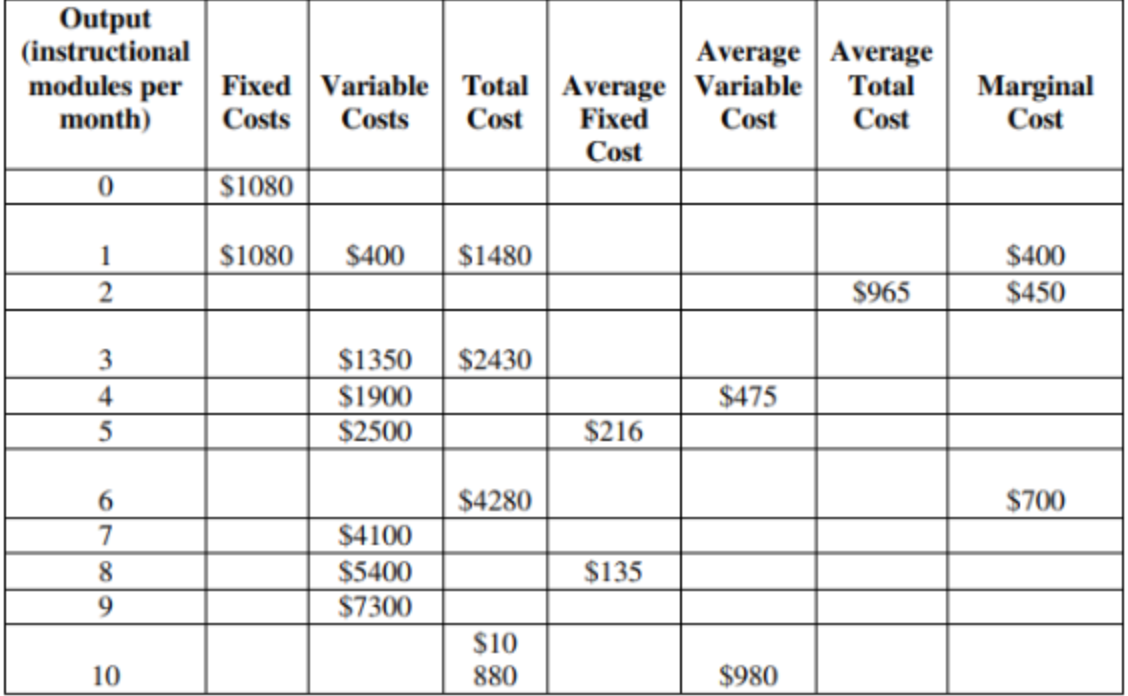
Teacher's Helper is a small company that has a subcontract to produce instructional materials for disabled children in public school districts. The owner rents several small rooms in an office building in the suburbs for $600 a month and has leased computer equipment that costs $480 a month.
Answer the following questions:
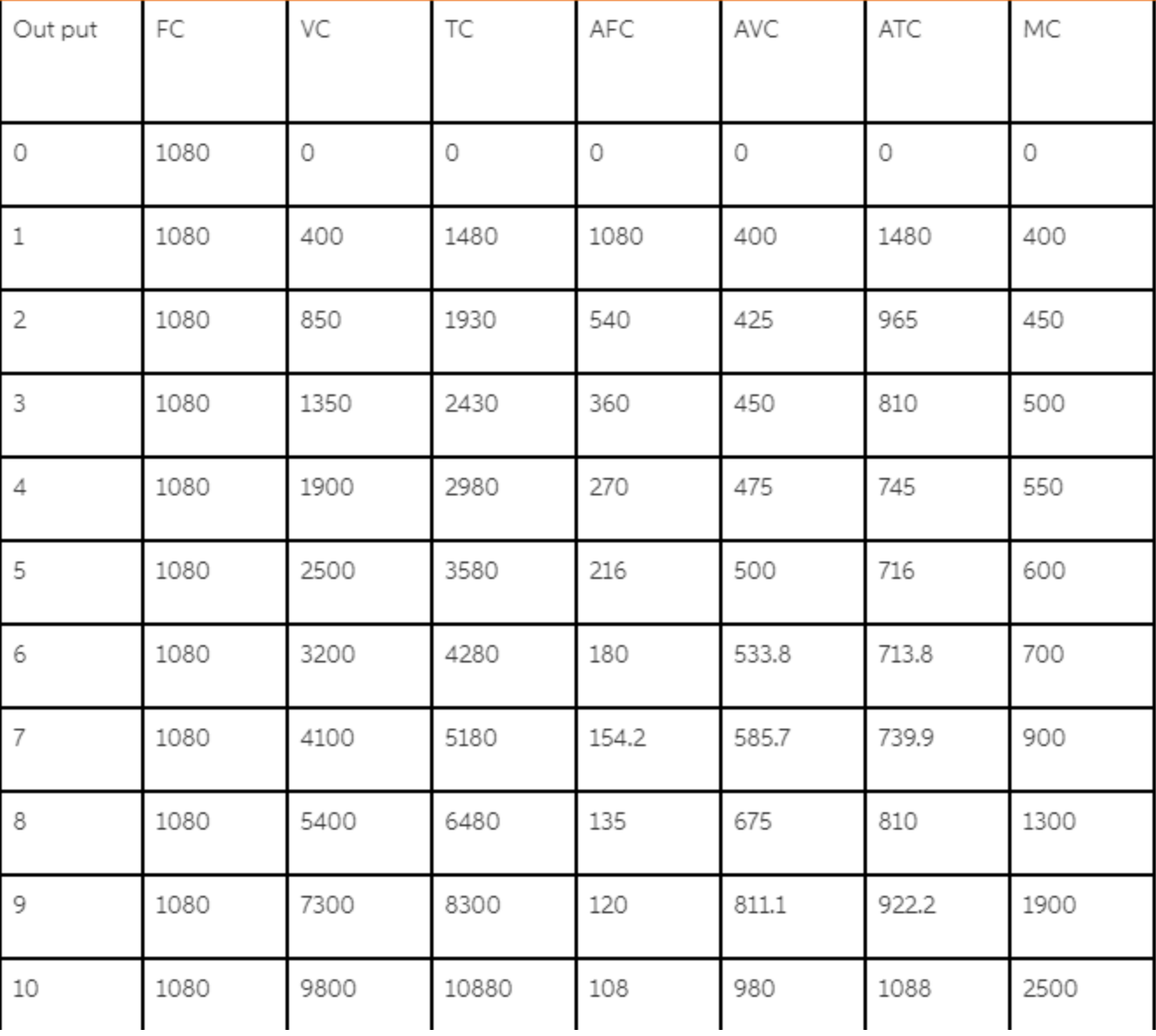
A) What is the marginal cost of creating the tenth instructional module in a given month?
B) What is the average variable cost for the month if six instructional modules are produced?
C) What is the average fixed cost for the month if nine instructional modules are produced?
D) How many instructional modules are produced when the marginal cost is $1300?
E) One month, Teacher's Helper produced 18 instructional modules. What was the average fixed cost for that month?
In: Economics
For each of the following situations, state whether the parameter of interest is a mean or...
For each of the following situations, state whether the parameter of interest is a mean or a proportion.
(a) A poll shows that 64% of Americans personally worry a great deal about federal spending and the budget deficit.
(b) A survey reports that local TV news has shown a 17% increase in revenue between 2009 and 2011 while newspaper revenues decreased by 6.4% during this time period.
(c) In a survey, high school and college students are asked whether or not they use geolocation services on thier smart phones.
(d) In a survey, smart phone users are asked whether or not they used a web-based taxi serivce.
(e) In a survey, smart phone users are asked how many times they used a web-based taxi service over the last year.
In: Math