Questions
Given the inverse demand function of monopoly is: ?(?) = ??? − ? the cost ?...
Given the inverse demand function of monopoly is: ?(?) = ??? − ?
the cost
? function of the monopoly is: ?(?) = ?? + ?? .
(i) Find the profit maximizing price and output level of monopoly
and the amount of profit.
(ii) Now assume that the same inverse demand function and cost
function are faced by a competitive market. Find the profit
maximizing price and output level of competitive market and the
amount of profit.
(iii) Calculate the consumer surplus, producer surplus and
deadweight loss due to monopoly.
(iv) Assume that government imposes the monopoly a lump-sum tax of
? = $??? on total profit. How does the tax affect the profit of the
monopoly?
In: Economics
Marcia Miller died July 23, 2017. Marcia (born April 2, 1930) resided at 117 Brandywine Way,...
Marcia Miller died July 23, 2017. Marcia (born April 2, 1930) resided at 117 Brandywine Way, Eastern City, PA 19000 and was a lifelong Pennsylvania resident. Her first husband, Arthur Adams, died in 1999. In June 1999, she married Matt Miller, a U.S. citizen, who survived her. Marcia has three children (Andy, Annie, and Archie Adams) from her first marriage.
Date of death values of the properties discovered at Marcia’s death are listed below.
Principal residence with a value of $420,000. Purchased by Marcia in 2001 and titles in the names of Matt and Marcia Miller, joint tenants with right of survivorship.
Household furnishings acquired by Marcia during her first marriage and values at $62,000 when she died.
$1 million cash in money market account in Marcia’s name. On her date of death, there also was $2,200 of accrued interest in the account.
$17,000 checking account at Keystone State Bank in the names of Marcia and Matt as tenants in common.
Stock portfolio in Marcia’s name with fair market value at her death of $5.6 million.
$1 million like insurance policy. Marcia purchased the policy in 1990 and held incidents of ownership. Beneficiary is Marcia’s estate, and Marcia held incidents of ownership.
Trust at Quaker State Bank with value of $500,000. The trust was created under the will of Marcia’s uncle, Josh Judson, who died in 1992. Marcia was entitled to receive all the income annually for life and was granted the power to will the property to such of her descendants as she so desired with the specification that, if she did not exercise the power, the property would pass to Josh’s Former housekeeper, Yvonne Jones.
Marcia’s will includes the following provisions:
I bequeath to Matt all of my tangible, personal property.
To First Lutheran Church I leave $50,000.
To a trust with PHL Bank I leave $200,000. Matt is to receive all the trust income quarterly for life, and the remainder is to be divided equally at his death among my three children or their estates.
I leave my sister Annette $100,000, but if she disclaims this amount, it will go to my beloved Matthew.
I appointed the property on the trust at Quaker State Bank to Annie Adams.
The rest of my property I leave to Andy (my first born).
Other pertinent information follows:
As of her date of death, Marcia owed her country club $800.
The cost of Marcia’s funeral and tombstone totaled $15,000.
Her accountant’s, attorney’s, and executor’s fees are estimated to be $120,000.
Annette made a qualified disclaimer of the $100,000 bequest.
Marcia’s executor, Susan, will make whatever elections will result in the lower tax payable. During her life, Marcia never made any taxable gifts and never consented to gift splitting.
Assume that, under state law, taxes and nay other costs associated with death are payable from the estate’s residue and that the state death tax owed is equal to the state death tax credit available on the federal estate tax return.
Prepare an estate tax return (Form 706) for Marcia. You will also need to prepare the following sub-schedules for Marcia:
B, C, D, E, F, J, K, M, O (These forms all need to be downloaded from the IRS website and the numbers must be manually loaded into the forms and then printed).
In: Accounting
Case study: Married with two young children, John and his wife rented a two-bedroom apartment in...
Case study:
Married with two young children, John and his wife rented a two-bedroom apartment in a safe neighborhood with good schools. John liked his job as a delivery driver for a large foodservice distributor, where he had worked for more than four years. His goal was to become a supervisor in the next year. John’s wife was a stay-at-home mom.
John had always been healthy. Although he had health insurance through his job, he rarely needed to use it. He smoked half a pack of cigarettes each day and drank socially a couple of times a month.
One afternoon, John’s company notified him that it was laying him off along with more than a hundred other employees. Though he was devastated about losing his job, John was grateful that he and his wife had some savings that they could use for rent and other bills, in addition to the unemployment checks he would receive for a few months.
John searched aggressively for jobs in the newspaper and online, but nothing worked out. He began to have feelings of anger and worry that led to panic. His self-esteem fell, and he became depressed. When John’s wife was hired to work part-time at the grocery store, the couple felt better about finances. But demoralized by the loss of his job, John started to drink more often.
Two beers a night steadily increased to a six-pack. John and his wife started to argue more often. Then, about six months after losing his job, John stopped receiving unemployment checks. That week, he went on a drinking binge that ended in an argument with his wife. In the heat of the fight, he shoved her. The next day, John’s wife took the children and moved in with her parents. No longer able to pay the rent, John was evicted from the apartment.
John tried to reconcile with his wife, but she said she’d had enough. Over the next few months, John “couch-surfed” with various family members and friends. At one point, he developed a cold, and when it worsened over a few weeks, he sought care at the emergency department. The hospital staff told him that he would be billed because he didn’t have insurance. John agreed, and a doctor diagnosed him with a sinus infection and prescribed antibiotics. With no money to spare, John could not get the prescription filled.
John continued to live with family and friends, but his heavy drinking and anger only got worse, and his hosts always asked him to leave. He went from place to place. Finally, when John ran out of people to call, he found himself without a place to stay for the night and started sleeping at the park.
One night when John was drunk, he fell and got a cut on his shin. The injury became red and filled with pus. John was embarrassed about his poor hygiene and didn’t want a health care provider to see him. But when he developed a fever and pain, he decided to walk to the nearest emergency department. He saw a provider who diagnosed him with cellulitis, a common but potentially serious bacterial skin infection, and gave him a copy of the patient instructions that read “discharge to home” and a prescription for antibiotics. John could not afford the entire prescription when he went to pick up the antibiotics, but he was able to purchase half the tablets.
Winter arrived, and it was too cold for John to sleep outside, so he began staying at a shelter run by the church. Each morning, he had to leave the shelter by 6 AM. He walked the streets all day and panhandled for money to buy alcohol.
One evening, some teenage boys jumped John in the park, stealing his backpack and kicking him repeatedly. An onlooker called 911, and John was taken to the emergency department. Later that evening, the hospital discharged John. He returned many times to the emergency department for his health care, seeking treatment for frequent colds, skin infections, and injuries. Providers never screen him for homelessness and always discharge him back to “home.”
One day at the park, an outreach team from the local Health Care for the Homeless (HCH), one of about 250 such non-profit organizations in the United States, approached John. The team, including a doctor, nurse, and caseworker, introduced themselves and asked John, “Are you OK?” John didn’t engage. They offered him a sandwich and a warm blanket. John took the food without making eye contact. The team visited John for the next several days. John started making eye contact and telling the team about his shortness of breath and the cut on his arm. The team began seeing John frequently, and he began to trust them.
A couple of weeks later, John agreed to go to the HCH clinic. It was the first time in years that John went to a health clinic. Upon his arrival, the staff at the clinic registered him and signed him up for health insurance through Medicaid and food benefits. John felt comfortable in the clinic, and he saw some of the people who also stayed at the shelter and spent their days in the park. They were happy to see him and told John about how the clinic staff care and would be able to help.
John began going to the HCH clinic on a regular basis. He saw a primary care provider, Maggie, a nurse practitioner. In John’s words, she treated him like a real person. In addition to primary care, the clinic offered behavioral health services. Both scheduled appointments and walk-in care were available. John connected with a therapist and began working on his depression and substance abuse. A year later, John’s health has improved. He rarely needs to go to the emergency room. He is sober and working with a case manager in finding housing.
Discussion Questions:
- What events in John’s life created a “downward spiral” into homelessness? Which events related to social needs, and which could health care have addressed?
- What were some of the barriers John faced in accessing health care?
- Why do you think the emergency department was the first place John thought to go for care? How might the emergency department improve care for patients like John?
- Why do you think John wouldn’t make eye contact with the HCH team at first? How would you build a trusting relationship with a person like John?
- What aspects of HCH care do you think represent high-quality care for the homeless? How do you think Maggie made John feel like he was a “real person?”
- In your own experience, have you encountered a homeless individual? What was that like? Do you recall what you were thinking?
Remember some of these questions are Two questions in One. Ensure you answer all completely (detailed) but does not need to be a novel.
In: Nursing
1. According to most estimates, the size of the "underground" economy in the United States could...
1. According to most estimates, the size of the "underground" economy in the United States could be as large as
a. The “above-ground” economy
b. The economy of China
c. 10% of GDP
d. The state of Rhode Island
2. The GDP per capita tells us
a. The amount of output each person would get if the economic pie were sliced evenly.
b. The amount of output each worker would get if the economic pie were sliced evenly.
c. The ratio of the maximum amount of output any person gets to the minimum amount of output each person gets.
d. The median amount of output each person gets, adjusted for inequality.
3. In the early 1940s, military planners needed to know the size of the economy so they could determine
a. The size of the tax base in the case of war
b. How many tanks and planes the economy could produce
c. The military budget for the next five years
d. Whether military spending was too large
4. Government social benefits paid to individuals are
a. Known as transfer payments, and are counted as part of government consumption and investment
b. Known as transfer payments, and are typically used to fund personal consumption
c. Known as output of government, and are counted as pert government consumption and investment
d. Known as output of government, and are typically used to fund personal consumption
5. GDP is defined as the dollar value of __________ in a given year.
a. The total output of the economy
b. All outputs used in the economy
c. All intermediate and final goods produced in the economy
d. The total purchases made in the economy
6. In GDP calculations, the work of stay-at-home parents is
a. Counted only for equivalent hours
b. Not counted
c. Counted as intermediate inputs
d. Counted at 50%
7. Government consumption includes all
a. Salaries paid to factory workers
b. Fuel for nuclear submarines
c. Cola served in a company cafeteria
d. Pencils bought by a private university
8. Imports enter the calculation of GDP
a. With a positive sign
b. With a negative sign
c. As an addition to changes in private inventories
d. Through the personal consumption category
9. Which of the following is NOT an element of the underground economy?
a. Off the books babysitting
b. Illegal drug deals
c. Commissioned salespeople
d. Cash only under the table businesses
10. If gross domestic purchases are ________, then net exports are ________.
a. Greater than gross domestic product; greater than net imports
b. Equal to zero; also equal to zero
c. Greater than gross domestic product; positive
d. Less than gross domestic product; positive
11. Gross domestic product does NOT include
a. Personal consumption
b. Intermediate inputs
c. Residential investment
d. Net exports
12. If a foreign car manufacturer builds a plant in the United States, the new plant will
a. Increase U.S. GDP by the amount produced
b. Have no effect on GDP because it is a foreign company
c. Decrease U.S. GDP by the amount produced because of foreign ownership
d. Increase U.S. GDP by the net exports of the company
In: Economics
CH 10. 1. The USA Today reports that the average expenditure on Valentine's Day is $100.89....
CH 10.
1.
The USA Today reports that the average expenditure on Valentine's Day is $100.89. Do male and female consumers differ in the amounts they spend? The average expenditure in a sample survey of 46 male consumers was $135.67, and the average expenditure in a sample survey of 34 female consumers was $68.64. Based on past surveys, the standard deviation for male consumers is assumed to be $38, and the standard deviation for female consumers is assumed to be $20.
- What is the point estimate of the difference between the
population mean expenditure for males and the population mean
expenditure for females (to 2 decimals)?
- At 99% confidence, what is the margin of error (to 2
decimals)?
- Develop a 99% confidence interval for the difference between
the two population means (to 2 decimals). Use
z-table.
( , )
2
|
Bank of America's Consumer Spending Survey collected data on annual credit card charges in seven different categories of expenditures: transportation, groceries, dining out, household expenses, home furnishings, apparel, and entertainment (U.S. Airways Attache, December 2003). Using data from a sample of 42 credit card accounts, assume that each account was used to identify the annual credit card charges for groceries (population 1) and the annual credit card charges for dining out (population 2). Using the difference data, the sample mean difference was = $827, and the sample standard deviation was sd= $1,151.
|
In: Statistics and Probability
Given the following information, prepare a Schedule C using 2019 rates. Denise operates her business under...
Given the following information, prepare a Schedule C using 2019 rates.
Denise operates her business under the name "Design by Denise." Her office is located at 2359 Dawnridge Drive, Houston, Texas 77025. The federal EIN for her business is 51- 4867579 and the principal business code is 541400. Denise, who materially participates in her business, has operated it profitably for 3 of the last 4 years and is fully "at risk" with respect to her investment. She also has filed all required Forms 1099.
In accounting for her business, Denise uses the cash method. For 2019, her records show the following income and expenses. She participated in James’s health insurance plan and did not have to pay any premiums.
Gross receipts (not reported on Form 1099) . . . . . . . . . . . . . . . . . . . . . . $90,000
Gross receipts (reported on Form 1099; payer was Bernice Ng’s Furnishings, EIN 68-8752318, nonemployee compensation) . . . . 25,000 Expenses:
Advertising . . . . . . . . . . . . . . . . . . . . . . . . . . . . . . . . . . . . . . . . . . . . . . . 2,000
Insurance . . . . . . . . . . . . . . . . . . . . . . . . . . . . . . . . . . . . . . . . . . . . . . . . . 4,000
Legal services . . . . . . . . . . . . . . . . . . . . . . . . . . . . . . . . . . . . . . . . . . . . . 3,500
Office expense . . . . . . . . . . . . . . . . . . . . . . . . . . . . . . . . . . . . . . . . . . . . . 4,300
Equipment and machinery rent . . . . . . . . . . . . . . . . . . . . . . . . . . . . . . . . . 2,800
Office rent . . . . . . . . . . . . . . . . . . . . . . . . . . . . . . . . . . . . . . . . . . . . . . . . 20,000
Supplies . . . . . . . . . . . . . . . . . . . . . . . . . . . . . . . . . . . . . . . . . . . . . . . . . . 7,000
Taxes and licenses . . . . . . . . . . . . . . . . . . . . . . . . . . . . . . . . . . . . . . . . . . 1,500
Utilities . . . . . . . . . . . . . . . . . . . . . . . . . . . . . . . . . . . . . . . . . . . . . . . . . . 3,400
Subscriptions . . . . . . . . . . . . . . . . . . . . . . . . . . . . . . . . . . . . . . . . . . . . . . 500
In connection with her business, Denise often travels from her business location to the homes and offices of her clients, where she provides advice and expertise on interior design. During 2019, her written auto log shows that she drove her vehicle (a 2018 Mitsubishi Mirage that she purchased and put in service on May 13, 2017) 22,400 miles for business purposes, 3,800 miles for commuting, and 1,800 miles for personal purposes. Denise did not keep track of all her specific expenditures for the car and she wishes to deduct her auto expenses using the standard mileage rate for 2019. She has written evidence to support her mileage. The business car was available for use during off-duty hours, but she and her spouse also have another vehicle available for personal use.
Also in connection with her business, Denise purchased a Mac computer and HP laser color printer. The computer was purchased for $2,200 on November 10, 2019. The printer was purchased for $5,800 on September 30, 2019. Denise used both the computer and printer for business purposes at her office 85 percent of the time, and personal purposes 15 percent of the time, for which she has written evidence. Denise would like to deduct the maximum allowable amount on each of these assets.
In: Finance
Macroeconomics Chapter 7 Homework
The town of Cleanville lies next to a lake, which the residents of the town use for fishing, boating, and other recreational activities. Last year, two firms, Filth Inc. and Sludge Inc., built factories on the other side of the lake and have been dumping trash into it. Although some of the trash will dissipate naturally, the amount of trash the two firms emit is too much for the lake to handle. Right now, each firm dumps 40 pounds of trash in the lake each year (total of 80 pounds). Environmental scientists in Cleanville estimate that the lake can handle only 30 pounds of trash per year. The table below reports the marginal costs to the two firms of reducing trash.
| Pounds reduced | Filth Inc.’s marginal costs (in $1,000s) | Sludge Inc.’s marginal costs (in $1,000s) |
| 5 | 2 | 7 |
| 10 | 4 | 10 |
| 15 | 6 | 13 |
| 20 | 8 | 16 |
| 25 | 10 | 19 |
| 30 | 12 | 22 |
| 35 | 14 | 25 |
| 40 | 16 | 28 |
The marginal cost numbers tell us how much it would cost to reduce the marginal five pounds of trash. Therefore, Filth Inc.'s marginal cost of reducing the first 5 pounds is $2,000 and the next 5 pounds $4,000. Therefore, the total cost to reduce 10 pounds is $6,000.
Suppose the city council agrees with the scientists' estimates and orders each firm to reduce trash by 25 pounds. The total cost to reduce this amount of trash is $  .
.
Part 2
Suppose that after taking your economics course you visit Cleanville and hear about the city council's solution to reducing the trash. You think to yourself, “Haven’t these people learned some basic economics and the Coase theorem?" You gather some data, crunch some numbers, and go to the next city council meeting. You tell them that they should give each firm three permits. Each permit allows the firm to emit 5 pounds per year. Each firm can therefore emit 15 pounds per year, which means they would have to reduce the amount of trash they emit by 25 pounds.
One of the council members raises his hand and asks, "But that's what our proposal does. How is yours any different?"
You answer, "What makes my proposal different is that we allow the firms to buy or sell these permits." The city council is amazed at your insight and comments how much you learned in your econ class. They realize that after your proposal has been put into place, the total cost of getting rid of the 50 pounds of trash will fall to $ , the lowest total cost possible.
Part 3
Let’s see how the drop in total costs will come about. Filth Inc. and Sludge Inc. each start with three permits. If a firm does not buy a permit or sell one of its permits, it would need to reduce trash by 25 pounds. If it sells a permit, it would have to get rid of more trash, and if it buys a permit, it would have to get rid of less.
| Pounds reduced | Filth Inc.’s marginal costs (in $1,000s) | Sludge Inc.’s marginal costs (in $1,000s) |
| 5 | 2 | 7 |
| 10 | 4 | 10 |
| 15 | 6 | 13 |
| 20 | 8 | 16 |
| 25 | 10 | 19 |
| 30 | 12 | 22 |
| 35 | 14 | 25 |
| 40 | 16 | 28 |
Hector Sludge, the owner of Sludge Inc., calls Jordan Filth and tells her he has an offer she can't refuse (a little trash humor): "I will buy one of your permits for $14,000."
In: Economics
When is by-product/scrap cost considered in setting the predetermined overhead rate in a job order costing system? When is cost not considered?
When is by-product/scrap cost considered in setting the predetermined overhead rate in a job order costing system? When is cost not considered?
In: Accounting
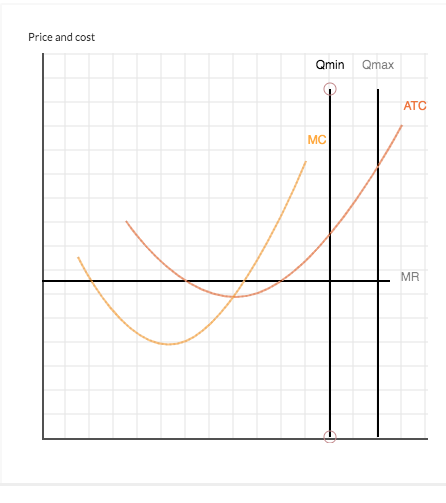
The graph below shows a particular firm's marginal revenue (MR), marginal cost (MC), and average total cost (ATC) curves
The graph below shows a particular firm's marginal revenue (MR), marginal cost (MC), and average total cost (ATC) curves, where the market is competitive. Suppose that a new management team is brought in and that this team is initially less concerned about maximizing profits than it is simply about making a profit. What range of production quantities will allow the firm to operate while earning a profit?
Give your answer by dragging the Qmin to Qmax lines into their correct positions. The output will need to lie somewhere betwen those limits.
To refer to the graphing tutorial for this question type, please click here.
In: Economics
Category Cost: Rent Monthly, cost $3000, Utilities Monthly $1100, Insurance Quarterly $1200, Property Taxes, annually $6000,...
Category Cost: Rent Monthly, cost $3000, Utilities Monthly $1100, Insurance Quarterly $1200, Property Taxes, annually $6000, Steel per shelf $9.00, forming per shelf $.25, Labor per shelf $.75 Price charged per shelf $20.00 This company will break even with monthly production of ____ units, and sales of __________
250; $5000
!0,000; $500
$5000; 250
500; $10,000
In: Finance