Questions
4.2 Question 4.2.1 to 4.2.3 is based on the excerpt below: SA Household Finances are in...
4.2 Question 4.2.1 to 4.2.3 is based on the excerpt below:
SA Household Finances are in Dire Straits The South African Reserve Bank (Sarb) yesterday painted a bleak picture of household finances, saying household expenditure had tanked for the first time in three years. In its quarterly bulletin for June, published yesterday, the central bank said consumption expenditure by households had fallen by 0.8% in the first quarter of 2019 following a 3.2% increase in the fourth quarter of 2018 as the economy wanes. The economy is on a downward spiral with gross domestic product contracting by 3.2% in the first quarter of 2019 – the largest contraction since the first quarter of 2009 when it contracted by 6.1%, at the height of the global financial crisis. The Sarb said the deterioration in the household consumption was in line with the decline in consumer confidence in the first quarter of 2019, as measured by the First National Bank/Bureau for Economic Research Consumer Confidence Index.The Sarb said consumers’ finances had been under pressure due to the prolonged period of weak economic activity, rising unemployment, an increased tax burden and successive fuel price increases. Growth in the real disposable income of households was weighed down by lacklustre employment growth and slower wage growth.
4.2.1 The article states that “the economy is on a downward spiral……first quarter of 2019.” Explain which phase of the business cycle this represents. (5)
4.2.2 The article further states that “growth in the real disposable income……and slower wage growth.” In terms of this statement, discuss the type of fiscal policy that government can implement to remedy this situation, paying specific attention in your answer to the tool that needs to be targeted. (5)
4.2.3 Discuss a demand side policy that can be implemented by government to reduce unemployment mentioned in the article.
In: Economics
To test Upper H 0H0: muμequals=100 versus Upper H 1H1: muμnot equals≠100, a simple random sample...
In: Statistics and Probability
Property Flask 1 Flask 2 Flask 3 Flask 4 Contents 100 ml water 100 ml water...
|
Property |
Flask 1 |
Flask 2 |
Flask 3 |
Flask 4 |
|
Contents |
100 ml water |
100 ml water |
74ml acetic acid,1.1g sodium acetate, 26ml water |
74ml acetic acid, 1.1g sodium acetate,26 ml water |
|
Initial pH |
7.00 |
7.00 |
5.01 |
5.01 |
|
pH after adding strong acid(HCL) |
2.32 |
4.97 |
||
|
pH after adding strong base(NAOH) |
11.68 |
5.06 |
1. Compare what happen to the pH of flask 1 to what happened to the pH of flask 3 when HCl was added.
2. Which substance, water or the buffer does a better job of maintaining pH when small amounts of strong acid are added?
3. Compare what happen to the pH of flask 2 to what happened to the pH of flask 4 when NaOH was added.
4. Which substance, water or the buffer does a better job of maintaining pH when small amounts of strong base are added?
5. Write equations for the reactions taking place in each of the flasks. For an equilibrium arrow use equals sign (=) ( use H2O for water, A- for acetate ion, HA for acetic acid, H+ for hydrogen ion, H3O+ for hydronium ion, Na+ for sodium ion, and OH- for hydroxide ion.
a. Reaction in flask 1
b. Reaction in flask 2
c. Reaction in flask 3.
d. Reaction in flask 4.
6. In your own words, tell how this experiment is related to the buffer systems in the blood.
In: Chemistry
Composition Melting Point Range (C) Benzoic Acid (100%) 123 C Maleic Acid (100%) 135 C Benzoic:Maleic...
| Composition | Melting Point Range (C) |
| Benzoic Acid (100%) | 123 C |
| Maleic Acid (100%) | 135 C |
| Benzoic:Maleic (75:25) |
113-116 C |
| Benzoic:Maleic (50:50) | 113-118 C |
| Benzoic:Maleic (25:75) | 123-129 C |
A) Summarize the data (melting point ranges of the 3 mixed samples)
B) What conclusions can be made about the effect of impurities on the melting point range?
C) How did you reach that conclusion?
In: Chemistry
Final_exam assignment_grade Tutorial_attend 100 90 5 100 75 5 90 75 5 85 85 5 85...
| Final_exam | assignment_grade | Tutorial_attend |
| 100 | 90 | 5 |
| 100 | 75 | 5 |
| 90 | 75 | 5 |
| 85 | 85 | 5 |
| 85 | 100 | 5 |
| 80 | 95 | 5 |
| 70 | 80 | 5 |
| 60 | 95 | 5 |
| 60 | 80 | 5 |
| 55 | 95 | 5 |
| 55 | 25 | 4 |
| 50 | 80 | 5 |
| 45 | 90 | 5 |
| 40 | 65 | 5 |
| 40 | 65 | 4 |
| 35 | 0 | 3 |
| 30 | 70 | 4 |
| 30 | 55 | 4 |
| 25 | 85 | 5 |
| 25 | 90 | 4 |
| 15 | 5 | 3 |
| 15 | 80 | 5 |
| 15 | 50 | 5 |
| 15 | 45 | 3 |
| 5 | 75 | 3 |
| 5 | 70 | 4 |
| 100 | 100 | 5 |
| 95 | 75 | 5 |
| 90 | 100 | 5 |
| 85 | 85 | 5 |
| 80 | 95 | 5 |
| 70 | 45 | 5 |
| 70 | 100 | 5 |
| 65 | 90 | 5 |
| 60 | 100 | 5 |
| 55 | 65 | 4 |
| 55 | 90 | 5 |
| 55 | 80 | 4 |
| 50 | 50 | 5 |
| 45 | 50 | 4 |
| 45 | 75 | 3 |
| 40 | 75 | 5 |
| 40 | 70 | 5 |
| 35 | 90 | 4 |
| 30 | 95 | 5 |
| 30 | 55 | 5 |
| 25 | 75 | 4 |
| 25 | 20 | 3 |
| 25 | 65 | 2 |
| 15 | 60 | 4 |
| 15 | 60 | 4 |
| 15 | 80 | 5 |
| 10 | 55 | 4 |
| 10 | 80 | 2 |
| 0 | 0 | 2 |
| SUMMARY OUTPUT | ||||||||
| Regression Statistics | ||||||||
| Multiple R | 0.612917385 | |||||||
| R Square | 0.375667721 | |||||||
| Adjusted R Square | 0.351654941 | |||||||
| Standard Error | 22.82783542 | |||||||
| Observations | 55 | |||||||
| ANOVA | ||||||||
| df | SS | MS | F | Significance F | ||||
| Regression | 2 | 16305.00365 | 8152.501823 | 15.64449105 | 4.79524E-06 | |||
| Residual | 52 | 27097.72363 | 521.1100697 | |||||
| Total | 54 | 43402.72727 | ||||||
| Coefficients | Standard Error | t Stat | P-value | Lower 95% | Upper 95% | Lower 95.0% | Upper 95.0% | |
| Intercept | -35.7528379 | 15.54695813 | -2.299667729 | 0.025513459 | -66.95009176 | -4.555584041 | -66.95009176 | -4.555584041 |
| assignment_grade | 0.218051561 | 0.153416203 | 1.421307252 | 0.161197169 | -0.089800572 | 0.525903695 | -0.089800572 | 0.525903695 |
| Tutorial_attend | 15.33752081 | 4.29606168 | 3.570135151 | 0.000778134 | 6.716842368 | 23.95819925 | 6.716842368 | 23.95819925 |
7. Using your multiple regression results to predict Final_exam for a student with the mean assignment_grade and tutorial_attend equal to (i) 2 tutorials, (ii) 3, (iii) 4 and (iv) 5 tutorials. (Hint this means you will have 4 distinct predictions for Final_exam) Carefully interpret your results.
In: Statistics and Probability
Group Sample Size Sample Mean Sample Standard Deviation Atlanta 100 29.11 20.72 St. Louis 100 21.97...
|
Group |
Sample Size |
Sample Mean |
Sample Standard Deviation |
|
Atlanta |
100 |
29.11 |
20.72 |
|
St. Louis |
100 |
21.97 |
14.23 |
A. Use the six step hypothesis testing procedure to determine if there is evidence that the mean commute times are different in the populations of Atlanta and St. Louis residents.
Step 1: Identify the population, comparison distribution, and assumptions [4 points]
Step 2: State the null and research hypotheses [4 points]
H0:
H1:
Step 3: Determine the characteristics of the comparison distribution (shape, mean, & standard error) [4 points]
Step 4: Determine the critical values [4 points]
Step 5: Calculate the test statistic [4 points]
Step 6: Make a decision (reject/fail to reject + real world conclusion) [4 points]
B. Compute Cohen’s d for the difference in sample means. [4 points]
In: Statistics and Probability
Consider the following substitution block cipher: Plain-text 000 110 001 100 010 111 011 001 100...
Consider the following substitution block cipher:
Plain-text
-
000 110
-
001 100
-
010 111
-
011 001
-
100 101
-
101 000
-
110 010
-
111 011
Cipher-text
[10]
Compute the cipher-text belonging to plaintext 001 110 000 101 110 (using a block size of 3 bits) for the Electronic Code Book (ECB) mode and Cipher Block Chaining (CBC) mode taking IV = 111. Show the intermediate steps.
In: Computer Science
1.When students apply for graduate studies (i.e. at the master’s or doctoral level), they are required...
1.When students apply for graduate studies (i.e. at the master’s
or doctoral level), they are
required to submit an official copy of their transcript, mailed
directly from the Registrar’s
Office at their academic institution. The customer service division
of the Registrar’s
Office at a large Canadian university is interested in determining
if they are more than
25% faster at processing transcripts than another university in the
area, which can process
transcripts in 16 business hours. The customer service manager
obtains a random sample
of 10 waiting times (in business hours), which are provided
below.
11 12 18 20 23
15 10 12 13 14
a. Conduct an appropriate hypothesis test. Use the critical value
method. Use a
population standard deviation of 2 hours. [9 marks]
HINT: You will first have to determine what it means to be 25%
faster, in terms
of hours.
b. Explain what a Type I Error means in this context. [1 mark]
2. A major keyboard manufacturer has a line of keyboards designed
for apartment dwellers.
These keyboards need to be light enough to be carried up flights of
stairs. The lead
engineer wants to use a new type of material. The engineer claims
that the new keyboards
will be lighter than the old keyboards.
They take a sample of 4 keyboards manufactured using the old
material and compute an
average weight of 21 kg with a standard deviation of 1 kg.
They take a sample of 8 keyboards manufactured using the new
material and compute an
average weight of 17 kg with a standard deviation of 2 kg.
a. Conduct an appropriate hypothesis test using the p-value method.
Use the old
material as population 1. [8 marks]
b. How much evidence is there against the null hypothesis in part
(a)? [1 mark]
c. Explain what a Type II Error means in this context. [1 mark
3.An insurance company is interested in estimating the
population mean cost of basic dental
cleaning at dentists in Saskatoon. Suppose there are only two
dentists in Saskatoon:
Dentist A and Dentist B. Suppose also that the cost of basic dental
cleaning varies only
depending on how well the patient practices regular dental hygiene,
so that the cost of
basic dental cleaning roughly follows a Normal distribution
regardless of the dentist.
The insurance company selects 8 sample patients and sends them to
both Dentist A and
Dentist B. They send the patients in random order, such that half
of the patients are seen
by Dentist A first, and half are seen by Dentist B first, so as not
to bias the results. The
cost of basic dental cleaning for these 8 patients seen by both
Dentists A and B are
provided below. The insurance company would like to determine
whether the population
mean cost of basic dental cleaning by Dentist A is different from
the population mean
cost of basic dental care by Dentist B. Let the population of costs
of basic dental care
from Dentist A be population 1.
Patient 1 2 3 4 5 6 7 8
Dentist A $100 $120 $125 $110 $95 $105 $120 $115
Dentist B $150 $100 $140 $100 $95 $105 $100 $120
Conduct an appropriate hypothesis test using the critical value
method. [10 marks]
In: Math
Delsing Canning Company is considering an expansion of its facilities. Its current income statement is as...
Delsing Canning Company is considering an expansion of its facilities. Its current income statement is as follows:
| Sales | $ | 6,600,000 |
| Variable costs (50% of sales) | 3,300,000 | |
| Fixed costs | 1,960,000 | |
| Earnings before interest and taxes (EBIT) | $ | 1,340,000 |
| Interest (10% cost) | 520,000 | |
| Earnings before taxes (EBT) | $ | 820,000 |
| Tax (35%) | 287,000 | |
| Earnings after taxes (EAT) | $ | 533,000 |
| Shares of common stock | 360,000 | |
| Earnings per share | $ | 1.48 |
The company is currently financed with 50 percent debt and 50 percent equity (common stock, par value of $10). In order to expand the facilities, Mr. Delsing estimates a need for $3.6 million in additional financing. His investment banker has laid out three plans for him to consider:
- Sell $3.6 million of debt at 12 percent.
- Sell $3.6 million of common stock at $30 per share.
- Sell $1.80 million of debt at 11 percent and $1.80 million of common stock at $40 per share.
Variable costs are expected to stay at 50 percent of sales, while fixed expenses will increase to $2,460,000 per year. Delsing is not sure how much this expansion will add to sales, but he estimates that sales will rise by $1 million per year for the next five years
Delsing is interested in a thorough analysis of his expansion plans and methods of financing.He would like you to analyze the following:
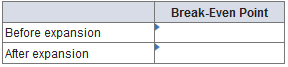
a. The break-even point for operating expenses before and after expansion (in sales dollars). (Enter your answers in dollars not in millions, i.e, $1,234,567.)
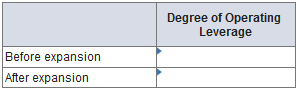
b. The degree of operating leverage before and after expansion. Assume sales of $6.6 million before expansion and $7.6 million after expansion. Use the formula: DOL = (S − TVC) / (S − TVC − FC). (Round your answers to 2 decimal places.)
c-1. The degree of financial leverage before expansion. (Round your answer to 2 decimal places.)

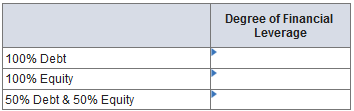
c-2. The degree of financial leverage for all three methods after expansion. Assume sales of $7.6 million for this question. (Round your answers to 2 decimal places.)
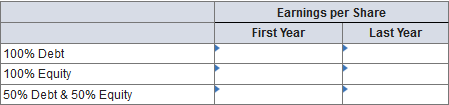
d. Compute EPS under all three methods of financing the expansion at $7.6 million in sales (first year) and $10.5 million in sales (last year). (Round your answers to 2 decimal places.)
In: Finance
Delsing Canning Company is considering an expansion of its facilities. Its current income statement is as...
Delsing Canning Company is considering an expansion of its
facilities. Its current income statement is as follows:
| Sales | $ | 6,100,000 |
| Variable costs (50% of sales) | 3,050,000 | |
| Fixed costs | 1,910,000 | |
| Earnings before interest and taxes (EBIT) | $ | 1,140,000 |
| Interest (10% cost) | 420,000 | |
| Earnings before taxes (EBT) | $ | 720,000 |
| Tax (40%) | 288,000 | |
| Earnings after taxes (EAT) | $ | 432,000 |
| Shares of common stock | 310,000 | |
| Earnings per share | $ | 1.39 |
The company is currently financed with 50 percent debt and 50
percent equity (common stock, par value of $10). In order to expand
the facilities, Mr. Delsing estimates a need for $3.1 million in
additional financing. His investment banker has laid out three
plans for him to consider:
- Sell $3.1 million of debt at 13 percent.
- Sell $3.1 million of common stock at $20 per share.
- Sell $1.55 million of debt at 12 percent and $1.55 million of common stock at $25 per share.
Variable costs are expected to stay at 50 percent of sales,
while fixed expenses will increase to $2,410,000 per year. Delsing
is not sure how much this expansion will add to sales, but he
estimates that sales will rise by $1 million per year for the next
five years.
Delsing is interested in a thorough analysis of his expansion plans
and methods of financing.He would like you to analyze the
following:
a. The break-even point for operating expenses
before and after expansion (in sales dollars). (Enter your
answers in dollars not in millions, i.e,
$1,234,567.)
Break-Even Point
Before expansion ___________
After expansion ___________
b. The degree of operating leverage before and
after expansion. Assume sales of $6.1 million before expansion and
$7.1 million after expansion. Use the formula: DOL = (S −
TVC) / (S − TVC − FC). (Round
your answers to 2 decimal places.)
Degree of Operating Leverage
Before expansion ________________
After expansion _________________
c-1. The degree of financial leverage before
expansion. (Round your answer to 2 decimal places.)
Degree of financial leverage ___________
c-2. The degree of financial leverage for all
three methods after expansion. Assume sales of $7.1 million for
this question. (Round your answers to 2 decimal
places.)
Degree of financial leverage
100% debt ___________________
100% equity ___________________
50% debt and 50% equity ________________
d. Compute EPS under all three methods of
financing the expansion at $7.1 million in sales (first year) and
$10.0 million in sales (last year). (Round your answers to
2 decimal places.)
Earnings per share
First Year Last Year
100% debt _________________________________
100% Equity _________________________________
50%debt and 50% equity ______________________________
In: Finance