Questions
Determining opportunity cost

Juanita is deciding whether to buy a suit that she wants, as well as where to buy it. Three stores carry the same suit, but it is more convenient for Juanita to get to some stores than others. For example, she can go to her local store, located 15 minutes away from where she works, and pay a marked-up price of $112 for the suit:
|
Store |
Travel Time Each Way |
Price of a Suit |
|---|---|---|
|
(Minutes) |
(Dollars per suit) |
|
| Local Department Store | 15 | 112 |
| Across Town | 30 | 89 |
| Neighboring City | 60 | 70 |
Juanita makes $26 an hour at work. She has to take time off work to purchase her suit, so each hour away from work costs her $26 in lost income. Assume that returning to work takes Juanita the same amount of time as getting to a store and that it takes her 30 minutes to shop. As you answer the following questions, ignore the cost of gasoline and depreciation of her car when traveling.
Complete the following table by computing the opportunity cost of Juanita's time and the total cost of shopping at each location.
|
Store |
Opportunity Cost of Time |
Price of a Suit |
Total Cost |
|---|---|---|---|
|
(Dollars) |
(Dollars per suit) |
(Dollars) |
|
| Local Department Store | 112 | ||
| Across Town | 89 | ||
| Neighboring City | 70 |
Assume that Juanita takes opportunity costs and the price of the suit into consideration when she shops. Juanita will minimize the cost of the suit if she buys it from the _______ .
In: Economics
Juanita is deciding whether to buy a dress that she wants, as well as where to buy it.
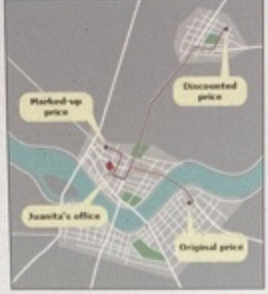
Juanita is deciding whether to buy a dress that she wants, as well as where to buy it. Three stores carry the same dress, but it is more convenient for Juanita to get to some stores than others. For example, she can go to her local store, located 15 minutes away from where she works, and pay a marked-up price of $103 for the dress:
Store | Travel Time Each Way | Price of a Dress |
|---|---|---|
(Minutes) | (Dollars per dress) | |
| Local Department Store | 15 | 103 |
| Across Town | 30 | 89 |
| Neighboring City | 60 | 63 |
Juanita makes $16 an hour at work. She has to take time off work to purchase her dress, so each hour away from work costs her $16 in lost income. Assume that returning to work takes Juanita the same amount of time as getting to a store and that it takes her 30 minutes to shop. As you answer the following questions, ignore the cost of gasoline and depreciation of her car when traveling.
Complete the following table by computing the opportunity cost of Juanita's time and the total cost of shopping at each location.
Store | Opportunity Cost of Time | Price of a Dress | Total Cost |
|---|---|---|---|
(Dollars) | (Dollars per dress) | (Dollars) | |
| Local Department Store | |||
| Across Town | |||
| Neighboring City |
Assume that Juanita takes opportunity costs and the price of the dress into consideration when she shops. Juanita will minimize the cost of the dress if she buys it from the store in the _______ .
In: Economics
Juanita is deciding whether to buy a skirt that she wants, as well as where to...
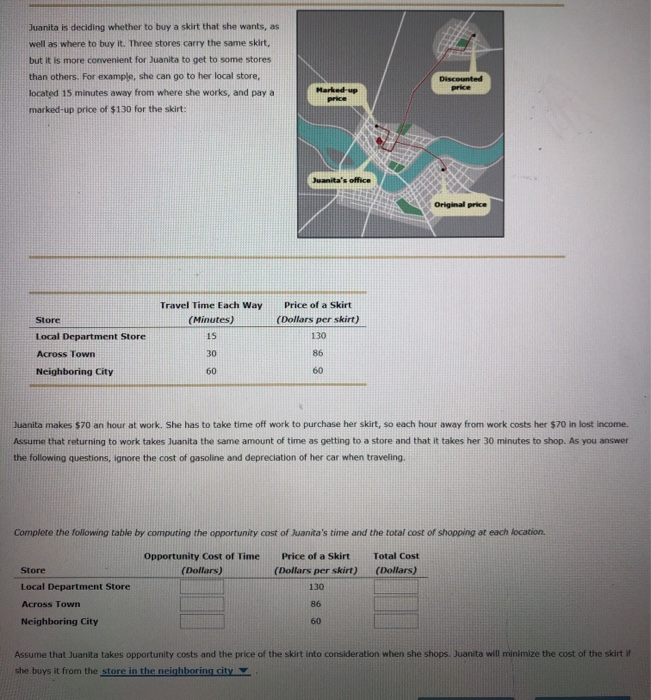
Juanita is deciding whether to buy a skirt that she wants, as well as where to buy it. Three stores carry the same skirt, but it is more convenient for Juanita to get to some stores than others. For example, she can go to her local store, located 15 minutes away from where she works, and pay a marked-up price of $130 for the skirt:
| Travel Time Each Way | Price of a Skirt | |
|---|---|---|
| Store | (Minutes) | (Dollars per skirt) |
| Local Department Store | 15 | 130 |
| Across Town | 30 | 86 |
| Neighboring City | 60 | 60 |
Juanita makes $70 an hour at work. She has to take time off work to purchase her skirt, so each hour away from work costs her $70 in lost income. Assume that returning to work takes Juanita the same amount of time as getting to a store and that it takes her 30 minutes to shop. As you answer the following questions, ignore the cost of gasoline and depreciation of her car when traveling.
Complete the following table by computing the opportunity cost of Juanita's time and the total cost of shopping at each location.
| Store | Opportunity Cost of Time (Dollars) | Price of a Skirt (Dollars per skirt) | Total Cost (Dollars) |
|---|---|---|---|
| Local Department Store | 130 | ||
| Across Town | 86 | ||
| Neighboring City | 60 |
Assume that Juanita takes opportunity costs and the price of the skirt into consideration when she shops. Juanita will minimize the cost of the skirt if she buys it from the store in the neighboring city.
In: Accounting
Juanita is deciding whether to buy a dress that she wants, as well as where to buy it
Juanita is deciding whether to buy a dress that she wants, as well as where to buy it. Three stores carry the same dress, but it is more convenient for Juanita to get to some stores than others. For example, she can go to her local store, located 15 minutes away from where she works, and pay a marked-up price of $129 for the dress:
| Store | Travel Time Each Way (Minutes) | Price of a Dress (Dollars per dress) |
|---|---|---|
| Local Department Store | 15 | 129 |
| Across Town | 30 | 86 |
| Neighboring City | 60 | 63 |
Juanita makes \(\$ 50\) an hour at work. She has to take time off work to purchase her dress, so each hour away from work costs her \(\$ 50\) in lost income. Assume that returning to work takes Juanita the same amount of time as getting to a store and that it takes her 30 minutes to shop. As you answer the following questions, ignore the cost of gasoline and depreciation of her car when traveling.
Complete the following table by computing the opportunity cost of Juanita's time and the total cost of shopping at each location.
| Store | Opportunity Cost of Time (Dollars) | Price of a Dress (Dollars per dress) | Total Cost (Dollars) |
|---|---|---|---|
| Local Department Store | 129 | ||
| Across Town | 86 | ||
| Neighboring City | 63 |
Assume that Juanita takes opportunity costs and the price of the dress into consideration when she shops. Juanita will minimize the cost of the dress if she buys it from the _______.
In: Economics
. Determining opportunity cost Juanita is deciding whether to buy a suit that she wants, as...
. Determining opportunity cost
Juanita is deciding whether to buy a suit that she wants, as well as where to buy it. Three stores carry the same suit, but it is more convenient for Juanita to get to some stores than others. For example, she can go to her local store, located 15 minutes away from where she works, and pay a marked-up price of $129 for the suit:
|
Store |
Travel Time Each Way |
Price of a Suit |
|---|---|---|
|
(Minutes) |
(Dollars per suit) |
|
| Local Department Store | 15 | 129 |
| Across Town | 30 | 86 |
| Neighboring City | 60 | 63 |
Juanita makes $50 an hour at work. She has to take time off work to purchase her suit, so each hour away from work costs her $50 in lost income. Assume that returning to work takes Juanita the same amount of time as getting to a store and that it takes her 30 minutes to shop. As you answer the following questions, ignore the cost of gasoline and depreciation of her car when traveling.
Complete the following table by computing the opportunity cost of Juanita's time and the total cost of shopping at each location.
|
Store |
Opportunity Cost of Time |
Price of a Suit |
Total Cost |
|---|---|---|---|
|
(Dollars) |
(Dollars per suit) |
(Dollars) |
|
| Local Department Store | 129 | ||
| Across Town | 86 | ||
| Neighboring City | 63 |
Assume that Juanita takes opportunity costs and the price of the suit into consideration when she shops. Juanita will minimize the cost of the suit if she buys it from the .
In: Economics
2. A teddy bear factory is found to be leaking a harmful substance called “luv”. As...
2. A teddy bear factory is found to be leaking a harmful substance called “luv”. As long as the average amount of luv in the ground soil is less than 4mg per meter, it will be safe. You are part of team determining whether the amount of luv is dangerous or not.
(a) [4 pts] Your team gathers 100 soil samples and finds that the average amount of luv is 3.5mg per meter, with a deviation of 0.7mg. Conduct an hypothesis test to see if there is too much luv. Remember, you need to give me H0, H1, and an appropriate p-value. You will be analyzing your answer in part (c).
(b) [4 pts] What is the smallest confidence interval that would capture the 4mg per meter safety limit?
(c) [2 pts] If your findings need to be at the 1% significance level, should the town worry? Explain your answer.
3. We are in the same situation as the previous problem. Only this time your team can only gather 3 samples. The average in the samples is still 3.5mg per meter, with a deviation of 0.7mg.
(a) [4 pts] Conduct an hypothesis test to see if there is too much luv. Remember, you need to give me H0, H1, and an appropriate p-value. You will be analyzing your answer in part (c).
(b) [4 pts] What is the smallest confidence interval that would capture the 4mg per meter safety limit?
(c) [2 pts] Using a 1% signficance level sShould the town worry? Explain your answer.
In: Statistics and Probability
Determining opportunity cost Juanita is deciding whether to buy a skirt that she wants, as well...
Determining opportunity cost Juanita is deciding whether to buy a skirt that she wants, as well as where to buy it. Three stores carry the same skirt, but it is more convenient for Juanita to get to some stores than others. For example, she can go to her local store, located 15 minutes away from where she works, and pay a marked-up price of $100 for the skirt: Store Travel Time Each Way Price of a Skirt (Minutes) (Dollars per skirt) Local Department Store 15 100 Across Town 30 86 Neighboring City 60 63 Juanita makes $56 an hour at work. She has to take time off work to purchase her skirt, so each hour away from work costs her $56 in lost income. Assume that returning to work takes Juanita the same amount of time as getting to a store and that it takes her 30 minutes to shop. As you answer the following questions, ignore the cost of gasoline and depreciation of her car when traveling. Complete the following table by computing the opportunity cost of Juanita's time and the total cost of shopping at each location. Store Opportunity Cost of Time Price of a Skirt Total Cost (Dollars) (Dollars per skirt) (Dollars) Local Department Store 100 Across Town 86 Neighboring City 63 Assume that Juanita takes opportunity costs and the price of the skirt into consideration when she shops. Juanita will minimize the cost of the skirt if she buys it from the _____ .
In: Economics
Jane Ericsson has just purchased a 62 square-meter down-town flat at NOK 3,500,000 financed with 20%...
Jane Ericsson has just purchased a 62 square-meter down-town flat at NOK 3,500,000 financed with
20% of her own capital. Financing the rest of the purchase, a 20-year NOK 2,800,000 ordinary annuity
mortgage at 3.15% per year species end-of-month payments of interest including principal over the amortization period.
The rest payment is due one month from today. A two percent initiation fee charged by the lender requires Jane to increase her equity contribution by NOK 56,000.
It is commonly expected that down-town ats in Jane's neighborhood will appreciate by 2 percent per year over the next ten years.
Please provide numerical answers to the questions below:
(a) (7 points) Which monthly payment will amortize the mortgage-loan over the 20-year term?
(b) (7 points) What effective yield is Jane paying on the mortgage over the 20-year term?
Assume that Jane wants a 50% equity-share in her at after exactly 10 years (ie. 120 monthly payments).
Towards that end, she has received the lender's approval to adjust her monthly payment of interest and
principal.
(c) (8 points) Which monthly payment accommodates a 50% ownership in the at after 10 years?
(d) (8 points) Given the monthly payment calculated in (c), how many years does it take until
the loan is fully amortized (paid-down)?
In: Finance
statistics and probability questions, solve clearly, show steps and in 30 minutes for thumbs up vote...
statistics and probability questions, solve clearly, show steps and in 30 minutes for thumbs up vote
please answer all parts of the question, garunteed thumbs up.
A proposal to amalgamate the two towns of Smallville and
Palookatown into one municipality is scheduled to be put to a
referendum vote at the next local election. A random survey of 200
voters in each town is conducted, with 113 voters in Smallville
indicating their support for the proposal, and 90 voters in
Palookatown indicating their support.
a) Find the proportion of voters in support of amalgamation for
both towns.
b) Calculate confidence intervals for the difference between the
levels of support for amalgamation in the two towns, for:
i. LOC = 95%
ii. LOC = 99%
c) Comment on whether or not the results from Part (a) support the
idea that one town is more supportive, overall, of the amalgamation
proposal.
d) Assume that this data was collected after a claim was made that
the level of support is different in the two towns. Test this claim
at LOC = 95%, using the critical value method.
e) Use the p-value method to determine if your decision from Part
(d) above would change for any of
α = 0.10, 0.01, 0.005, 0.001 .
f) Assuming that the sampling in this study was done in a random
and unbiased manner, do you think that the level of support for
amalgamation is equal in the two towns, or are observed differences
probably just attributable to random sampling error? Explain in the
context of your answers above (Note: there is no single right
answer to this question – but your answer needs to be consistent
with the arguments supporting it).
In: Statistics and Probability
1.When the value of the standard deviation increases, the value of the z score will generally...
1.When the value of the standard deviation increases, the value of the z score will generally tend to
a. increase
b. decrease
2. In a standard normal distribution, what z-score corresponds to the 75th percentile?
a. z=.67
b. z=.07
c. z=.75
d. z=1.75
3. The total area under the normal curve is approximately 1.
a. true
b. false
4. If IQ scores are normally distributed with a mean of 100 and a standard deviation of 20, then the probability of a person's have an IQ score of at least 130
a. is does not exist
b. .0668
c. is .4332
d. is .5000
5. The life of a brand of battery is normally distributed with a mean of 2 hours and a standard deviation of 6 hours. The probability that a single randomly selected battery lasts more than 70 hours is
a. .0000
b. .0918
c. .4082
d. .9082
6. Suppose family incomes in a small town are normally distributed with a mean of $1200 and a standard deviation of $600 per month. The probability that a given family has an income between $1000 and $2050 per month is
a. .0918
b. .4082
c. .9082
d. .5515
7. Suppose family incomes in a small town are normally distributed with a mean of $1200 and a standard deviation of $600 per month. The probability that a given family has an income up to $2,000 per month is
a. .9082
b. .0918
c. .4082
d. .5515
8. The normal distribution is centered at its mean.
a. true
b. false
In: Statistics and Probability