Questions
34% of a certain country's voters think that it is too easy to vote in their...
34% of a certain country's voters think that it is too easy to vote in their country. You randomly select 12 likely voters. Find the probability that the number of likely voters who think that it is too easy to vote is (a) exactly three, (b) at least four, (c) less than eight.
In: Statistics and Probability
The number of miles a motorcycle, X, will travel on one gallon of gasoline is modeled...
The number of miles a motorcycle, X, will travel on one gallon of gasoline is modeled by a normal distribution with mean 44 and standard deviation 5. If Mike starts a journey with one gallon of gasoline in the motorcycle, find the probability that, without refueling, he can travel more than 50 miles.
In: Statistics and Probability
62% of U.S. adults have very little confidence in newspapers. You randomly select 10 U.S....
62% of U.S. adults have very little confidence in newspapers. You randomly select 10 U.S. adults. Find the probability that the number of U.S. adults who have very little confidence in newspapers is (a) exactly five, (b) at least six, and (c) less than four.
In: Math
The Decadent Desserts cookbook has recipes for desserts. The number of calories per serving for the...
The Decadent Desserts cookbook has recipes for desserts. The number of calories per serving for the recipes in the cookbook is normally distributed with a mean of 378 and a standard deviation of 34.5. If 18 recipes are randomly selected to serve at a reception, what is the probability that the average calories per serving for the sample is over 385?
In: Math
One reason the Normal approximation may fail to give accurate estimates of binomial probabilities is that...
One reason the Normal approximation may fail to give accurate estimates of binomial probabilities is that the binomial distributions are discrete and the Normal distributions are continuous. That is, counts take only whole number values, but Normal variables can take any value. We can improve the Normal approximation by treating each whole number count as if it occupied the interval from 0.50.5 below the number to 0.50.5 above the number. For example, approximate a binomial probability ?(?≥10)P(X≥10) by finding the Normal probability ?(?≥9.5)P(X≥9.5) . Be careful: binomial ?(?>10)P(X>10) is approximated by Normal ?(?≥10.5)P(X≥10.5) .
According to CDC estimates, more than 22 million people in the United States are sickened each year with antibiotic‑resistant infections, with at least 23,00023,000 dying as a result. Antibiotic resistance occurs when disease‑causing microbes become resistant to antibiotic drug therapy. Because this resistance is typically genetic and transferred to the next generations of microbes, it is a very serious public health problem. Of the three infections considered most serious by the CDC, gonorrhea has an estimated 800,000800,000 cases occurring annually, with approximately 30%30% of those cases resistant to any antibiotic.
Suppose a local health clinic sees 4040 cases. The exact binomial probability that 1515 or more cases are resistant to any antibiotic is 0.1930.193 .
(a) Show that this setting satisfies the rule of thumb for the use of the Normal approximation (just barely). (Enter your answers rounded to one decimal place.)
??=np=
?(1−?)=n(1−p)=
(b) What is the Normal approximation to ?(?≥15)P(X≥15) ? (Enter your answer to four decimal places.)
?(?≥15)=P(X≥15)=
It can be observed that the Normal approximation using continuity correction gives a much closer value to the true binomial probability than the Normal approximation.
(c) What is the Normal approximation using the continuity correction? (Enter your answer to four decimal places.)
?(?≥14.5)=P(X≥14.5)=
In: Statistics and Probability
Ex1) Download the code from the theory section, you will find zipped file contains the code...
Ex1) Download the code from the theory section, you will find zipped file contains the code of Singly linked list and Doubly linked list, in addition to a class Student.
In Class SignlyLinkedList,
1. There is a method display, what does this method do?
2. In class Test, and in main method, create a singly linked list objet, test the methods of the list.
3. To class Singly linked list, add the following methods:
a- Method get(int n), it returns the elements in the node number n, assume the first node number is 1. You need to check that n is within the range of nodes in the list, otherwise method get returns null.
What is the complexity of your method? Test the method in main.
b- Method insertAfter(int n, E e), its return type is void, it inserts element e in a new node after the node number n, assume the first node number is 1. You need to check that n is within the range of nodes in the list, otherwise through an exception.
What is the complexity of your method?
Test the method in main.
c- Method remove(int n): it removes the node number n, and returns the element in that node, assuming the first node number is 1. You need to check that n is within the range of nodes in the list, otherwise method get returns null.
What is the complexity of your method?
Test the method in main.
d- Method reverse( ): it has void return type. It reverse the order of the elements in the singlylinked list.
What is the complexity of your method?
Test the method in main.
Ex2) In Class DoublyLinkedList
1. There are two methods printForward, printBackward, what do they do?
2. In class Test, and in main method, create a doubly linked list objet, test the methods of the list.
4. To class Doubly linked list, add the following methods:
e- Method get(int n), it returns the elements in the node number n, assume the first node number is 1. You need to check that n is within the range of nodes in the list, otherwise method get returns null.
To make your code more efficient, you should start from the end (header or trailer) that is closer to the target node.
What is the complexity of your method?
Test the method in main.
f- Method insertAfter(int n, E e), its return type is void, it inserts element e in a new node after the node number n, assume the first node number is 1. You need to check that n is within the range of nodes in the list, otherwise through an exception. . To make your code more efficient, you should start from the end (header or trailer) that is closer to the target node.
What is the complexity of your method?
Test the method in main.
g- Method remove(int n): it removes the node number n, and returns the element in that node, assuming the first node number is 1. You need to check that n is within the range of nodes in the list, otherwise method get returns null. To make your code more efficient, you should start from the end (header or trailer) that is closer to the target node.
What is the complexity of your method?
Test the method in main.
Assignment:
To class DoublyLinedList, add method remove(E e) which removes all nodes that has data e. This method has void return type.
doublylinkedlist class:
package doubly;
public class DoublyLinkedList <E>{
private Node<E> header;
private Node<E> trailer;
private int size=0;
public DoublyLinkedList() {
header=new
Node<>(null,null,null);
trailer=new
Node<>(null,header,null);
header.setNext(trailer);
}
public int size() { return size;}
public boolean isEmpty() {return size==0;}
public E first()
{
if (isEmpty()) return null;
return
header.getNext().getData();
}
public E last()
{
if (isEmpty()) return null;
return
trailer.getPrev().getData();
}
private void addBetween(E e, Node<E>
predecessor, Node<E> successor)
{
Node<E> newest=new
Node<>(e,predecessor,successor);
predecessor.setNext(newest);
successor.setPrev(newest);
size++;
}
private E remove(Node<E> node)
{
Node<E>
predecessor=node.getPrev();
Node<E>
successor=node.getNext();
predecessor.setNext(successor);
successor.setPrev(predecessor);
size--;
return node.getData();
}
public void addFirst(E e){
addBetween(e,header,header.getNext());
}
public void addLast(E e){
addBetween(e,trailer.getPrev(),trailer);
}
public E removeFirst(){
if(isEmpty()) return null;
return
remove(header.getNext());
}
public E removeLast()
{
if(isEmpty()) return null;
return remove(trailer.getPrev());
}
public void printForward()
{
for (Node<E>
tmp=header.getNext();tmp!=trailer;tmp=tmp.getNext())
System.out.println(tmp.getData());
}
public void printBackward()
{
for (Node<E>
tmp=trailer.getPrev();tmp!=header;tmp=tmp.getPrev())
System.out.println(tmp.getData());
}
}
node class:
package doubly;
public class Node <E>{
private E data;
private Node<E> prev;
private Node<E> next;
public Node(E d, Node<E> p,Node<E>
n)
{
data=d;
prev=p;
next=n;
}
public E getData() { return data; }
public Node<E> getNext(){ return next; }
public Node<E> getPrev(){ return prev; }
public void setNext(Node<E> n) { next=n;}
public void setPrev(Node<E> p) { prev=p;}
}
student class:
package doubly;
public class Student {
private int id;
private String name;
public Student(int id, String name) {
super();
this.id = id;
this.name = name;
}
public int getId() {
return id;
}
public void setId(int id) {
this.id = id;
}
public String getName() {
return name;
}
public void setName(String name) {
this.name = name;
}
@Override
public String toString() {
return "[id=" + id + ", name=" + name + "]";
}
}
test class:
package doubly;
public class Test {
public static void main(String arg[])
{
DoublyLinkedList<Student> myList=new
DoublyLinkedList<>();
myList.addFirst(new Student(1,"Ahmed"));
myList.addFirst(new Student(2,"Khaled"));
myList.addLast(new Student(3,"Ali"));
myList.removeLast();
myList.printForward();
}
}
In: Computer Science
Ex1) Download the code from the theory section, you will find zipped file contains the code...
Ex1) Download the code from the theory section, you will find zipped file contains the code of Singly linked list and Doubly linked list, in addition to a class Student.
In Class SignlyLinkedList,
1. There is a method display, what does this method do?
2. In class Test, and in main method, create a singly linked list objet, test the methods of the list.
3. To class Singly linked list, add the following methods:
a- Method get(int n), it returns the elements in the node number n, assume the first node number is 1. You need to check that n is within the range of nodes in the list, otherwise method get returns null.
What is the complexity of your method? Test the method in main.
b- Method insertAfter(int n, E e), its return type is void, it inserts element e in a new node after the node number n, assume the first node number is 1. You need to check that n is within the range of nodes in the list, otherwise through an exception.
What is the complexity of your method?
Test the method in main.
c- Method remove(int n): it removes the node number n, and returns the element in that node, assuming the first node number is 1. You need to check that n is within the range of nodes in the list, otherwise method get returns null.
What is the complexity of your method?
Test the method in main.
d- Method reverse( ): it has void return type. It reverse the order of the elements in the singlylinked list.
What is the complexity of your method?
Test the method in main.
Ex2) In Class DoublyLinkedList
1. There are two methods printForward, printBackward, what do they do?
2. In class Test, and in main method, create a doubly linked list objet, test the methods of the list.
4. To class Doubly linked list, add the following methods:
e- Method get(int n), it returns the elements in the node number n, assume the first node number is 1. You need to check that n is within the range of nodes in the list, otherwise method get returns null.
To make your code more efficient, you should start from the end (header or trailer) that is closer to the target node.
What is the complexity of your method?
Test the method in main.
f- Method insertAfter(int n, E e), its return type is void, it inserts element e in a new node after the node number n, assume the first node number is 1. You need to check that n is within the range of nodes in the list, otherwise through an exception. . To make your code more efficient, you should start from the end (header or trailer) that is closer to the target node.
What is the complexity of your method?
Test the method in main.
g- Method remove(int n): it removes the node number n, and returns the element in that node, assuming the first node number is 1. You need to check that n is within the range of nodes in the list, otherwise method get returns null. To make your code more efficient, you should start from the end (header or trailer) that is closer to the target node.
What is the complexity of your method?
Test the method in main.
Assignment:
To class DoublyLinedList, add method remove(E e) which removes all nodes that has data e. This method has void return type.
doublylinkedlist class:
package doubly;
public class DoublyLinkedList <E>{
private Node<E> header;
private Node<E> trailer;
private int size=0;
public DoublyLinkedList() {
header=new
Node<>(null,null,null);
trailer=new
Node<>(null,header,null);
header.setNext(trailer);
}
public int size() { return size;}
public boolean isEmpty() {return size==0;}
public E first()
{
if (isEmpty()) return null;
return
header.getNext().getData();
}
public E last()
{
if (isEmpty()) return null;
return
trailer.getPrev().getData();
}
private void addBetween(E e, Node<E>
predecessor, Node<E> successor)
{
Node<E> newest=new
Node<>(e,predecessor,successor);
predecessor.setNext(newest);
successor.setPrev(newest);
size++;
}
private E remove(Node<E> node)
{
Node<E>
predecessor=node.getPrev();
Node<E>
successor=node.getNext();
predecessor.setNext(successor);
successor.setPrev(predecessor);
size--;
return node.getData();
}
public void addFirst(E e){
addBetween(e,header,header.getNext());
}
public void addLast(E e){
addBetween(e,trailer.getPrev(),trailer);
}
public E removeFirst(){
if(isEmpty()) return null;
return
remove(header.getNext());
}
public E removeLast()
{
if(isEmpty()) return null;
return remove(trailer.getPrev());
}
public void printForward()
{
for (Node<E>
tmp=header.getNext();tmp!=trailer;tmp=tmp.getNext())
System.out.println(tmp.getData());
}
public void printBackward()
{
for (Node<E>
tmp=trailer.getPrev();tmp!=header;tmp=tmp.getPrev())
System.out.println(tmp.getData());
}
}
node class:
package doubly;
public class Node <E>{
private E data;
private Node<E> prev;
private Node<E> next;
public Node(E d, Node<E> p,Node<E>
n)
{
data=d;
prev=p;
next=n;
}
public E getData() { return data; }
public Node<E> getNext(){ return next; }
public Node<E> getPrev(){ return prev; }
public void setNext(Node<E> n) { next=n;}
public void setPrev(Node<E> p) { prev=p;}
}
student class:
package doubly;
public class Student {
private int id;
private String name;
public Student(int id, String name) {
super();
this.id = id;
this.name = name;
}
public int getId() {
return id;
}
public void setId(int id) {
this.id = id;
}
public String getName() {
return name;
}
public void setName(String name) {
this.name = name;
}
@Override
public String toString() {
return "[id=" + id + ", name=" + name + "]";
}
}
test class:
package doubly;
public class Test {
public static void main(String arg[])
{
DoublyLinkedList<Student> myList=new
DoublyLinkedList<>();
myList.addFirst(new Student(1,"Ahmed"));
myList.addFirst(new Student(2,"Khaled"));
myList.addLast(new Student(3,"Ali"));
myList.removeLast();
myList.printForward();
}
}
In: Computer Science
The weight of a small Starbucks coffee is a normally distributed random variable with a mean...
The weight of a small Starbucks coffee is a normally distributed random variable with a mean of 340 grams and a standard deviation of 11 grams. Find the weight that corresponds to each event. (Use Excel or Appendix C to calculate the z-value. Round your final answers to 2 decimal places.)
highest 30 percent
middle 70 percent
highest 90 percent
lowest 20 percent
In: Math
The following is a diagram of energy states and transitions in the hydrogen atom.
The following is a diagram of energy states and transitions in the hydrogen atom.
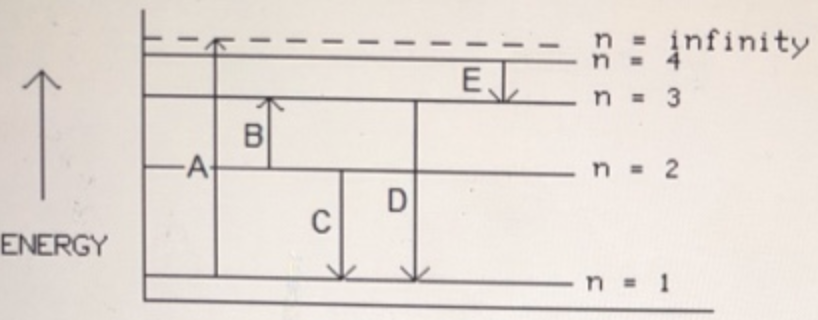
Match each of the responses below with the correct arrow from the figure.
1.) The emission line with the shortest wavelength.
2.) The absorption line with the longest wavelength.
3.) The emission line with the highest energy.
4.) The absorption line with the lowest energy.
5.) The emission line with the highest frequency.
6.) The line corresponding to the ionization energy of hydrogen.
In: Chemistry
The following table shows income distribution data for an economy in a particular year. Household Group &n
The following table shows income distribution data for an economy in a particular year.
Household Group Share of Aggregate Income
One-fifth with lowest income 8.1%
Next lowest one-fifth 11.5%
Middle one-fifth 20.0%
Next highest one-fifth 22.8%
One-fifth with highest income 37.6%
What is the Gini coefficient for this economy?
|
.440 |
||
|
.328 |
||
|
.281 |
||
|
1.453 |
||
|
.459 |
In: Economics