Questions
Expanding Universe For this week’s assignment, please answer EACH of the following questions/prompts,and post them to...
Expanding Universe
For this week’s assignment, please answer EACH of the following questions/prompts,and post them to the drop box as a single document.
- What is a particle accelerator?
How do scientists use particle accelerators to study subatomic particles? - What particle is exchanged to generate each of the four fundamental forces?
- What medical technologies (e.g. PET) rely on the physics of
elementary particles?
What are the benefits of noninvasive procedures such as PET? - How is astronomy the oldest science?
- How does the energy produced at the core of the Sun reach the photosphere?
- Why won’t the Sun become a supernova or black hole?
- Why does the existence of the cosmic redshift lead to the big bang picture of the universe?
- If a galaxy is 1,000 Mpc away, how fast is it receding from us?
- The average temperature of the universe is 2.7 Kelvin. What is that temperature in degrees Fahrenheit?
- The Milky Way has a radius of approximately 100,000 light years. How many miles is that? How long would it take you to travel across our galaxy if you were traveling at 50% the speed of light (be sure to show your work for full credit)?
In: Physics
The accident. Given your excellent physics legal advice in Worksheet 2-2, you've been asked to make a judgement on another car accident.
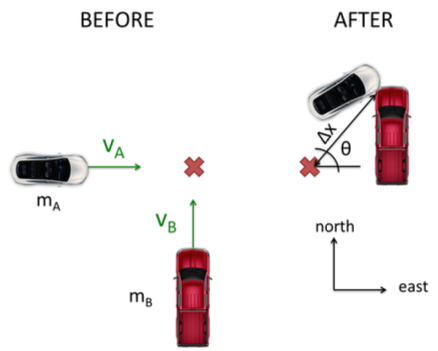
The accident. Given your excellent physics legal advice in Worksheet 2-2, you've been asked to make a judgement on another car accident. In this case, a Tesla with mass ma = 2000 kg travelling due east has collided with a Ford F150 Raptor with mass me = 2500 kg travelling due north. After the collision, it is found that the two vehicles (stuck together) have slid Ax = 7.7 m from the accident site at an angle of 40° north of east (see figure). The car driver claims the accident happened because the truck was speeding; the truck driver claims the car was speeding. The posted speed limit is 35 miles/hour.
(a) Work this problem backwards: Determine from the location of the vehicles what the total speed of the car+truck system was after the collision. Assume a coefficient of kinetic friction of uk = 0.90 between the car tire and road surfaces (hint: this is really an energy problem)
(b) Now determine the speeds of the car and truck before the collision, assuming it was an inelastic collision. Based on these values, was either car speeding? Who is telling the truth?
In: Physics
The setting is a moderately sized community, with a population of about 150,000 people. It is...
The setting is a moderately sized community, with a population
of about 150,000 people. It is a cluster of homes, with a short
distance between other clusters of homes. It was once a
manufacturing city, but has now been met with decline. The
neighboring areas are smaller communities but healthcare is
centered around this clinic. Your facility is in the center of this
community. Your group is tasked with establishing a new ambulatory
care clinic to meet the needs of the aging population in this
region. There is a hospital about 20 miles away, but it is felt
that the area is under-served, thus the need for this clinic. This
is the final department to be established – the ambulatory care,
with services for urgent care, pediatrics, and a diabetes care
center. The area has few physicians but has a large pool of family
nurse practitioners that have demonstrated interest in this
endeavor. Your group was chosen because of your previous background
and expertise as well as, the diverse members who bring a variety
of management skills with them
Identification of a framework or philosophy of nursing should be developed; Identify the style of nursing you would use; Analyze the major factors that are escalating the cost of healthcare today and apply those factors to the nursing healthcare delivery system
In: Nursing
At a local auto parts store, the economy ball joints have questionable quality. In the supply...
At a local auto parts store, the economy ball joints have
questionable quality. In the supply the 20 at the stir 7 are
unstable for install in a vehicle.
A. If 4 customers purchase ball joints from the supply (1 joint per customer for a total of 4) what is the probability that at most one of the customers will need to return for a replacement?
B. From part a) assume that a customer did in fact need to return one of the joints (no other customer need to return). What is the probability this customer will need to return again if they decide to buy 2 joints the second time (both joints defective)
C. Upon installing a non-defective ball joint in his car, Ralph forgets to properly torque the lug nuts on his wheel. If the wheel has a 5 lug pattern what is the probability that he will make it exactly 15 miles back to the parts store to return the extra ball joint if the probability a lug will come off in any given mile is .25? (Wheels fall off in parking lot when he locks the door) You may assume the lugs will not fall off at the same time.
In: Statistics and Probability
John has always had problems with maintaining his weight, and he is used to counting kilocalories...
John has always had problems with maintaining his weight, and he is used to counting kilocalories and maintaining an active lifestyle. He has noticed that recently his diet of 2,500 kilocalories is no longer good for him. He is steadily gaining weight, and he has to go on a weight-loss diet from time to time to stay in shape. John is now 53; he is 5 feet 9 inches tall and weighs 168 pounds. He loves exercise. He bikes a 28-mile route with his cycling club on Mondays, plays volleyball on Thursdays, and runs 3 to 5 miles on other days. What is John’s EER and how many kilocalories should he consume to maintain his weight? The Harris-Benedict equation for calculation of Resting Metabolic Rate (RMR) is as follows: Adult males RMR (kcal) = 66.5 + (13.7 × weight in kilograms) + (5.0 × height in centimeters) – (6.8 × age) EER = RMR (from Harris-Benedict equation) × activity factor
Round the final number of kilocalories to the nearest whole number. During calculations, use numbers rounded to the first decimal place.
In: Biology
Student scores on Professor Combs' Stats final exam are normally distributed with a mean of 77...
Student scores on Professor Combs' Stats final exam are normally distributed with a mean of 77 and a standard deviation of 7.5 Find the probability of the following: **(use 4 decimal places)** a.) The probability that one student chosen at random scores above an 82. b.) The probability that 20 students chosen at random have a mean score above an 82. c.) The probability that one student chosen at random scores between a 72 and an 82. d.) The probability that 20 students chosen at random have a mean score between a 72 and an 82.
q2. World class marathon runners are known to run that distance
(26.2 miles) in an average of 143 minutes with a standard deviation
of 13 minutes.
If we sampled a group of world class runners from a particular
race, find the probability of the following:
**(use 4 decimal places)**
a.) The probability that one runner chosen at random finishes the
race in less than 137 minutes.
b.) The probability that 10 runners chosen at random have an
average finish time of less than 137 minutes.
c.) The probability that 50 runners chosen at random have an
average finish time of less than 137 minutes.
In: Statistics and Probability
An irrigation canal contractor wants to determine whether he should purchase a used Caterpillar mini excavator...
An irrigation canal contractor wants to determine whether he should purchase a used Caterpillar mini excavator or a Toro powered rotary tiller for servicing irrigation ditches in an agricultural area of California. The initial cost of the excavator is $26,500 with a $9000 salvage value after 10 years. Fixed costs for insurance, license, etc. are expected to be $18,000 per year. The excavator will require one operator at $15 per hour and maintenance at $1 per hour. In 1 hour, 0.15 mile of ditch can be prepared. Alternatively, the contractor can purchase a tiller and hire 2 workers at $11 per hour each. The tiller costs $1200 and has a useful life of 5 years with no salvage value. Its operating cost is expected to be $1.20 per hour, and with the tiller, the two workers can prepare 0.04 mile of ditch in 1 hour. The contractor’s MARR is 10% per year. Determine the number of miles of ditch per year the contractor would have to service for the two options to break even. Solve the problem using Annual worth (AW), present worth (PW), anf future worth (FW).
In: Economics
A mechanical. person is intrested in testing if tuning a car engine would improve the gas...
A mechanical. person is intrested in testing if tuning
a car engine would improve the gas miliage. A simple random sample
of 8 cars were selected to determine the milage (miles per gallon).
Then each of the 8 cars were given a tune up
(SHOW WORK, please helpp)
Data:
After Tune up: 28.21, 29.4, 30.42, 29.67, 31.31, 29.68, 28.82,
29.38
Mean: 29.61
Standard Deviation: 0.94
Before Tune Up: 26.9, 26.37, 29.13, 28.46, 28.17,
27.67, 27.84, 27.18,
Mean: 27.72
Standard deviation: 0.89
Difference (After-Before): 1.31, 3.03, 1.29, 1.21,
3.14, 2.01, 0.98, 2.2,
Mean: 1.9
Standard Deviation: 0.84
1.) Are the 2 samples (Before and after Tune Mileage) independent or dependent? Explain
2.) Show which plot you would use to check your assumptions? Show picture of it
3.)Are their and serious violations of any other assumption plots? Explain
4.) What is your output? state below Explain why you chose this output
5.) What is your conclusion at a 5% confidence
level?
In: Statistics and Probability
Ramp metering is a traffic engineering idea that requires cars entering a freeway to stop for...
Ramp metering is a traffic engineering idea that requires cars entering a freeway to stop for a certain period of time before joining the traffic flow. The theory is that ramp metering controls the number of cars on the freeway and the number of cars accessing the freeway, resulting in a freer flow of cars, which ultimately results in faster travel times. To test whether ramp metering is effective in reducing travel times, engineers conducted an experiment in which a section of freeway had ramp meters installed on the on-ramps. The response variable for the study was speed of the vehicles. A random sample of 15 cars on the highway for a Monday at 6 p.m. with the ramp meters on and a second random sample of 15 cars on a different Monday at 6 p.m. with the meters off resulted in the following speeds (in miles per hour).
|
Ramp Meters On 28 47 56 37 31 25 43 47 50 35 54 40 42 26 48 |
|---|
|
Ramp Meters Off 23 27 42 33 37 32 46 37 19 28 23 39 38 52 42 |
|---|
Determine the P-value for this test.
P-valueequals=
(Round to three decimal places as needed.)
In: Statistics and Probability
Course Project Case Study: Mr. Lopez is an 85 year-old Hispanic man who was admitted to...
Course Project Case Study: Mr. Lopez is an 85 year-old Hispanic man who was admitted to the hospital with complaints of fatigue, decreased appetite, and a 25 pound weight loss over the past six months. He also reports change in his short term memory. He used to be active with his local retired friends and walked 1.5 miles a day but now spends most of his time in his recliner watching television. He has a medical history of coronary artery disease and hypertension.
rders include:
Regular diet, calorie count
Ensure shakes TID daily
Ambulate TID daily, stand by assist
Daily weights
Warfarin 2 mg PO daily
Digoxin 125 mcg PO daily
Atorvastatin 20 mg PO daily
Escitalopram 10 mg PO daily
Metoprolol 50 mg PO BID
Do not resuscitate
Choose five labs or diagnostic tests that might be ordered for your case study client and explain why. Note normal results, expected abnormal values, and what that would signify for your client.
In: Nursing