Questions
Use the following information to answer the next four questions: Consider two municipalities, A and B,...
Use the following information to answer the next four questions: Consider two municipalities, A and B, in the same province. Residents in municipality A enjoy attending outdoor music concerts (a public good) held in their public park. Each resident in municipality A has a marginal benefit curve for these concerts given by MB=10-2Q, where Q is the number of outdoor concerts. There are 100 residents in this municipality. Residents in municipality B do not enjoy outdoor music concerts (they are more into sports activities). Each resident in municipality B therefore receives no marginal benefit for these concerts. There are 400 residents in municipality B. Each municipality has the same constant marginal cost of providing these concerts given by MC=125. Suppose outdoor music concerts are typically financed by municipalities with distortionary taxation and that the marginal cost of public funds is MCF=1.6 (assume with no tax exporting).
44. The efficient number of concerts in municipality A is _______________.
45. The efficient number of concerts in municipality B is _______________.
46. Now suppose the two municipalities amalgamate. As a result assume that each of the two municipalities is required to have the same number of concerts and that the number in each municipality is the average of the number before amalgamation. The total loss in net social welfare resulting from the requirement that the two municipalities provide the same number of concerts is $ ___________________.
47. Suppose that instead of financing their concerts with distortionary taxation each of the municipalities (before their amalgamation) had the option of shifting all their tax burden (of financing their concerts) to other jurisdictions through tax exporting. Under this scenario, the number of concerts provided by municipality A (before its amalgamation) would have been ____________.
Please answer with work!!
In: Economics
Britton Carter is interested in building a new hotel in Queenstown, New Zealand. His company estimates...
Britton Carter is interested in building a new hotel in Queenstown, New Zealand. His company estimates that the hotel would require an initial investment of $20 million, would produce a positive cash flow of $6.5 million a year and at the end of each of the next 15 years can be salvaged (after tax) $10 million at t=15. The company recognizes that the cash flow could in fact be much higher or lower depending on whether that area becomes a popular tourist area. It is believed that at the end of two years, a 15% chance exists in the tourism will not be spreading in that direction and yearly cash flow will be only $2.5 million for 15 years within after-tax salvage value of $7 million and 85% chance exists that tourism will be heading that way in the yearly cash flow will be $8.5 million for 15 years with an after-tax salvage value of $18 million. If the firm waits two years, the initial investment will be $25 million. The project's cost of capital is 12%. Should the firm proceed with the project today or should it wait two years before deciding? (Round NPVS to the nearest dollar) choose the closest answer
A. wait two years, the NPV of building today is $2,745,595 worst in the NPV for waiting two years.
B. Build it now since the NPV of building today is $2,38,340 better than the NPV for waiting two years
C. Wait two years the NPV of building today is $3,652,072 worst in the NPV for waiting two years
D. Build it now since the NPV of building today is $4122163 better than the NPV of waiting two years
E. Build it now since the NPV a building today is $1,580,882 better than the MPV for waiting two years
In: Finance
The typical supermarket has 30,000 different products on sale at any given time. The manager of...
The typical supermarket has 30,000 different products on sale at any given time. The manager of that supermarket must determine not only what mix of products to have on hand but where to locate those products and what price to set on each one at any specific time. Usually, the price is based on a markup on the cost of the item, and the only reason the price is altered is that costs change. When you reserve a hotel room, you find that there are several different prices offered for that same room, depending on whether you work for the government, are a member of AARP or some other organization, are staying more than one night, and so on. Why doesn’t the hotel just offer a single price? These examples illustrate just a few of the many problems confronting businesses in their relations with customers. Companies do not seem to know much about their customers. For instance, companies often base prices on the anecdotal evidence of a few vocal salespeople or product managers. Even Mercedes-Benz, when it was about to launch one of its A-class models in the German market, initially proposed a price tag of DM29,500, based on little more than the belief that DM30,000 was a psychologically important barrier. Consultants point out that price has a disproportionate effect on the bottom line, far more than greater volume or cuts in fixed and variable costs. Assuming that volumes stay constant, a 1 percent price increase produces between an 8 percent and 11 percent improvement in operating profits.
So does this mean that most businesses should raise their prices? Explain your answer.
Are these businesses leaving money on the table—that is, not generating the greatest revenue they could by knowing the customer better?” Explain your answer.
In: Economics
El Durazno is the only resort hotel on a small desert island off the coast of...
El Durazno is the only resort hotel on a small desert island off the coast of South America. It faces two market segments: bargain travelers and high-end travelers. The demand curve for bargain travelers is given by ??? = 400 ? 2???. The demand curve for high-end travelers is given by ??? = 500 ? ???. In each equation, Q denotes the number of travelers of each type who stay at the hotel each day, and P denotes the price of one room per day. The marginal cost of serving an additional traveler of either type is $20 per traveler per day.
a. Under the assumption that there is a positive demand from each type of traveler, what is the equation of the overall market demand curve facing the resort?
b. What is the profit-maximizing price under the assumption that the resort must set a uniform price for all travelers? For the purpose of this problem, you may assume that at the profit-maximizing price, both types of travelers are served. Under the uniform price, what fraction of customers are bargain travelers, and what fraction are high end?
c. Suppose that the resort can engage in third-degree price discrimination based on whether a traveler is a high-end traveler or a bargain traveler. What is the profitmaximizing price in each segment? Under price discrimination, what fraction of customers are bargain travelers and what fraction are high end?
d. The management of La Durazno is probably unable to determine, just from looking at a customer, whether he or she is a high-end or bargain traveler. How might La Durazno screen its customers (i.e., cause them to self-identify type through their choices) so that it can charge the profit-maximizing discriminatory prices you derived in part (c)?
In: Economics
For a given AD curve, a reduction in the availability of labor or raw materials would...
For a given AD curve, a reduction in the availability of labor or raw materials would cause the short run aggregate supply to shift to the left which would cause prices to fall and output to increase in the short run.
Select one:
True
False
According to the AD/AS model, an economic contraction caused by a leftward shift of aggregate demand remedies itself over time as the expected price level falls, shifting the short run aggregate supply rightward.
Select one:
True
False
According to the AD/AS model, if the long-run aggregate supply curve is vertical then the economy will always return to the level of output that occurs when the rate of unemployment is at its natural level.
Select one:
True
False
The sticky price theory of short-run aggregate supply says that when the price level falls unexpectedly, some firms will have higher than desired prices which increases their sales.
Select one:
True
False
As the United States entered World War II in the early 1940s, the U.S government increased military expenditures that caused the aggregate demand curve in the U.S. to shift to the left and that caused the rate of unemployment to rise to historic levels.
Select one:
True
False
In: Economics
Consider the competitive market for dress shirts. The following graph shows the marginal cost (MC), average total cost (ATC), and average variable cost (AVC) curves for a typical firm in the industry.
6. Deriving the short-run supply curve
Consider the competitive market for dress shirts. The following graph shows the marginal cost (MC), average total cost (ATC), and average variable cost (AVC) curves for a typical firm in the industry.
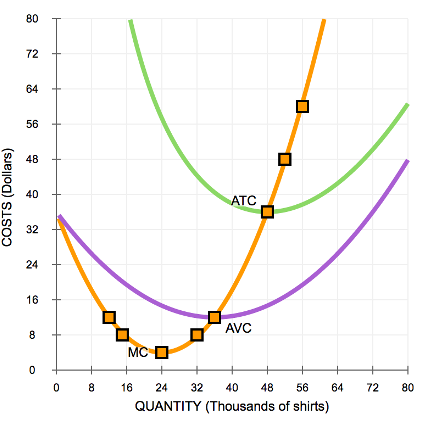
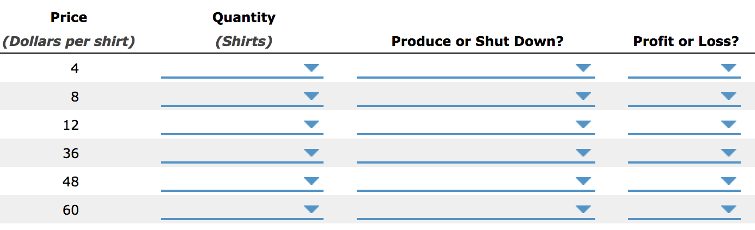
For each price in the following table, use the graph to determine the number of shirts this firm would produce in order to maximize its profit. Assume that when the price is exactly equal to the average variable cost, the firm is indifferent between producing zero shirts and the profit-maximizing quantity. Also, indicate whether the firm will produce, shut down, or be indifferent between the two in the short run. Lastly, determine whether it will make a profit, suffer a loss, or break even at each price.
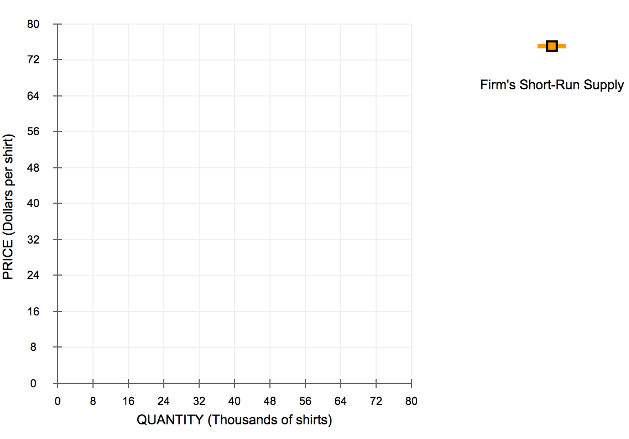
On the following graph, use the orange points (square symbol) to plot points along the portion of the firm's short-run supply curve that corresponds to prices where there is positive output. (Note: You are given more points to plot than you need.)
Suppose there are 9 firms in this industry, each of which has the cost curves previously shown.
On the following graph, use the orange points (square symbol) to plot points along the portion of the industry's short-run supply curve that corresponds to prices where there is positive output. (Note: You are given more points to plot than you need.) Then, place the black point (plus symbol) on the graph to indicate the short-run equilibrium price and quantity in this market.
Note: Dashed drop lines will automatically extend to both axes.
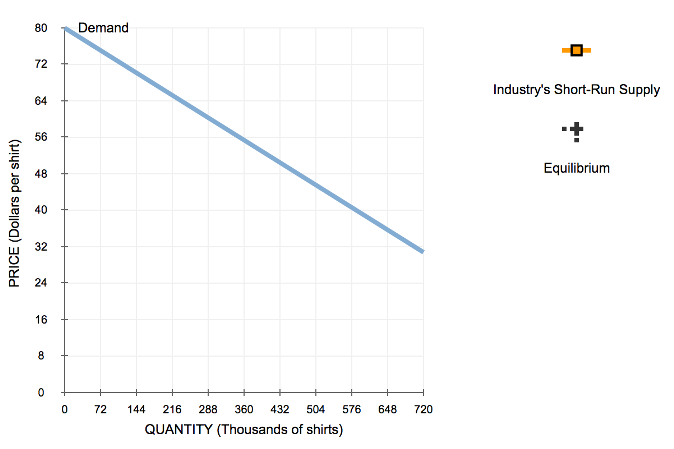
At the current short-run market price, firms will _______ in the short run. In the long run, _______ .
In: Economics
Consider the competitive market for dress shirts. The following graph shows the marginal cost (MC), average total cost (ATC), and average variable cost (AVC) curves for a typical firm in the industry.
6. Deriving the short-run supply curve
Consider the competitive market for dress shirts. The following graph shows the marginal cost (MC), average total cost (ATC), and average variable cost (AVC) curves for a typical firm in the industry.
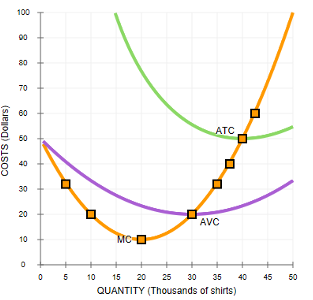
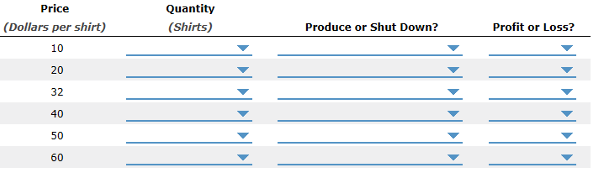
For each price in the following table, use the graph to determine the number of shirts this firm would produce in order to maximize its profit. Assume that when the price is exactly equal to the average variable cost, the firm is indifferent between producing zero shirts and the profit-maximizing quantity. Also, indicate whether the firm will produce, shut down, or be indifferent between the two in the short run. Lastly, determine whether it will make a profit, suffer a loss, or break even at each price.
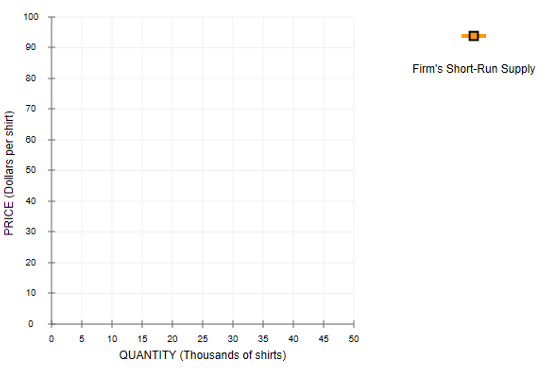
On the following graph, use the orange points (square symbol) to plot points along the portion of the firm's short-run supply curve that corresponds to prices where there is positive output. (Note: You are given more points to plot than you need.)
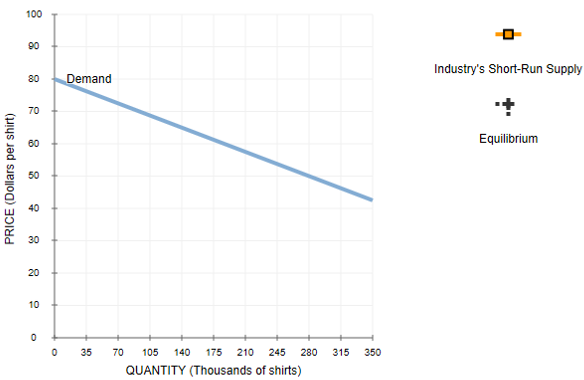
Suppose there are 7 firms in this industry, each of which has the cost curves previously shown.
On the following graph, use the orange points (square symbol) to plot points along the portion of the industry's short-run supply curve that corresponds to prices where there is positive output. (Note: You are given more points to plot than you need.) Then, place the black point (plus symbol) on the graph to indicate the short-run equilibrium price and quantity in this market.
Note: Dashed drop lines will automatically extend to both axes.
At the current short-run market price, firms will _______ in the short run. In the long run, _______ .
In: Economics
use muller's method to find the roots of the equation f(x) = sin x - x/2...
use muller's method to find the roots of the equation f(x) = sin x - x/2 =0 near x=2
In: Advanced Math
Explain and discuss what stall is and what causes an airfoil to stall. Why are commercial...
Explain and discuss what stall is and what causes an airfoil to stall. Why are commercial aircraft not allowed to fly at conditions near stall?
In: Mechanical Engineering
Explain and discuss what stall is and what causes an airfoil to stall. Why are commercial...
Explain and discuss what stall is and what causes an airfoil to stall. Why are commercial aircraft not allowed to fly at conditions near stall?
In: Mechanical Engineering