Questions
3. What is the relationship between cash flows from operations and Income for the year of...
3. What is the relationship between cash flows from operations and Income for the year of the statement?
4. Explain the difference between the direct method and the indirect method of disclosing cash flows from operations.
5. Do you believe that cash inflows and outflows associated with nonoperating items such as interest expense, interest revenue, and dividend revenue, should be separated from operating cash flows? Explain.
In: Accounting
According to the midpoint method, the price elasticity of demand between points A and B is approximately _______ .
6. Elasticity and total revenue
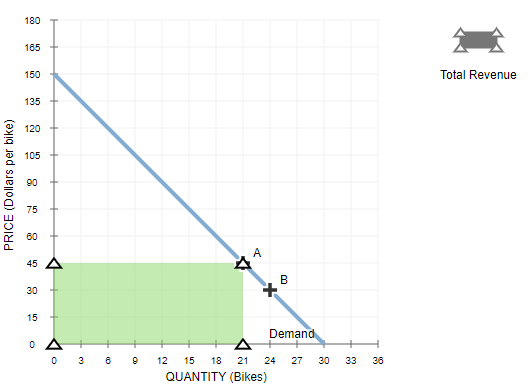
The following graph shows the daily demand curve for bikes in San Diego.
Use the green rectangle (triangle symbols) to compute total revenue at various prices along the demand curve. Note: You will not be graded on any changes made to this graph.
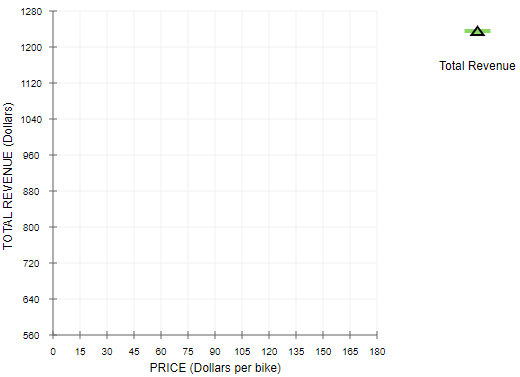
On the following graph, use the green point (triangle symbol) to plot the annual total revenue when the market price is $30, $45, $60, $75, $90, $105, and $120 per bike.
According to the midpoint method, the price elasticity of demand between points A and B is approximately _______ .
Suppose the price of bikes is currently $30 per bike, shown as point B on the initial graph. Because the demand between points A and B is _______ , a $15-per-bike increase in price will lead to _______
in total revenue per day.
In general, in order for a price decrease to cause a decrease in total revenue, demand must be _______ .
In: Accounting
Supermarket customers load their carts with goods totaling between $5 and $200, uniformly (and continuously) distributed;...
Supermarket customers load their carts with goods totaling between $5 and $200, uniformly (and continuously) distributed; call this the raw order amount. Assume that customers purchase independently of each other. At checkout, 63% of customers have loyalty card that gives them 4% off their raw order amount. Also at checkout, 18% of customers have coupons that give them 7% off their raw order amount. These two discounts occur independently of each other, and a given customer could have one or the other of them, both of them, or neither of them, to get to their net order amount (what they actually pay). Construct a spreadsheet simulation to simulate 100 customers and collect statistics on the net order amount; these statistics should include the average, standard deviation, minimum, maximum, and a histogram to describe the distribution of the net order amounts between $0 and $250. To make the requested histogram, you can either mimic what was done in the newsvendor spreadsheet simulation, or use a different approach via whatever built in excel facilities you'd like. Excel sheet with formulas would be best thanks.
In: Statistics and Probability
QUESTION 1 Your organization has started experiencing low sales amid the Covid-19 pandemic. The management has...
QUESTION 1
Your organization has started experiencing low sales amid the
Covid-19 pandemic. The management has decided to carry out an
Action Research to beef up the sales and enhance the overall
performance of the organization. As a Research Officer of the
organization, outline and briefly discuss most suitable elements of
an Action Research proposal for management consideration.
QUESTION 2
Case Study
The case below relates to an MBA Accounting & Finance student,
Eli, at UPSA, who was interested in the applicability of
organizational citizenship behaviour theory to Ghanaian workers.
The title of the research is: The applicability of organizational
citizenship behaviour theory to a Ghanaian organisation.
Background
The early definition of organisational citizenship behaviour (OCB)
viewed this as discretionary behaviours by employees that were not
recognised through the reward system (Organ 1988; Organ et al.
2006). Partly because such behaviours could subsequently be
recognised through reward, OCB was redefined as ‘performance that
supports the social and psychological environment’ within which
work occurs (Organ 1997: 95). It has been adopted by researchers
such as Bolino et al. (2002) to indicate situations where employees
work beyond contractual requirements to support one another, to
subordinate individual interests to organizational ones and to
demonstrate organisational commitment. In this way OCBs may
contribute to organisational performance and potentially offer a
source of competitive advantage. Podsakoff et al. (2009) report
finding over 650 published articles on OCB, mainly examining the
categories of behaviour that make up OCB (its dimensions), what
causes employees to engage in these behaviours (the determinants or
antecedents of OCB) and how OCB is related to these other
variables. An early, influential study to identify its dimensions
used interviews with managers in a manufacturing company to
‘identify instances of helpful, but not absolutely required job
behaviour’ to help to define OCB (Smith et al. 1983). This and
other early studies led to the identification of five categories of
OCBs (Organ 1988). These were labelled as altruism (helping a
co-worker with a workplace task); civic virtue (participating in
the organisation); conscientiousness (working beyond the minimum
requirements for the job); courtesy (considering how one’s own
behaviour might affect others and acting to facilitate harmony);
and sportsmanship (not complaining even in less than ideal
situations) (e.g. Organ 1988). Further research led to new
dimensions of OCB being proposed (Organ et al. 2006), although
these five original categories have remained the most commonly
tested.
However, continuing to use some of these dimensions of OCB and the
measurement scales associated with them (Organ 1988; Podsakoff et
al. 1990) has been questioned for two important reasons. Firstly,
the nature of work has changed since the 1980s and 1990s.
Manufacturing and manual work is now less important in many
economies while knowledge work is much more important. Based on
research, Dekas et al. (2013) developed an OCB scale for knowledge
workers that reflects the nature of knowledge-based work, such as
working flexibly and taking personal initiative. This new scale
overlaps with some earlier OCB dimensions but replaces or
eliminates outdated items related to willingly obeying rules or
regimented working practices.
Secondly, questions have been asked about the transferability of
OCB scales to other cultures.
OCB studies may apply only to the cultural context within which
they are conducted (Choi, 2009). The applicability of OCB to other
cultural settings therefore requires further research. Hui et al.
(2004) examined the relationships between psychological contract
constructs and OCBs in Ghana.
They adopted the OCB scale developed by Podsakoff et al. (1990)
(see earlier) and, in part, found that that more research is
required to understand how culture affects the applicability of
OCB. Farh et al. (1997) examined the relationships between
organisational justice theory and OCBs in Ghana, using a Ghanaian
OCB scale they developed. They found that the relationships between
organisational justice and OCB were moderated by cultural
(attitudes about either modernity or tradition) and gender factors.
Some behaviour of Ghanaian employees may be due to socialization or
broader cultural norms and be more personally focused than
organizationally related (Farh et al. 1997; Hui et al. 2004). This
raises questions about the applicability of OCB in Ghana and
whether organisational justice and psychology contract constructs
may be determinants or antecedents of OCB. In addition, Hui et al.
(2004) point out that organisational type may affect OCB; for
example, they cite research saying that Ghanaian employees may
prefer working for a foreign-owned company rather than a
state-owned enterprise.
Research question and research objectives
The research question is:
To what extent are organisational citizenship behaviour,
organisational justice and psychological contract theories
applicable to Ghanaian organisations and why?
The research objectives are:
1) To identify suitable measurement scales for each theory, to use
in the case study of Ghanaian organisation.
2) To examine the relationship in the case study organisation
between findings from the organisational justice scale and findings
from the organisational citizenship behaviour scale.
3) To examine the relationship in the case study organisation
between findings from the psychological contract scale and findings
from the organisational citizenship behaviour scale.
4) To examine the relationship between findings in the case study
organisation from the organisational citizenship behaviour scale
and findings in other national contexts from organisational
citizenship behaviour research.
5) To draw conclusions from the relationships observed in
objectives 2, 3 and 4, to evaluate the applicability of these
concepts in a Ghanaian organisation.
Method
Research design
This research is designed to test the applicability of these
theories in a case study, Ghanaian organisation. The research will
use a survey strategy incorporating existing scales from
peer-reviewed, high-quality academic journals. The research will be
cross-sectional in nature.
Participants
The intended participants in this study work for [company name] in
Ghana. Its management have agreed to grant me access to a
representative sample of employees drawn from the different grades
and occupations and between males and females employed within the
organisation [email attached]. Eli is currently in correspondence
with the manager of the human resource department to finalise a
stratified random sample to represent the characteristics of the
organisation’s workforce. It is envisaged that the sample size will
be 200 employees.
Techniques
The scales for organisational citizenship behaviour, organisational
justice and the psychological contract will be incorporated into a
questionnaire that will also collect data about respondents’
demographic characteristics. This questionnaire will be
administered in Ghana. It will be checked for accuracy of
translation and pilot tested by some of my fellow students.
Amendments will be made where necessary. It will then be
administered in paper form. The data will be analysed
quantitatively using IBM SPSS Statistics. A range of statistical
techniques will be used to analyse these data and the results from
these will be used to identify relationships between the concepts
identified in the research objectives and to allow comparison with
previously published research.
Ethical considerations and procedures
Eli will compose a letter to be sent to members of the sample that
informs them about who I am and the purpose of my research project,
and to assure them that their responses to each of the
questionnaire items will be seen and used only by Eli. Respondents
will not be asked for their name on the questionnaire. The
questionnaire will ask for only limited personal data about each
participant [for example, whether they are male or female as
previous research has found this to be a significant factor in the
applicability of organisational justice and organizational
citizenship behaviours in a Ghanaian context (Farh et al.
1997)].
Completed questionnaires will be posted into a sealed container
that will be returned to Eli to ensure respondent confidentiality
and the anonymity of the data that they provide. These
questionnaires will be given an anonymous code and the data they
contain entered into a spreadsheet by Eli. Once I have input the
data and it has been checked carefully to ensure accuracy the
questionnaires will be shredded by Eli. Ensuring confidentiality
and anonymity should mean that no harm should result from
participating in this research. Part of my covering letter will
state that participation is entirely voluntary and if an intended
participant does not wish to take part, they are not under any
obligation to do so. Another matching employee will be sent a copy
of my letter and asked if they would like to receive a copy of my
questionnaire. If he or she is willing to complete the
questionnaire, he or she will be informed to post it personally
into the sealed container.
Resources
I will be responsible for producing and copying the questionnaire.
I will pay for the cost of posting these to Ghana. I also have
access to IBM SPSS Statistics and am competent in the analytical
techniques required to analyse the data and interpret this
analysis. The company has kindly agreed to pay the costs of
returning the completed questionnaires to Eli. Once I have received
these questionnaires I will be responsible for inputting the data
into the software to analyse it. There should not be any other
resource requirements in order to be able to undertake this
research project.
Required:
a) Using the information in the ‘Background’ section of the
proposal, what concerns may be raised about the proposed ‘Research
design’, ‘Title’, ‘Research question and research
objectives’?
b) What further information would be helpful to know in the
‘Participants’ section?
c) Based on the concerns raised in questions 1 and 2, suggest
appropriate ‘Title’, ‘Research question and research objectives’
and the ‘Research design’?
In: Finance
Based on historical data, your manager believes that 44% of the company's orders come from first-time...
Based on historical data, your manager believes that 44% of the
company's orders come from first-time customers. A random sample of
59 orders will be used to estimate the proportion of
first-time-customers. What is the probability that the sample
proportion is between 0.33 and 0.49?
(Enter your answer as a number accurate to 4 decimal places.)
In: Statistics and Probability
You may need to use the appropriate technology to answer this question. Consider the following data...
You may need to use the appropriate technology to answer this question.
Consider the following data on price ($) and the overall score for six stereo headphones tested by a certain magazine. The overall score is based on sound quality and effectiveness of ambient noise reduction. Scores range from 0 (lowest) to 100 (highest).
| Brand | Price ($) | Score |
|---|---|---|
| A | 180 | 74 |
| B | 150 | 71 |
| C | 95 | 59 |
| D | 70 | 56 |
| E | 70 | 40 |
| F | 35 | 24 |
(a)
The estimated regression equation for this data is
ŷ = 22.328 + 0.317x,
where x = price ($) and y = overall score. Does the t test indicate a significant relationship between price and the overall score? Use α = 0.05.
State the null and alternative hypotheses.
H0: β1 = 0
Ha: β1 ≠
0H0: β1 ≥ 0
Ha: β1 <
0 H0:
β0 ≠ 0
Ha: β0 =
0H0: β0 = 0
Ha: β0 ≠
0H0: β1 ≠ 0
Ha: β1 = 0
Find the value of the test statistic. (Round your answer to three decimal places.)
Find the p-value. (Round your answer to four decimal places.)
p-value =
What is your conclusion?
Do not reject H0. We conclude that the relationship between price ($) and overall score is significant.Reject H0. We conclude that the relationship between price ($) and overall score is significant. Do not reject H0. We cannot conclude that the relationship between price ($) and overall score is significant.Reject H0. We cannot conclude that the relationship between price ($) and overall score is significant.
(b)
Test for a significant relationship using the F test. Use α = 0.05.
State the null and alternative hypotheses.
H0: β1 = 0
Ha: β1 ≠
0H0: β1 ≠ 0
Ha: β1 =
0 H0:
β1 ≥ 0
Ha: β1 <
0H0: β0 ≠ 0
Ha: β0 =
0H0: β0 = 0
Ha: β0 ≠ 0
Find the value of the test statistic. (Round your answer to two decimal places.)
Find the p-value. (Round your answer to three decimal places.)
p-value =
What is your conclusion?
Do not reject H0. We cannot conclude that the relationship between price ($) and overall score is significant.Do not reject H0. We conclude that the relationship between price ($) and overall score is significant. Reject H0. We conclude that the relationship between price ($) and overall score is significant.Reject H0. We cannot conclude that the relationship between price ($) and overall score is significant.
(c)
Show the ANOVA table for these data. (Round your p-value to three decimal places and all other values to two decimal places.)
| Source of Variation |
Sum of Squares |
Degrees of Freedom |
Mean Square |
F | p-value |
|---|---|---|---|---|---|
| Regression | |||||
| Error | |||||
| Total |
In: Statistics and Probability
you may need to use the appropriate technology to answer this question. Consider the following data...
you may need to use the appropriate technology to answer this question.
Consider the following data on price ($) and the overall score for six stereo headphones tested by a certain magazine. The overall score is based on sound quality and effectiveness of ambient noise reduction. Scores range from 0 (lowest) to 100 (highest).
| Brand | Price ($) | Score |
|---|---|---|
| A | 180 | 74 |
| B | 150 | 73 |
| C | 95 | 61 |
| D | 70 | 58 |
| E | 70 | 42 |
| F | 35 | 28 |
(a) The estimated regression equation for this data is ŷ = 26.268 + 0.297x, where x = price ($) and y = overall score. Does the t test indicate a significant relationship between price and the overall score? Use α = 0.05.
State the null and alternative hypotheses.
State the null and alternative hypotheses.
H0: β0 = 0
Ha: β0 ≠ 0H0:
β1 = 0
Ha: β1 ≠
0 H0: β1 ≥
0
Ha: β1 < 0H0:
β1 ≠ 0
Ha: β1 = 0H0:
β0 ≠ 0
Ha: β0 = 0
Find the value of the test statistic. (Round your answer to three decimal places.)
Find the p-value. (Round your answer to four decimal places.)
p-value =
What is your conclusion?
Reject H0. We conclude that the relationship between price ($) and overall score is significant.Reject H0. We cannot conclude that the relationship between price ($) and overall score is significant. Do not reject H0. We conclude that the relationship between price ($) and overall score is significant.Do not reject H0. We cannot conclude that the relationship between price ($) and overall score is significant.
(b)
Test for a significant relationship using the F test. Use α = 0.05.
State the null and alternative hypotheses.
H0: β0 ≠ 0
Ha: β0 = 0H0:
β0 = 0
Ha: β0 ≠
0 H0: β1 =
0
Ha: β1 ≠ 0H0:
β1 ≥ 0
Ha: β1 < 0H0:
β1 ≠ 0
Ha: β1 = 0
Find the value of the test statistic. (Round your answer to two decimal places.)
Find the p-value. (Round your answer to three decimal places.)
p-value =
What is your conclusion?
A) Reject H0. We cannot conclude that the relationship between price ($) and overall score is significant.
B) Do not reject H0. We cannot conclude that the relationship between price ($) and overall score is significant.
C) Do not reject H0. We conclude that the relationship between price ($) and overall score is significant
D) Reject H0. We conclude that the relationship between price ($) and overall score is significant.
(c)Show the ANOVA table for these data. (Round your p-value to three decimal places and all other values to two decimal places.)
| Source of Variation |
Sum of Squares |
Degrees of Freedom |
Mean Square |
F | p-value |
|---|---|---|---|---|---|
| Regression | |||||
| Error | |||||
| Total |
In: Statistics and Probability
Discuss whether it is important to differentiate between Revenue earned from an Exchange and Non-exchange transaction....
Discuss whether it is important to differentiate between Revenue earned from an Exchange and Non-exchange transaction. Provide reasons for your answer.
In: Accounting
Carefully draw the appropriate revenue and cost curves for a profit-maximizing monopolist, which is indifferent between...
Carefully draw the appropriate revenue and cost curves for a profit-maximizing monopolist, which is indifferent between producing and not producing in the short-run. Show the deadweight loss caused by the monopoly. In the long run, will the firm produce more or less? (8 points)
In: Economics
What is the primary difference between an in-state 4.2% YTM Revenue Municipal Bond, a 2.65% YTM...
What is the primary difference between an in-state 4.2% YTM Revenue Municipal Bond, a 2.65% YTM U.S. T-Note, and a BB-Rated 6.72% YTM Corporate Debenture (assuming each has 8 years to maturity and Muni uses a tax-equivalent yield) in terms of tax treatment of coupon interest and default risk (how each is collateralized). Also, assume a marginal tax rate of 28%?
In: Finance